Key takeaways
- Memory: The 9070 XT ships with 16GB of GDDR6 on a 256-bit bus, while the RTX 5070 offers 12GB of faster GDDR7 on a narrower 192-bit bus — capacity versus bandwidth per gigabyte.
- Rasterization: In conventional rendering the Radeon typically leads by a comfortable double-digit margin at 1440p, and stretches that lead further at 4K where its frame buffer stops being a bottleneck.
- Ray tracing: RDNA 4 closed most of the gap, but NVIDIA still holds an edge in path-traced showcases and titles built around heavy RT reflections and global illumination.
- Upscaling and frame generation: FSR 4 is a genuine leap for AMD and looks excellent in supported games, though DLSS 4 retains broader adoption and Multi Frame Generation for very high refresh displays.
- Power and thermals: The 9070 XT draws roughly 300W and wants a quality 750W supply; the RTX 5070 sits near 250W and is happy on a good 650W unit, making it easier to slot into small builds.
- Productivity: CUDA, OptiX and NVENC still make the NVIDIA card the safer pick for 3D rendering, video editing and local AI tinkering.
What's inside
The mid-to-upper mainstream GPU bracket has never been more competitive, and in 2026 the fight comes down to two cards that approach the same problem from opposite directions. AMD’s Radeon RX 9070 XT leans on RDNA 4, a wide 256-bit memory bus and a generous 16GB frame buffer to deliver brute-force rasterization performance. NVIDIA’s GeForce RTX 5070 counters with Blackwell efficiency, faster GDDR7 memory and the most mature software stack in the business, headlined by DLSS 4 and Multi Frame Generation.
Choosing between them matters more than it used to. Game engines have shifted decisively toward ray-traced global illumination and heavy streaming textures, which means VRAM capacity and upscaling quality now influence your experience as much as raw shader throughput. Spend wisely and you’ll get a card that comfortably handles 1440p ultra — and often 4K with upscaling — for the next three to four years. Spend badly and you’ll be turning down texture settings by 2028. Below we break down where each card wins, where it compromises, and which buyer should pick which.
As an Amazon Associate we earn from qualifying purchases.




⚡ Save on Your Next PC — Amazon Prime
Prime members get fast free shipping on the systems above, plus early access to Prime Day & Black Friday PC deals. New members get a 30-day free trial.
Watch: RX 9070 XT vs RTX 5070: 2026 Comparison — Video Review
Quick Verdict
The RX 9070 XT is the better pure gaming card for most people: it’s meaningfully faster in traditional rasterization, carries 16GB of VRAM, and holds up far better at 4K and in texture-heavy titles. The RTX 5070 is the smarter buy if you lean hard on ray tracing and path tracing, want DLSS 4’s Multi Frame Generation, need CUDA for creative or AI workloads, or are building in a compact case with a modest power supply. Gamers first, AMD; feature breadth and efficiency, NVIDIA.
Key Differences
- Memory: The 9070 XT ships with 16GB of GDDR6 on a 256-bit bus, while the RTX 5070 offers 12GB of faster GDDR7 on a narrower 192-bit bus — capacity versus bandwidth per gigabyte.
- Rasterization: In conventional rendering the Radeon typically leads by a comfortable double-digit margin at 1440p, and stretches that lead further at 4K where its frame buffer stops being a bottleneck.
- Ray tracing: RDNA 4 closed most of the gap, but NVIDIA still holds an edge in path-traced showcases and titles built around heavy RT reflections and global illumination.
- Upscaling and frame generation: FSR 4 is a genuine leap for AMD and looks excellent in supported games, though DLSS 4 retains broader adoption and Multi Frame Generation for very high refresh displays.
- Power and thermals: The 9070 XT draws roughly 300W and wants a quality 750W supply; the RTX 5070 sits near 250W and is happy on a good 650W unit, making it easier to slot into small builds.
- Productivity: CUDA, OptiX and NVENC still make the NVIDIA card the safer pick for 3D rendering, video editing and local AI tinkering.
Radeon RX 9070 XT: Raster Muscle and a Bigger Buffer
The 9070 XT’s appeal is straightforward. Sixty-four RDNA 4 compute units, boost clocks approaching 3GHz on factory-overclocked models, and 16GB of memory add up to a card that simply doesn’t flinch at maximum texture settings. That headroom is the real story: as games ship increasingly aggressive asset streaming, the difference between 12GB and 16GB shows up as smoother frame pacing and fewer traversal stutters rather than a higher average framerate. It’s the kind of advantage you feel more than you measure.
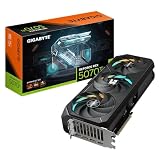
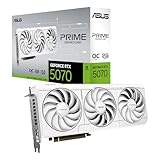
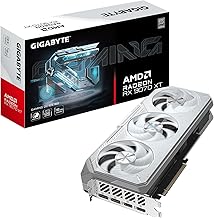
Board partner choice matters here because cooling and acoustics vary widely. The GIGABYTE Gaming OC 16G and its Gaming OC ICE sibling are the premium triple-fan options, with reinforced structures and thicker heatsinks that keep noise low under sustained load. The ASUS Prime OC Edition offers a tidy 2.5-slot design with dual BIOS and Axial-tech fans, while the ASRock Challenger OC and XFX Swift Triple Fan editions cover the value end without giving up much thermal performance. The PowerColor Reaper is the compact pick, designed for cases where length and clearance are tight. All feature PCIe 5.0, DisplayPort 2.1a and HDMI 2.1b for high-refresh 4K panels.
GeForce RTX 5070: Efficiency and Software Advantage
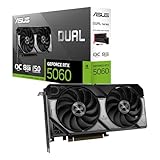
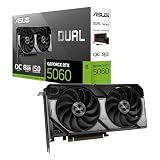
The RTX 5070 is the more refined product even if it isn’t the faster one. Blackwell’s fourth-generation RT cores and fifth-generation Tensor cores make it punch above its raster weight in ray-traced workloads, and DLSS 4’s transformer-based upscaling remains the quality benchmark. Multi Frame Generation is genuinely useful if you own a 240Hz or faster monitor and are willing to accept the latency trade-off — and NVIDIA Reflex keeps that trade-off manageable.
Efficiency is the other quiet win. A ~250W board power means less heat dumped into your case, quieter fan curves, and compatibility with mid-range power supplies that many upgraders already own. Add NVENC for streaming and recording, CUDA support that virtually every creative application targets, and strong driver-day support for new releases, and the 5070 becomes the low-friction option. The 12GB frame buffer is its clear weak point, and it’s a limitation that will grow more noticeable over the card’s lifespan.
Which Should You Buy?
- For 1440p high-refresh gaming: Pick the RX 9070 XT — the extra raster performance translates directly into higher sustained framerates.
- For 4K gaming on a budget: Pick the RX 9070 XT, where 16GB of VRAM keeps texture settings maxed instead of compromised.
- For path-traced showcases: Pick the RTX 5070 and lean on DLSS 4 to reclaim the frames.
- For small form factor or modest PSU builds: Pick the RTX 5070, or the compact PowerColor Reaper if you’re set on Radeon.
- For content creation and local AI: Pick the RTX 5070 for CUDA, OptiX and NVENC support.
Frequently Asked Questions
Is 12GB of VRAM still enough in 2026?
At 1080p and most 1440p settings, yes. At 4K with ultra textures and ray tracing enabled, 12GB is increasingly the limiting factor, and it’s the main reason the 16GB Radeon ages better.
How does FSR 4 compare to DLSS 4?
FSR 4’s machine-learning model closed most of the image-quality gap and looks excellent in supported titles. DLSS 4 still has wider game support and the additional option of Multi Frame Generation.
What power supply do I need?
Plan on a quality 750W unit for the RX 9070 XT and 650W for the RTX 5070. Both are 8-pin PCIe cards on most partner designs, so no adapter drama.
Do the different RX 9070 XT models perform differently?
Only marginally. Factory overclocks account for a few percent at most; the meaningful differences are cooling noise, physical size and warranty terms.
Final Verdict
If gaming is your priority, the Radeon RX 9070 XT is the stronger card — faster where it counts, better equipped for 4K, and future-proofed by its 16GB frame buffer, with excellent options from GIGABYTE, ASUS, XFX and PowerColor depending on your case and noise tolerance. The RTX 5070 remains the right answer for ray-tracing enthusiasts, creators and anyone building small or quiet. Match the card to your workload rather than the benchmark chart, and either choice will serve you well.