Key takeaways
- Core count: The RTX 5080 packs roughly 10,752 CUDA cores against the 5070 Ti’s 8,960 — about a 20% wider shader array, which is where most of the raw performance delta comes from.
- Memory bandwidth: Both use 16GB GDDR7 on a 256-bit bus, but the 5080 runs faster memory (30Gbps vs 28Gbps), giving it roughly 960GB/s versus 896GB/s.
- Real-world performance: Expect a 15–20% raster advantage for the 5080 at 4K, narrowing to around 12–15% at 1440p where CPU limits start to intrude.
- Power and cooling: The 5080 draws about 360W versus 300W for the 5070 Ti, pushing recommended PSUs from 750W to 850W and generally requiring larger heatsinks.
- Physical footprint: Premium 5080 designs run three slots or more; 5070 Ti cards are more likely to fit mid-tower and compact builds without measuring twice.
- Feature parity: DLSS 4 with Multi Frame Generation, PCIe 5.0, DisplayPort 2.1 and the ninth-gen NVENC encoder are identical on both — no feature is locked behind the higher tier.
What's inside
Two years into the Blackwell generation, the GeForce RTX 5080 and RTX 5070 Ti have settled into the roles that matter most for real buyers in 2026: one is the sensible ceiling for high-refresh 1440p and comfortable 4K, and the other is the value pick that still refuses to feel like a compromise. They share the same architecture, the same 16GB of GDDR7 memory, and the same DLSS 4 feature set — which is exactly why the decision is harder than the naming suggests.
The gap between them is real but narrow enough that board partner design, cooling, case clearance, and power headroom often matter as much as the raw silicon. If you’re building or upgrading this year, the right question isn’t “which GPU is faster” — it’s “how much am I paying per frame, and will the card actually fit and stay quiet in my system?” Below we break down the differences that show up in games, not just on spec sheets.
As an Amazon Associate we earn from qualifying purchases.


⚡ Save on Your Next PC — Amazon Prime
Prime members get fast free shipping on the systems above, plus early access to Prime Day & Black Friday PC deals. New members get a 30-day free trial.
Watch: RTX 5080 vs 5070 Ti: Worth It in 2026? — Video Review
Quick Verdict
Buy the RTX 5080 if you game at 4K, drive a high-refresh ultrawide, run heavy ray tracing, or do GPU-accelerated creative work alongside gaming — it has meaningful headroom the 5070 Ti simply doesn’t. Buy the RTX 5070 Ti if 1440p at high refresh is your target, your budget is finite, or your build has power and space constraints. Neither card is a mistake; the 5080 is the performance choice, the 5070 Ti is the efficiency-and-value choice.
Key Differences
- Core count: The RTX 5080 packs roughly 10,752 CUDA cores against the 5070 Ti’s 8,960 — about a 20% wider shader array, which is where most of the raw performance delta comes from.
- Memory bandwidth: Both use 16GB GDDR7 on a 256-bit bus, but the 5080 runs faster memory (30Gbps vs 28Gbps), giving it roughly 960GB/s versus 896GB/s.
- Real-world performance: Expect a 15–20% raster advantage for the 5080 at 4K, narrowing to around 12–15% at 1440p where CPU limits start to intrude.
- Power and cooling: The 5080 draws about 360W versus 300W for the 5070 Ti, pushing recommended PSUs from 750W to 850W and generally requiring larger heatsinks.
- Physical footprint: Premium 5080 designs run three slots or more; 5070 Ti cards are more likely to fit mid-tower and compact builds without measuring twice.
- Feature parity: DLSS 4 with Multi Frame Generation, PCIe 5.0, DisplayPort 2.1 and the ninth-gen NVENC encoder are identical on both — no feature is locked behind the higher tier.
GeForce RTX 5080: The 4K Performance Pick
The RTX 5080 is the card to buy when you want native-resolution 4K with ray tracing enabled and still expect triple-digit framerates once DLSS 4 is in play. Its extra shader throughput and bandwidth show up most in path-traced titles and heavily modded games, and its 16GB frame buffer holds up well at 4K with high-resolution texture packs. For creators, the additional cores translate directly into faster renders in Blender, DaVinci Resolve and Stable Diffusion workloads.
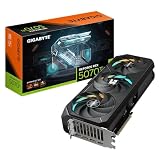
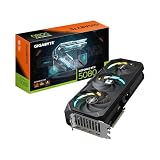
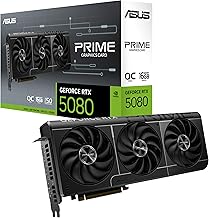
Board partner choice matters more here than on any other tier. The ASUS ROG Astral RTX 5080 OC uses a four-fan, 3.8-slot design with a vapor chamber and is the quietest, coolest option — provided your case can swallow it. The ASUS TUF Gaming RTX 5080 OC and GIGABYTE RTX 5080 Gaming OC 16G are the balanced picks, while the PNY RTX 5080 Epic-X RGB OC covers RGB-focused builds. For small form factor systems, the GIGABYTE RTX 5080 WINDFORCE OC SFF is the rare 5080 that’s genuinely compact-friendly, and the PNY RTX 5080 OC Triple-Fan is a straightforward no-frills option.
GeForce RTX 5070 Ti: The Value Sweet Spot
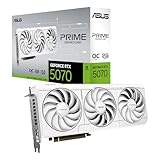
The RTX 5070 Ti is arguably the best-balanced GPU of the generation. At 1440p it delivers well above 100fps in nearly every current title at maxed settings, and with DLSS 4 Multi Frame Generation it handles 4K gaming credibly too — you’ll just be leaning on upscaling rather than brute force. Critically, it carries the same 16GB of GDDR7, so it isn’t the VRAM-starved compromise that mid-tier cards often become two years into a console cycle.
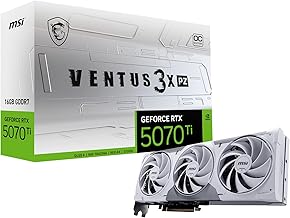
Its 300W draw is the practical advantage. Most existing 750W power supplies will run it without an upgrade, it produces noticeably less heat in a closed case, and two-slot and shorter three-slot variants are common. For anyone reusing an older build, that can save real money that never appears on the GPU’s own price tag.
Which Should You Buy?
- For 4K 120Hz gaming: Pick the RTX 5080 — the headroom is worth it, and it will age better on a 4K panel.
- For 1440p high-refresh: Pick the RTX 5070 Ti; you’ll be CPU-limited in plenty of titles before the 5080 stretches its legs.
- For path tracing and heavy RT: Pick the RTX 5080, where the extra cores meaningfully change playability in the most demanding scenes.
- For SFF or compact builds: Pick the RTX 5070 Ti, or the GIGABYTE RTX 5080 WINDFORCE OC SFF if you need 5080 performance in a small case.
- For mixed gaming and content creation: Pick the RTX 5080 — render and export times scale almost linearly with the core count advantage.
Frequently Asked Questions
Is 16GB of VRAM enough in 2026?
Yes, for both cards. A handful of 4K path-traced titles with maximum texture settings can approach the limit, but 16GB remains comfortable for gaming and only becomes restrictive in large AI or 3D rendering workloads.
Do I need a new power supply for the RTX 5080?
Plan on 850W or more from a quality unit with a native 12V-2×6 connector. The RTX 5070 Ti is generally fine on a good 750W supply, which is why it’s the easier drop-in upgrade.
How much faster is the RTX 5080 in practice?
Roughly 15–20% at 4K and 12–15% at 1440p in raster workloads, with slightly larger gaps in ray-traced and compute-heavy scenarios. It is not a generational leap over the 5070 Ti.
Does the 5070 Ti support DLSS 4 Multi Frame Generation?
It does. Every Blackwell GeForce card supports the full DLSS 4 stack, including Multi Frame Generation, so there’s no feature penalty for choosing the cheaper card.
Final Verdict
The RTX 5080 is the right call for 4K gamers, ray tracing enthusiasts and creators who can accommodate its power and size demands — and models like the ASUS ROG Astral and TUF Gaming 5080 make it a genuinely premium experience. For everyone else, particularly 1440p gamers and anyone upgrading within an existing build, the RTX 5070 Ti delivers the large majority of that performance for meaningfully less money, and remains the smarter buy in 2026.