Key takeaways
- GPU tier over generation: An RTX 4070 will generally outperform an RTX 5050 or 5060 in raw rasterization, even though it’s a generation older. Judge by the second digit — a 70-class card beats a 50-class card. Newer 50-series chips do bring better ray tracing and DLSS 4 multi-frame generation, so weigh which matters more to you.
- VRAM is the real bottleneck: 8GB of video memory is now the floor, and modern titles at high textures can exceed it at 1440p. If you’re deciding between two otherwise similar laptops, more VRAM ages far better than a marginally faster CPU.
- Match the panel to the GPU: A 165Hz QHD screen is wasted on a card that can only push 60fps at that resolution, and a 1080p panel limits an otherwise capable GPU. Look for FHD/WUXGA at 144–165Hz for most builds, and reserve QHD for RTX 4070-class hardware or better.
- Cooling determines sustained performance: Two laptops with identical specs can differ by 20% in long sessions depending on thermal design. Prioritize models with dual-fan setups, multiple heat pipes, and rear-and-side exhaust — thin chassis almost always throttle harder.
- Plan for storage and RAM upgrades: 16GB DDR5 is adequate today but 32GB is becoming the comfortable target, and 512GB fills up after four or five modern installs. Confirm the laptop has a free M.2 slot and accessible SO-DIMM slots before you buy — it’s the cheapest way to extend its life.
What's inside
Shopping for a gaming laptop under $1500 in 2026 has become genuinely confusing. The market is crowded with machines that look nearly identical on a spec sheet but perform very differently in real games, and the shift to NVIDIA’s RTX 50-series has left retailers selling both new and previous-generation hardware side by side at overlapping prices. A laptop with a newer GPU model number isn’t automatically faster than last year’s higher-tier card, and manufacturers rarely make that clear on the product page.
This guide cuts through that noise. We’ve focused on machines that deliver real frame rates at 1080p and 1440p, with the CPU headroom, memory, and cooling to stay playable for the next several years — not just laptops that happen to fit the budget. Below you’ll find our top picks, a practical buying checklist, and honest notes on where each machine makes its compromises.
As an Amazon Associate we earn from qualifying purchases.


⚡ Save on Your Next PC — Amazon Prime
Prime members get fast free shipping on the systems above, plus early access to Prime Day & Black Friday PC deals. New members get a 30-day free trial.
Watch: Best Gaming Laptop Under $1500 — Video Review
How to Choose Gaming Laptop Under $1500
- GPU tier over generation: An RTX 4070 will generally outperform an RTX 5050 or 5060 in raw rasterization, even though it’s a generation older. Judge by the second digit — a 70-class card beats a 50-class card. Newer 50-series chips do bring better ray tracing and DLSS 4 multi-frame generation, so weigh which matters more to you.
- VRAM is the real bottleneck: 8GB of video memory is now the floor, and modern titles at high textures can exceed it at 1440p. If you’re deciding between two otherwise similar laptops, more VRAM ages far better than a marginally faster CPU.
- Match the panel to the GPU: A 165Hz QHD screen is wasted on a card that can only push 60fps at that resolution, and a 1080p panel limits an otherwise capable GPU. Look for FHD/WUXGA at 144–165Hz for most builds, and reserve QHD for RTX 4070-class hardware or better.
- Cooling determines sustained performance: Two laptops with identical specs can differ by 20% in long sessions depending on thermal design. Prioritize models with dual-fan setups, multiple heat pipes, and rear-and-side exhaust — thin chassis almost always throttle harder.
- Plan for storage and RAM upgrades: 16GB DDR5 is adequate today but 32GB is becoming the comfortable target, and 512GB fills up after four or five modern installs. Confirm the laptop has a free M.2 slot and accessible SO-DIMM slots before you buy — it’s the cheapest way to extend its life.
The Best Picks Reviewed
ASUS ROG Strix G16 (2025)
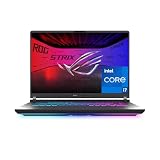
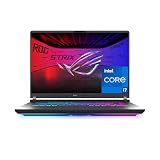
The Strix G16 is the most complete package here, pairing an RTX 5060 with a genuinely fast Core i7-14650HX and a 16:10 165Hz panel that gives you noticeably more vertical workspace than standard 16:9 screens. Wi-Fi 7, a full 1TB Gen 4 SSD, and ROG’s proven cooling make it our default recommendation for anyone who wants a machine that won’t need upgrading in a year.
MSI Katana 15
This is the pick for raw performance per dollar — the RTX 4070 inside is meaningfully faster in traditional rendering than any 50-series card at this price, and it’s paired with a QHD 165Hz display that actually justifies the extra pixels. The Core i7-13620H is a generation behind and Cooler Boost 5 gets loud under load, but if frame rates are your priority, nothing else here keeps up.
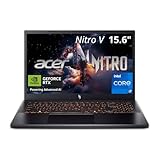
Acer Nitro V 15
The Nitro V is the value entry, undercutting everything else on this list while still delivering a 165Hz IPS panel and an RTX 5050 with 8GB of fast GDDR7 memory. The Core i5-13420H and 512GB SSD show where the savings came from, but for 1080p esports and medium-settings AAA gaming it’s a lot of laptop for the money.
GIGABYTE Gaming A16
GIGABYTE pairs an RTX 5060 with a 16-inch WUXGA 165Hz display and a full 1TB SSD, landing in the sweet spot between the Nitro V’s budget compromises and the Strix G16’s premium pricing. The i7-13620H is the weak link on paper, but in GPU-bound games it rarely matters, and the larger 16:10 panel is a real quality-of-life upgrade over 15-inch alternatives.
Lenovo LOQ 15
The LOQ is the practical, no-nonsense option — an RTX 5060 in a restrained chassis with a solid 144Hz FHD panel and Lenovo’s reliably good keyboard. The AMD Ryzen 7 250 is efficient rather than fast and 512GB of storage is tight, but the free M.2 slot makes that an easy and cheap fix.
Frequently Asked Questions
Is an RTX 5060 better than an RTX 4070?
In raw rasterized performance, the RTX 4070 laptop GPU is generally faster. The RTX 5060 pulls ahead in ray-traced titles and supports DLSS 4 multi-frame generation, which can produce higher on-screen frame rates in supported games. If you play mostly competitive or older titles, take the 4070; if you want the newest features and better efficiency, the 5060 is the safer long-term bet.
Is 16GB of RAM still enough for gaming in 2026?
Yes, for gaming alone — very few titles exceed 16GB. It becomes tight if you stream, keep a browser with dozens of tabs open, or run creative software alongside games. All of our picks use DDR5 and most have an accessible second SO-DIMM slot, so upgrading to 32GB later is inexpensive.
Should I get a 1440p or 1080p screen at this price?
For most buyers under $1500, 1080p or WUXGA is the smarter choice. It lets a mid-tier GPU actually hit the panel’s high refresh rate, and the difference in sharpness on a 15- or 16-inch screen is modest. Only step up to QHD if the laptop pairs it with RTX 4070-class hardware, as the MSI Katana 15 does.
Do these laptops need a cooling pad?
Not strictly, but they help. Gaming laptops in this range pull air from underneath, so anything that lifts the chassis and improves airflow can lower internal temperatures by several degrees and reduce throttling in long sessions. It matters most for thinner models and least for the larger 16-inch chassis with more internal volume.
Final Thoughts
If you want the best all-around machine and can stretch toward the top of the budget, the ASUS ROG Strix G16 is the one to buy — its combination of a modern Core i7-14650HX, RTX 5060, 1TB of storage, and a 16:10 165Hz panel leaves the fewest compromises. Frame-rate chasers should look hard at the MSI Katana 15, where the older RTX 4070 still outmuscles anything else at this price, especially at its native QHD resolution. And if you’re building on a tighter budget, the Acer Nitro V 15 delivers a genuinely capable 1080p gaming experience for well under the cap, with room in the budget for a RAM and storage upgrade down the line.