Key takeaways
- GPU tier comes first: The graphics card dictates your frame rates more than any other component. At this budget, an RTX 5050 or RTX 5060 delivers meaningfully better longevity than an older RTX 3050 — prioritize the newest generation you can afford before upgrading anything else.
- Insist on 16GB of RAM: Modern titles routinely allocate 12GB or more of system memory. An 8GB machine will technically run games but will stutter during asset streaming. If a deal only offers 8GB, confirm the RAM is user-upgradeable and budget roughly $40 for a second stick.
- Match the panel to the hardware: A 144Hz or 165Hz 1080p display is the sweet spot here. Higher-resolution panels look sharper on the desktop but force budget GPUs to render far more pixels than they comfortably can, which costs you frames where it matters.
- Check storage headroom: A 512GB SSD holds roughly four or five large modern installs before you’re deleting games to make room. A 1TB Gen 4 drive is worth paying for, though most chassis in this range accept a second M.2 drive if you’d rather add capacity later.
- Weigh thermals and build over thinness: Slim budget gaming laptops throttle. Slightly thicker chassis with dual-fan cooling sustain clock speeds through long sessions, and that sustained performance is what you actually feel while playing.
What's inside
Shopping for a gaming laptop under $1,000 in 2026 means walking a tightrope. Spend too little and you end up with a machine that stutters through modern titles at native resolution; stretch too far and you’ve blown past the budget you set in the first place. Complicating things further, manufacturers now sell half a dozen configurations under the same model name, and the differences between them — GPU tier, VRAM, panel refresh rate, RAM capacity — are exactly the specs that determine whether a laptop feels fast two years from now.
This guide cuts through that noise. We’ve focused on machines that consistently land at or below the $1,000 mark, prioritizing GPU performance per dollar, 16GB of RAM as a baseline where possible, and displays with genuine high-refresh capability rather than marketing-inflated numbers. Below you’ll find our current picks, followed by a practical buying framework and answers to the questions we hear most often from readers on a strict budget.
As an Amazon Associate we earn from qualifying purchases.



⚡ Save on Your Next PC — Amazon Prime
Prime members get fast free shipping on the systems above, plus early access to Prime Day & Black Friday PC deals. New members get a 30-day free trial.
Watch: Best Gaming Laptop Under $1000 — Video Review
How to Choose Gaming Laptop Under $1000
- GPU tier comes first: The graphics card dictates your frame rates more than any other component. At this budget, an RTX 5050 or RTX 5060 delivers meaningfully better longevity than an older RTX 3050 — prioritize the newest generation you can afford before upgrading anything else.
- Insist on 16GB of RAM: Modern titles routinely allocate 12GB or more of system memory. An 8GB machine will technically run games but will stutter during asset streaming. If a deal only offers 8GB, confirm the RAM is user-upgradeable and budget roughly $40 for a second stick.
- Match the panel to the hardware: A 144Hz or 165Hz 1080p display is the sweet spot here. Higher-resolution panels look sharper on the desktop but force budget GPUs to render far more pixels than they comfortably can, which costs you frames where it matters.
- Check storage headroom: A 512GB SSD holds roughly four or five large modern installs before you’re deleting games to make room. A 1TB Gen 4 drive is worth paying for, though most chassis in this range accept a second M.2 drive if you’d rather add capacity later.
- Weigh thermals and build over thinness: Slim budget gaming laptops throttle. Slightly thicker chassis with dual-fan cooling sustain clock speeds through long sessions, and that sustained performance is what you actually feel while playing.
The Best Picks Reviewed
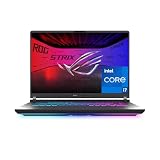
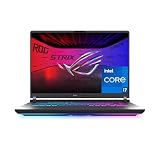
ASUS ROG Strix G16 (2025)
This is the most capable machine on the list when you can catch it near the $1,000 line — the RTX 5060 paired with a 14650HX and 16GB of DDR5 handles 1080p ultra settings across essentially everything current, with headroom left for the next few years. The 16:10 165Hz panel and 1TB Gen 4 SSD round out a configuration that would have cost considerably more a generation ago.
Acer Nitro V 16
The 16-inch Nitro V is our value champion: an RTX 5050, Core 7 240H, 16GB DDR5 and a 1TB SSD is a genuinely complete spec sheet at this price, with no obvious corner cut to hit the number. The 180Hz WUXGA display is unusually fast for the money, and the chassis has enough cooling capacity to hold boost clocks through extended sessions.
Alienware 16 Aurora
Alienware’s Aurora line brings the brand’s build quality and thermal engineering down to a budget most gamers can actually reach, pairing the RTX 5050 with a Core 7 240H in a chassis that runs quieter under load than most rivals here. Choose it if you want the more premium keyboard, screen and construction and can accept slightly less raw spec per dollar.
Acer Nitro V 15.6″
The 15.6-inch Nitro V trades the larger sibling’s screen size and storage for a lower entry price, but keeps the important part — an RTX 5050 with 8GB of GDDR7 VRAM, backed by 16GB of RAM and a 165Hz IPS panel. The 512GB SSD is the main compromise, though the drive is straightforward to supplement.
ASUS TUF Gaming A16
The TUF A16 is the durability pick, built to military-spec standards with a Ryzen 7 7445HS and RTX 4050 that still comfortably clear 60fps at 1080p high in most titles. Its 16-inch 145Hz Full HD+ display and 16GB of DDR5 make it a sensible choice for students or anyone who needs a laptop that travels well.
Frequently Asked Questions
Can a sub-$1,000 laptop run modern AAA games well?
Yes, at 1080p. With an RTX 5050 or 5060 you should expect high-to-ultra settings at comfortably playable frame rates in most current releases, particularly with DLSS enabled. What you’re giving up compared to pricier machines is 1440p headroom and heavy ray tracing, not basic playability.
Is a renewed gaming laptop worth considering?
It can be, provided it’s sold through a program with a clear return window and warranty. Renewed units let you access a better chassis or panel for less, but verify the specific configuration carefully — older-generation GPUs like the RTX 3050 offer less future headroom than a new-generation card at a similar price.
Should I prioritize the CPU or the GPU?
The GPU, almost without exception. Every processor on this list is a capable multi-core chip that will not bottleneck gaming performance meaningfully at 1080p, so putting your money toward a higher GPU tier delivers a much larger and more visible improvement.
Are these laptops upgradeable?
RAM and storage generally are — most of these chassis have accessible M.2 slots and SO-DIMM sockets, making a 512GB-to-1TB or 8GB-to-16GB upgrade a cheap, straightforward job. The GPU and CPU are soldered, which is why choosing the right graphics tier at purchase matters so much.
Final Thoughts
If your budget stretches to the top of this range, the ASUS ROG Strix G16 is the clear performance leader thanks to its RTX 5060 and 1TB of fast storage. For most buyers, though, the Acer Nitro V 16 is the smarter purchase — it delivers nearly everything that matters for meaningfully less money. And if build quality and thermals rank above raw specifications for you, the Alienware 16 Aurora is the most refined machine you can get at this price.