Key takeaways
- Core configuration: The 9950X3D offers 16 cores and 32 threads across two CCDs, while the 9800X3D provides 8 cores and 16 threads on a single die — half the parallel throughput, but with zero cross-die latency.
- Cache architecture: The 9800X3D stacks its cache directly beneath the compute die, allowing higher clocks and full overclocking. The 9950X3D carries 3D V-Cache on only one of its two CCDs, meaning the scheduler must route game threads correctly to see the benefit.
- Gaming performance: In practice the two trade blows, typically within a few percent of each other. The 9950X3D occasionally edges ahead in engines that scale with cores, but the 9800X3D is more consistent because there’s no CCD to get wrong.
- Productivity throughput: This is not close. In rendering, encoding, and compilation the 9950X3D roughly doubles the 9800X3D’s output — the single strongest argument for the higher tier.
- Power and cooling: The 9800X3D’s lower TDP is comfortable under a good 240mm AIO or a large air cooler. The 9950X3D draws considerably more under all-core load and rewards a 360mm AIO and a well-ventilated case.
- Total build cost: Beyond the chip premium, the 9950X3D nudges you toward stronger cooling and a higher-tier board, which compounds the difference across a full build.
What's inside
The 3D V-Cache era has settled into a two-tier structure, and by 2026 the decision facing most enthusiasts comes down to a single question: do you need sixteen cores, or do you just need the fastest frames per second money can reasonably buy? The Ryzen 9 9950X3D and the Ryzen 7 9800X3D both sit on AMD’s mature AM5 platform, both use Zen 5 cores, and both carry the stacked cache that transformed AMD’s reputation in gaming. What separates them is scope.
This matters more now than it did at launch. GPUs like the RTX 5080 have pushed CPU bottlenecks back into relevance at 1440p, competitive titles reward cache-heavy chips disproportionately, and creator workloads — local AI inference, 4K timeline scrubbing, heavy compilation — have become normal parts of a gaming PC’s life. Choosing wrong means either paying for cores you never touch, or hitting a wall every time you try to render while a game patch downloads. Below is a clear breakdown of where each chip earns its place.
As an Amazon Associate we earn from qualifying purchases.


⚡ Save on Your Next PC — Amazon Prime
Prime members get fast free shipping on the systems above, plus early access to Prime Day & Black Friday PC deals. New members get a 30-day free trial.
Watch: Ryzen 9 9950X3D vs 9800X3D: 2026 Showdown — Video Review
Quick Verdict
The Ryzen 7 9800X3D remains the smartest buy for the overwhelming majority of gamers: it delivers effectively flagship-tier gaming performance for a fraction of the outlay, runs cooler, and is easier to cool and feed. The Ryzen 9 9950X3D is the correct choice only if you genuinely run demanding productivity work alongside gaming — streaming with local encoding, video editing, 3D rendering, code compilation, or multitasking that saturates more than eight cores. Pay for the 9950X3D when you’ll use the extra silicon; otherwise the 9800X3D is the better-engineered value.
Key Differences
- Core configuration: The 9950X3D offers 16 cores and 32 threads across two CCDs, while the 9800X3D provides 8 cores and 16 threads on a single die — half the parallel throughput, but with zero cross-die latency.
- Cache architecture: The 9800X3D stacks its cache directly beneath the compute die, allowing higher clocks and full overclocking. The 9950X3D carries 3D V-Cache on only one of its two CCDs, meaning the scheduler must route game threads correctly to see the benefit.
- Gaming performance: In practice the two trade blows, typically within a few percent of each other. The 9950X3D occasionally edges ahead in engines that scale with cores, but the 9800X3D is more consistent because there’s no CCD to get wrong.
- Productivity throughput: This is not close. In rendering, encoding, and compilation the 9950X3D roughly doubles the 9800X3D’s output — the single strongest argument for the higher tier.
- Power and cooling: The 9800X3D’s lower TDP is comfortable under a good 240mm AIO or a large air cooler. The 9950X3D draws considerably more under all-core load and rewards a 360mm AIO and a well-ventilated case.
- Total build cost: Beyond the chip premium, the 9950X3D nudges you toward stronger cooling and a higher-tier board, which compounds the difference across a full build.
AMD Ryzen 9 9950X3D: The Do-Everything Flagship
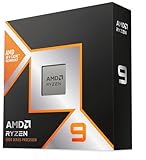
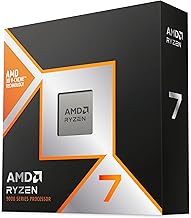
The Ryzen 9 9950X3D 16-Core Processor is built for people whose PC has more than one job. Sixteen Zen 5 cores handle Blender renders, DaVinci Resolve exports, Unreal shader compilation, and containerised dev workloads without the stutter that eight-core chips exhibit under sustained load. Crucially, it does this without surrendering gaming performance — the 3D V-Cache CCD keeps latency-sensitive titles running at the front of the pack, provided your chipset drivers and Windows game bar integration are current.
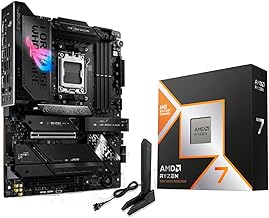
It’s also the natural centrepiece for a high-end system. The Mantis V2 prebuilt pairs it with an RTX 5080, 64GB of DDR5 and a 2TB Gen4 SSD for anyone who’d rather not assemble anything, while the 9950X3D and GIGABYTE X870E AORUS Elite WIFI7 ICE combo is the tidier route for builders who want PCIe 5.0, four M.2 slots and USB4 sorted in one purchase. Note too that AMD’s 9950X3D2 Dual Edition now addresses the single-cache-CCD compromise for buyers who want the theoretically cleanest 16-core gaming configuration.
AMD Ryzen 7 9800X3D: The Pure Gaming Value Pick
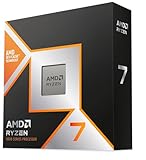
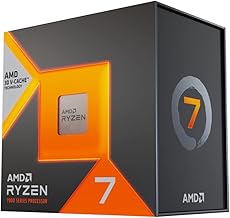
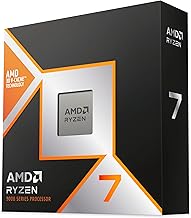
The Ryzen 7 9800X3D 8-Core, 16-Thread Processor is arguably the best-judged CPU AMD has shipped this generation. Moving the stacked cache below the cores solved the thermal ceiling that limited earlier X3D parts, so it clocks higher, overclocks freely, and behaves predictably. For gaming, that translates to elite 1% lows in simulation titles, MMOs, and competitive shooters — the scenarios where cache, not core count, decides whether frametimes stay smooth.
It’s also the easier chip to build around. Lower power draw means a mid-range cooler suffices, a B850 board is entirely adequate, and the money saved is far better spent on the GPU — which will influence your average framerate more than any CPU decision at 1440p and above. If your workload genuinely never exceeds eight cores, the Ryzen 9 9950X (non-X3D) is worth a glance for cheaper multithreaded muscle, but it gives up the cache advantage that makes X3D parts special.
Which Should You Buy?
- For pure gaming at any resolution: pick the 9800X3D and reinvest the savings into a better graphics card.
- For streaming, editing, or 3D work alongside gaming: pick the 9950X3D — the second CCD pays for itself in exported minutes.
- For a compact or air-cooled build: pick the 9800X3D; it’s far less demanding thermally.
- For a no-compromise flagship system: pick the 9950X3D, ideally as part of the motherboard combo or a prebuilt like the Mantis V2.
- For heavy multithreaded work with minimal gaming: consider the standard 9950X and skip the cache premium entirely.
Frequently Asked Questions
Is the 9950X3D actually faster in games?
Only marginally, and not universally. Across a broad test suite the two land within a few percent, with the 9950X3D ahead in a handful of core-hungry titles and the 9800X3D ahead where clock speed and consistency matter most.
Do I need a new motherboard for either chip?
Both use socket AM5. An X870E board offers the most connectivity, but a B850 board with a current BIOS runs either processor perfectly well.
What cooler should I plan for?
A quality 240mm AIO or premium air cooler suits the 9800X3D. For the 9950X3D under sustained all-core load, budget for a 360mm AIO to hold clocks steady.
Will these chips still be relevant in a few years?
Yes. AM5 has a long support runway, and cache-rich CPUs have aged unusually well as game engines grow more memory-latency sensitive.
Final Verdict
If gaming is the priority, the Ryzen 7 9800X3D is the rational purchase — near-flagship frames, lower running costs, and fewer variables to get wrong. If your machine also earns its keep with rendering, encoding, or development work, the Ryzen 9 9950X3D is the one CPU that refuses to compromise in either direction, and it’s worth every bit of its premium to the people who actually need it.