Key takeaways
- Stunning QD-OLED contrast, perfect blacks and vibrant, accurate color
- 240Hz with 0.03ms response gives exceptionally clean motion
- Effective glare-free coating and a well-built, fully adjustable stand
- Robust burn-in mitigation with a three-year warranty covering it
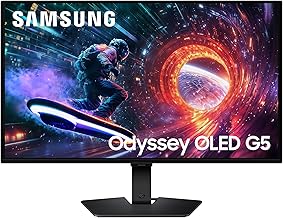
The Samsung Odyssey OLED G8 (G80SH) is a 32-inch 4K gaming monitor built around a QD-OLED panel, pairing 3840×2160 resolution with a 240Hz refresh rate and a claimed 0.03ms response time. It is one of the more complete high-end gaming displays of 2026: sharp enough for desktop work, fast enough for competitive play, and vivid enough to double as a movie screen.
This is a monitor for enthusiasts who want a single do-everything panel and have a GPU strong enough to feed 4K at high frame rates. If you sit closer to esports than cinema, or you are pushing a mid-range card, a cheaper high-refresh option may serve you better.
Our top picks


As an Amazon Associate we earn from qualifying purchases at no extra cost to you. Ratings are shown as listed on Amazon.
⚡ Save on Your Next PC — Amazon Prime
Prime members get fast free shipping on the systems above, plus early access to Prime Day & Black Friday PC deals. New members get a 30-day free trial.
Watch: Samsung Odyssey OLED G8 Review — Video Review
Design & Build
Samsung leans on a slim metal chassis with a thin profile that hides just how large a 32-inch panel is. The stand offers height, tilt, swivel and pivot adjustment, and the glare-free coating on this generation genuinely helps in bright rooms, cutting the mirror-like reflections that plagued earlier glossy OLEDs. Cable management runs through the stand, and the OLED Safeguard+ suite adds pixel-shift and heat-management features to fight burn-in. It is a premium-feeling unit, though the external power brick is bulky and the smart-TV menu system feels heavier than it needs to be for a monitor.
Performance
Image quality is the headline. QD-OLED delivers perfect blacks, per-pixel contrast and saturated, accurate color that LCD simply cannot match, and HDR content has real punch in highlights against those true blacks. Motion is superb: 240Hz combined with near-instant pixel response makes fast panning and flick-shots crystal clear, and G-Sync compatibility keeps tearing away.
The trade-offs are the familiar OLED ones. Full-screen brightness is lower than a top LCD, so in a sunlit room SDR content can look a touch dim despite the anti-glare layer. Text rendering on the triangular QD-OLED subpixel layout is slightly softer than on an LCD, noticeable in small fonts during long work sessions. And 4K at 240Hz demands a serious GPU to exploit fully.
Pros & Cons
- Stunning QD-OLED contrast, perfect blacks and vibrant, accurate color
- 240Hz with 0.03ms response gives exceptionally clean motion
- Effective glare-free coating and a well-built, fully adjustable stand
- Robust burn-in mitigation with a three-year warranty covering it
- Lower full-screen brightness than premium LCDs in bright rooms
- QD-OLED subpixel layout makes small text slightly soft
- 4K/240Hz needs a high-end GPU to take full advantage
Alternatives to Consider
If you prefer an immersive ultrawide over a flat 16:9 panel, the Samsung 34″ Odyssey OLED G8 (G85SD) swaps to a curved QD-OLED at 175Hz. Want the same 4K experience on a tighter desk? The Samsung 27″ Odyssey OLED G8 (G80SH) packs identical specs into a denser 27-inch panel with USB-C 96W. And if 4K is overkill for your GPU, the Samsung 27″ Odyssey OLED G6 (G61SH) steps down to a more attainable QHD resolution while keeping OLED image quality.
Frequently Asked Questions
Should I worry about OLED burn-in?
Modern QD-OLED with Samsung’s OLED Safeguard+ features greatly reduces the risk for mixed gaming and media use, and the three-year warranty explicitly covers burn-in, which is reassuring.
Is 4K at 240Hz too much for my PC?
To hit those frame rates in demanding titles you need a high-end current-generation GPU. The monitor still shines at lower frame rates, but you are paying for headroom you may not fully use on weaker hardware.
How is it for everyday desktop work?
Excellent for media and dark-themed apps, though small black text on white can look slightly soft due to the subpixel layout. It is fine for most, but worth knowing if you read text all day.
Does the anti-glare coating actually help?
Yes. This generation’s glare-free treatment noticeably tames reflections compared with older glossy OLEDs, making it far more usable in a well-lit room.
Verdict
The Samsung Odyssey OLED G8 (G80SH) is a superb flagship that nails the hardest combination to get right: 4K sharpness, 240Hz speed and OLED image quality in one panel. Brightness and text sharpness keep it from being flawless, and it demands a strong GPU, but for enthusiasts who want one monitor to game, create and watch on, it is among the best you can buy in 2026.