Key takeaways
- Contrast and black level: OLED produces true black with effectively infinite contrast; IPS relies on a backlight and typically shows grey-ish blacks and visible glow, though mini-LED backlights narrow the gap considerably.
- Response time: OLED panels are rated around 0.03ms grey-to-grey, eliminating smearing entirely. Fast IPS panels land near 1ms and still show mild overshoot or trailing in dark transitions.
- Peak brightness: IPS wins on sustained full-screen brightness, which matters in bright rooms. OLED counters with very high small-highlight peaks that make HDR specular detail pop.
- Burn-in risk: OLED carries a small long-term risk from static elements, mitigated by pixel shifting, logo dimming, and dedicated warranty coverage. IPS has no burn-in risk whatsoever.
- Viewing angles and uniformity: OLED holds colour and contrast at extreme angles; IPS is good but shows gamma shift and backlight non-uniformity on large or curved panels.
- Price and size: IPS still costs less per inch at 4K and ultrawide sizes, though the OLED premium has shrunk to a modest margin at 27 inches.
What's inside
The gaming monitor market in 2026 splits cleanly down the middle. On one side sit OLED panels, where every pixel generates its own light and switches off completely for true black. On the other sit IPS panels — the LCD workhorse that has absorbed a decade of refinements, from tuned overdrive to mini-LED backlights with thousands of dimming zones. Both technologies now reach 240Hz and beyond, both support G-Sync and FreeSync, and both look excellent on a spec sheet. The differences that remain are the ones you feel in a dark corridor or a fast flick shot.
This decision matters more than it did two years ago because OLED has stopped being a luxury tier. QD-OLED and LG’s latest WOLED panels have pushed 27-inch 1440p models into territory that flagship IPS monitors used to own, and multi-year burn-in coverage is now standard rather than exceptional. With cost and longevity largely addressed, the choice comes down to something more practical: how bright your room is, how many hours the screen spends showing static desktop elements, and whether you value perfect motion or maximum durability.
As an Amazon Associate we earn from qualifying purchases.


⚡ Save on Your Next PC — Amazon Prime
Prime members get fast free shipping on the systems above, plus early access to Prime Day & Black Friday PC deals. New members get a 30-day free trial.
Watch: OLED vs IPS Gaming Monitor: 2026 Comparison — Video Review
Quick Verdict
OLED is the better gaming display, full stop — it delivers instantaneous pixel response, infinite contrast, and motion clarity no LCD can match, making it the right call for competitive shooters, atmospheric single-player titles, and anyone gaming in a light-controlled room. IPS remains the smarter buy if your monitor doubles as an all-day work display, sits opposite a sunny window, or needs to survive years of static UI elements without any risk of image retention.
Key Differences
- Contrast and black level: OLED produces true black with effectively infinite contrast; IPS relies on a backlight and typically shows grey-ish blacks and visible glow, though mini-LED backlights narrow the gap considerably.
- Response time: OLED panels are rated around 0.03ms grey-to-grey, eliminating smearing entirely. Fast IPS panels land near 1ms and still show mild overshoot or trailing in dark transitions.
- Peak brightness: IPS wins on sustained full-screen brightness, which matters in bright rooms. OLED counters with very high small-highlight peaks that make HDR specular detail pop.
- Burn-in risk: OLED carries a small long-term risk from static elements, mitigated by pixel shifting, logo dimming, and dedicated warranty coverage. IPS has no burn-in risk whatsoever.
- Viewing angles and uniformity: OLED holds colour and contrast at extreme angles; IPS is good but shows gamma shift and backlight non-uniformity on large or curved panels.
- Price and size: IPS still costs less per inch at 4K and ultrawide sizes, though the OLED premium has shrunk to a modest margin at 27 inches.
OLED Gaming Monitors
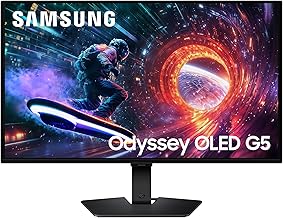
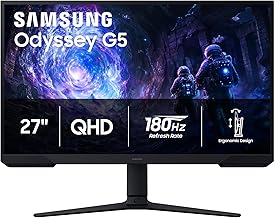
OLED’s advantage is structural rather than incremental. Because each pixel is its own light source, there is no backlight to bleed, no dimming zones to lag behind fast-moving highlights, and no liquid crystal to twist into position. The result is a display that renders a muzzle flash against a night sky exactly as intended, and keeps moving text legible at speeds where IPS blurs. The 27-inch 1440p class is where the value is strongest in 2026 — the Samsung Odyssey OLED G6 (G61SH) pairs a glare-free QD-OLED coating with 240Hz, while LG’s UltraGear 27GX704A-B and 27GS93QE deliver the same 0.03ms response with HDMI 2.1 and DisplayHDR True Black 400.
Beyond 27 inches, OLED becomes the immersion choice. The LG 34GX900A-B curves a 240Hz WQHD ultrawide around your field of view, and the 32GX850A-B adds dual-mode operation that switches between 4K at 165Hz and 1080p at 330Hz depending on whether you are exploring or competing. At the extreme end, the Samsung Odyssey OLED G9 (G91SD) spans 49 inches of Dual QHD for sim racing and flight sims. Modern panels include automatic brightness limiting, pixel refresh cycles, and multi-year burn-in warranties that make normal mixed use safe.
IPS Gaming Monitors
IPS earns its place through practicality. It sustains high full-screen brightness indefinitely, which OLED cannot, so a bright living room or an office with unshaded windows favours LCD. It uses a conventional RGB subpixel layout, so small text renders cleanly without the colour fringing some OLED arrangements produce. And it is immune to burn-in, which matters if your taskbar, Discord sidebar, or trading dashboard lives on screen for ten hours a day.
Modern IPS is also faster than its reputation suggests. Well-tuned 1ms panels at 240Hz or 360Hz are genuinely competitive for esports, and mini-LED backlighting with high zone counts delivers HDR highlights that rival OLED in bright scenes — falling short mainly in dark ones, where blooming around subtitles and starfields gives the technology away. For a budget-conscious build or a dual-purpose work-and-play desk, IPS still makes complete sense.
Which Should You Buy?
- For competitive shooters: pick OLED. The 0.03ms response of the 27GX704A-B or 27GS93QE removes smearing entirely, and dual-mode panels like the 32GX850A-B push refresh higher still.
- For cinematic single-player games: pick OLED. Infinite contrast transforms HDR titles, and the curved 34GX900A-B adds width without sacrificing black level.
- For a bright, sunlit room: pick IPS, ideally mini-LED. Sustained brightness beats contrast when ambient light is washing out the screen anyway.
- For work plus gaming: pick IPS if static UI dominates your day; choose the Odyssey OLED G6 with its glare-free coating and OLED Safeguard if gaming is the priority.
- For sim racing and ultrawide immersion: pick the 49-inch Odyssey OLED G9, or a large IPS ultrawide if budget is the binding constraint.
Frequently Asked Questions
Is OLED burn-in still a real concern in 2026?
For typical mixed gaming and desktop use, no. Pixel shifting, logo dimming, automatic refresh cycles, and heat-management layers have substantially reduced risk, and manufacturers back panels with multi-year burn-in warranties. Sustained static content at maximum brightness for many hours daily remains the one genuinely risky pattern.
Does OLED actually feel faster than a 240Hz IPS?
Yes, noticeably. Two panels at the same refresh rate can differ significantly in perceived clarity because IPS pixels take longer to change state. OLED transitions are effectively instant, so moving objects stay sharp instead of trailing.
Is text rendering a problem on OLED monitors?
It is much improved. Newer QD-OLED and WOLED panels reduce the colour fringing that affected earlier models, and at 4K densities like the 32GX850A-B it is essentially a non-issue. At 1440p, most users adapt within days.
Should I choose 1440p, 4K, or ultrawide?
Match it to your GPU. 1440p at 240Hz is the sweet spot for high-frame-rate play, 4K suits powerful cards and visual showcases, and ultrawide formats like WQHD or Dual QHD prioritise immersion in racing, flight, and open-world games.