Key takeaways
- Immersion: Curved panels wrap the edges of the image toward your eyes, which increases perceived field of view; flat panels present a flatter, more neutral frame that reads more like a window than a cockpit.
- Viewing distance: Curvature only pays off when you sit near the panel’s radius — roughly 1.5m for 1500R and 1m for 1000R. Flat monitors look correct from any seat in the room.
- Geometry and straight lines: Flat screens keep horizons, spreadsheet gridlines, and UI edges perfectly straight. Curved screens introduce mild bowing that most people stop noticing within a week but some never do.
- Off-axis viewing: Curved panels hold contrast and color better at the edges for the person sitting centrally; flat panels are far easier to share with someone watching from the side.
- Multi-monitor setups: Flat displays tile cleanly side by side. Curved monitors either need matching curves angled inward or end up with a visible mismatch at the join.
- Price per inch: Curvature is now cheap to manufacture, so budget 27-inch and 32-inch curved panels frequently undercut equivalent flat models at the same refresh rate.
What's inside
Curved and flat panels have been competing for desk space for the better part of a decade, but the gap between them in 2026 is narrower — and more interesting — than it has ever been. High refresh rates, once the exclusive territory of small flat esports panels, are now standard on curved screens at 240Hz and beyond. Meanwhile, flat monitors have absorbed most of the color and HDR improvements that used to justify paying a premium. The result is that curvature has become a genuine preference decision rather than a technical compromise.
That makes the choice worth thinking about before you buy. Curvature affects how large a screen can practically sit on your desk, how consistent the image looks at the edges, how usable the panel is for work between sessions, and even whether a second monitor makes sense alongside it. Below we break down where each design genuinely wins, then match specific 2026 monitors to the kind of gaming you actually do.
As an Amazon Associate we earn from qualifying purchases.


⚡ Save on Your Next PC — Amazon Prime
Prime members get fast free shipping on the systems above, plus early access to Prime Day & Black Friday PC deals. New members get a 30-day free trial.
Watch: Curved vs Flat Gaming Monitor: 2026 Guide — Video Review
Quick Verdict
Choose a curved monitor if you play immersive single-player games, sim titles, or open-world RPGs, and you want a large 27-inch to 34-inch screen that stays comfortable at close viewing distances — the SANSUI 32-inch Curved 240Hz and Sceptre 34-inch Ultrawide are strong examples. Choose flat if you’re a competitive shooter player, you do photo, video, or CAD work on the same display, or you plan to run a multi-monitor array where curvature creates awkward seams.
Key Differences
- Immersion: Curved panels wrap the edges of the image toward your eyes, which increases perceived field of view; flat panels present a flatter, more neutral frame that reads more like a window than a cockpit.
- Viewing distance: Curvature only pays off when you sit near the panel’s radius — roughly 1.5m for 1500R and 1m for 1000R. Flat monitors look correct from any seat in the room.
- Geometry and straight lines: Flat screens keep horizons, spreadsheet gridlines, and UI edges perfectly straight. Curved screens introduce mild bowing that most people stop noticing within a week but some never do.
- Off-axis viewing: Curved panels hold contrast and color better at the edges for the person sitting centrally; flat panels are far easier to share with someone watching from the side.
- Multi-monitor setups: Flat displays tile cleanly side by side. Curved monitors either need matching curves angled inward or end up with a visible mismatch at the join.
- Price per inch: Curvature is now cheap to manufacture, so budget 27-inch and 32-inch curved panels frequently undercut equivalent flat models at the same refresh rate.
Curved Gaming Monitors
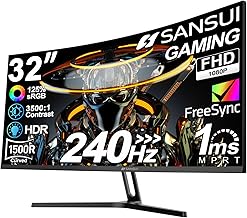
Curved displays make the most sense once you get past about 27 inches, because that’s the point where a flat panel’s outer thirds start sitting noticeably further from your eyes than its center. The Samsung 32-inch Odyssey G55C uses an aggressive 1000R curve with QHD resolution and 165Hz, which suits sim racing and third-person adventure titles where peripheral detail matters. If your priority is speed rather than resolution, the SANSUI 32-inch Curved 240Hz and the Sceptre 32-inch Prime both push 1080p at very high refresh rates for less money, with the Sceptre reaching 260Hz over DisplayPort.
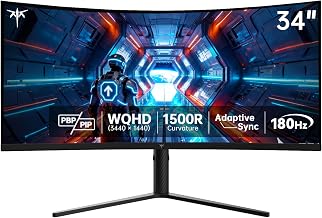
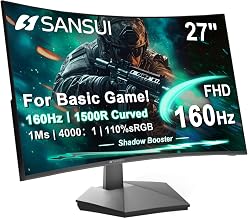
Ultrawide is where curvature becomes close to mandatory. The Sceptre 34-inch Curved Ultrawide runs 3440 × 1440 at up to 180Hz with 99% sRGB coverage, and its 1500R curve is what keeps the far edges of a 34-inch canvas readable without head-turning. Smaller curved options like the SANSUI 27-inch Curved 240Hz exist mainly as value picks — the curve does less at that size, but it costs nothing extra and adds a little edge comfort.
Flat Gaming Monitors
Flat panels remain the default for competitive play. In fast shooters and fighting games you’re tracking a small central area, not absorbing scenery, so the immersion advantage evaporates while the geometric accuracy of a flat screen helps with crosshair placement and recoil control. Flat monitors also dominate at 24 to 27 inches, sit closer to the desk, and are simpler to wall-mount or arm-mount without fighting the curve.
The other case for flat is mixed use. Straight lines matter in spreadsheets, timelines, layout tools, and vector work, and flat panels avoid the slight edge distortion that curved screens introduce. If you want a middle path, gentler curves behave almost like flat panels: the Samsung 27-inch Essential S3 uses a relaxed 1800R curve at 100Hz, making it a low-cost everyday display that happens to be curved rather than a curved display you buy for gaming.
Which Should You Buy?
- For competitive FPS: Pick flat at 24–27 inches, or a fast 1080p curved panel like the SANSUI 27-inch Curved 240Hz if you want high refresh on a budget.
- For sim racing and flight: Pick curved, ideally the Sceptre 34-inch Ultrawide for its wide field of view.
- For single-player and RPGs: Pick curved QHD — the Samsung 32-inch Odyssey G55C balances sharpness and immersion well.
- For dual-monitor productivity: Pick flat, or keep the curve gentle with something like the Samsung 27-inch Essential S3.
- For maximum frames per dollar: Pick the Sceptre 32-inch Prime, which reaches 260Hz at 1080p.
Frequently Asked Questions
Does a curved monitor actually improve gaming performance?
No. Curvature affects perceived immersion and edge comfort, not frame rates or input latency. Performance comes from refresh rate, response time, and adaptive sync support.
What does 1500R or 1000R mean?
It’s the radius of the circle the screen would form if extended, in millimetres. A 1000R curve is more aggressive than 1500R, and the number roughly indicates the ideal viewing distance.
Are curved monitors bad for design or office work?
Not bad, but slightly compromised. Straight lines bow gently near the edges, which is irrelevant for documents and browsing but can annoy anyone doing precise layout or CAD work.
Can I mix a curved and a flat monitor?
Yes, and it’s common to pair a curved primary with a flat secondary rotated to portrait. Two mismatched curved panels side by side is the setup that tends to look wrong.
Final Verdict
Curvature is a comfort and immersion feature, not a performance one. If you sit close to a large screen and play atmospheric or simulation titles, a curved panel like the Sceptre 34-inch Ultrawide or Samsung 32-inch Odyssey G55C is worth choosing deliberately. If you play competitively, work on your monitor, or run multiple displays, flat remains the safer buy — and either way, refresh rate and panel quality should outrank the shape of the glass.