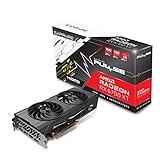
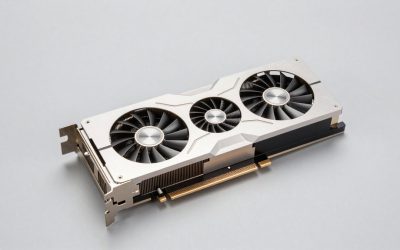
Key takeaways
- At 1440p, with the RTX 4080 at 128 percent: RX 7800 XT $499 / 100 = $4.99 per point; RTX 4080 $1,199 / 128 = $9.37 per point.
- At 4K, with the RTX 4080 at 140 percent: RTX 4080 $1,199 / 140 = $8.56 per point.
The RX 7800 XT is the better value for 1440p gamers on a mid-range budget, while the RTX 4080 is the card to choose for 4K, heavy ray tracing and path tracing, as long as you accept paying far more per frame. These two GPUs sit in different performance classes: the RTX 4080 is roughly 25 to 45 percent faster in rasterized games and much further ahead with ray tracing, but it launched at well over double the price.
The RTX 4080 debuted in September 2022 at $1,199 as NVIDIA’s second-tier Ada Lovelace card, and was later succeeded by the cheaper RTX 4080 Super. The RX 7800 XT arrived in August 2023 at $499 as AMD’s RDNA 3 answer for 1440p. Both are now previous generation, replaced by the RTX 50 and RX 9000 lineups, so buyers comparing them are usually looking at used cards or remaining stock.
Spec Comparison
| Specification | RTX 4080 | RX 7800 XT |
|---|---|---|
| Architecture | Ada Lovelace | RDNA 3.0 |
| Release date | 20 September 2022 | 25 August 2023 |
| Launch MSRP | $1,199 | $499 |
| Shaders | 9728 CUDA cores | 3840 stream processors |
| Boost clock | 2505 MHz | 2430 MHz |
| Process | 5 nm | 5 nm |
| TDP | 320 W | 263 W |
| VRAM | 16 GB GDDR6X | 16 GB GDDR6 |
| Memory bus | 256-bit | 256-bit |
| Bandwidth | 716.8 GB/s | 624.1 GB/s |
| Cache | 64 MB L2 | 4 MB L2 + 64 MB L3 |
| Interface | PCIe 4.0 x16 | PCIe 4.0 x16 |
| Power connectors | 1x 16-pin | 2x 8-pin |
| Length / width | 310 mm, 3-slot | 267 mm, 2-slot |
| Outputs | 1x HDMI 2.1, 3x DP 1.4a | 1x HDMI 2.1a, 3x DP 2.1 |
Both cards have 16 GB on a 256-bit bus, so memory capacity is not the deciding factor. The RTX 4080 has 15 percent more bandwidth and a 64 MB L2 cache, while the RX 7800 XT relies on 64 MB of Infinity Cache. The rated power gap is 57 W, and the physical size gap is significant.
Rasterized Performance
Published comparisons agree the RTX 4080 is clearly faster, with the size of its lead depending on resolution. Technical City’s aggregated averages put it roughly 25 percent ahead at 1440p and about 40 percent ahead at 4K. Tech4Gamers’ seven-game comparison at 4K measured about a 45 percent advantage. Nanoreview’s 4K figures sit closer to 28 percent. Summarizing: roughly 25 to 30 percent at 1440p and 35 to 45 percent at 4K.
The gap is narrower at 1440p because the RTX 4080 starts running into CPU limits in some titles, especially with a mid-range processor. In practice, at 1440p high settings the RX 7800 XT generally delivers well over 60 FPS and often 90 FPS or more in current games, while the RTX 4080 typically pushes past 100 FPS in many of the same games, with results varying by settings, CPU and patch level. At 4K, the RX 7800 XT usually needs upscaling to stay above 60 FPS in demanding releases, while the RTX 4080 can run many titles at native 4K.
Ray tracing and path tracing
This is where the two cards are furthest apart. RDNA 3’s ray tracing hardware trails Ada considerably, and reviewers consistently rate ray tracing and upscaling as the RX 7800 XT’s main weaknesses. Even the faster RX 7900 XTX trailed the RTX 4080 Super by roughly 30 percent with ray tracing enabled in some published comparisons, and by far more in full path tracing, so the RX 7800 XT’s deficit against the RTX 4080 is larger still. Path-traced modes are largely impractical on the RX 7800 XT, while the RTX 4080 handles them at 1440p and at 4K with DLSS.
Upscaling, Frame Generation and Software
The RTX 4080 supports DLSS 4’s transformer-based Super Resolution, Ray Reconstruction and single frame generation, plus Reflex for lower latency, with very wide game support. It does not support DLSS Multi Frame Generation, which is exclusive to RTX 50 cards.
The RX 7800 XT uses FSR 3.1 for upscaling and frame generation, along with AMD Fluid Motion Frames at the driver level. AMD’s machine-learning FSR 4 upscaler is officially limited to RDNA 4 cards. In aggressive upscaling modes, FSR 3.1 shows more shimmer and ghosting than DLSS, which matters most at 4K where upscaling is most useful.
Cost Per Frame at Launch Prices
Using the RX 7800 XT as the 100 percent baseline:
- At 1440p, with the RTX 4080 at 128 percent: RX 7800 XT $499 / 100 = $4.99 per point; RTX 4080 $1,199 / 128 = $9.37 per point.
- At 4K, with the RTX 4080 at 140 percent: RTX 4080 $1,199 / 140 = $8.56 per point.
At launch MSRP, the RTX 4080 cost almost twice as much per unit of raster performance at 1440p and about 70 percent more at 4K. Ray tracing narrows the value gap, but the RX 7800 XT remains the stronger value proposition unless the RTX 4080’s extra capabilities are what you are paying for. Used prices compress this gap, so rerun the math with the prices you find.
Power Supply and Case Requirements
Using the sizing rule of GPU power plus CPU power plus about 150 W of headroom, with a 125 W CPU:
- RX 7800 XT: 263 + 125 + 150 = 538 W, so a quality 650 W unit is comfortable.
- RTX 4080: 320 + 125 + 150 = 595 W, so a quality 750 W unit is the sensible choice.
Despite the higher rating, the RTX 4080 has been widely praised for its efficiency, delivering far more performance per watt than RDNA 3 cards. It uses a single 16-pin connector, either through a native PSU cable or an adapter. The RX 7800 XT uses two standard 8-pin plugs.
Case fit is a real consideration. The RTX 4080’s listed 310 mm length and three-slot width, with many partner cards being even larger and heavier, require a roomy mid-tower and ideally a support bracket to prevent sag. The RX 7800 XT’s 267 mm, two-slot reference dimensions fit a much wider range of cases.
Pick the RTX 4080 If, Pick the RX 7800 XT If
| Resolution / budget | Better choice | Why |
|---|---|---|
| 1440p, mid-range budget | RX 7800 XT | Strong 1440p performance at far lower cost |
| 1440p high refresh with ray tracing | RTX 4080 | Much stronger RT plus DLSS and Ray Reconstruction |
| 4K native or near-native | RTX 4080 | 35 to 45 percent faster at 4K in raster |
| Path tracing | RTX 4080 | The RX 7800 XT cannot run it at playable settings |
| Compact case or 600 W PSU | RX 7800 XT | 2-slot, 267 mm, standard 8-pin plugs |
| Streaming and creative software | RTX 4080 | NVENC and CUDA support |
Buying Used in 2026
On the used market, RX 7800 XT cards usually sell in the broad $330 to $420 range, while used RTX 4080 cards typically sit around $650 to $850, depending on model and condition. At those prices, compare carefully against new current-generation options. A new RX 9070 or RX 9070 XT offers FSR 4 and much-improved ray tracing near the used RTX 4080’s price, and the RTX 5070 Ti delivers similar performance to the RTX 4080 with Multi Frame Generation and a warranty.
When buying a used RTX 4080, inspect the 16-pin connector for discoloration and confirm the card has not been heavily used for cryptocurrency or compute workloads. For a used RX 7800 XT, check that fans are quiet and hotspot temperatures are reasonable under load.
Frequently Asked Questions
How much faster is the RTX 4080 than the RX 7800 XT?
Published comparisons put it roughly 25 to 30 percent faster at 1440p and 35 to 45 percent faster at 4K in rasterized games. With ray tracing enabled, the RTX 4080’s lead is considerably larger, and path tracing widens it further.
Is the RX 7800 XT good enough for 4K?
For lighter games and with upscaling, yes. In demanding new releases, it usually needs FSR upscaling and reduced settings to maintain 60 FPS at 4K. It is best suited to 1440p.
Do both cards have enough VRAM?
Yes. Both have 16 GB on a 256-bit bus, which covers 1440p comfortably and 4K in nearly all current games. VRAM is not a meaningful difference in this comparison.
What PSU do I need for the RTX 4080?
A quality 750 W unit is recommended with a typical gaming CPU. It requires a 16-pin power connection, provided through a native cable on newer PSUs or through the included adapter.
Is the RTX 4080 still worth buying over an RTX 5070 Ti?
Only if it is meaningfully cheaper. The RTX 5070 Ti performs in a similar class, adds DLSS Multi Frame Generation and comes with a full warranty when bought new. A discounted used RTX 4080 remains a strong 4K card.