Key takeaways
- Your Game Rotation Habits: Are you an active variety gamer who jumps between five or six massive multiplayer games, or do you focus on one narrative-driven campaign at a time? If you only play one or two games concurrently, a smaller, budget-friendly card will suffice. If your household has multiple gamers with different tastes, maximum capacity is non-negotiable.
- Active Play vs. Cold Storage: Are you willing to spend 15 minutes transferring games back and forth between a cheap external USB drive and your console’s internal storage, or do you want to click “play” instantly? If you demand a seamless, zero-friction experience, you need a dedicated, officially licensed expansion card that matches the console’s internal speed.
- Your Long-Term Console Lifecycle: Consider how long you plan to own your current console. If you intend to keep your Series X or S for several more years, investing in a high-capacity 2TB expansion card is a smarter, future-proof choice. If you are a casual player who may transition to a different platform soon, a 512GB stopgap card is more logical.
What's inside
- Decide These 3 Things First
- 1. Storage Capacity and Physical Footprint
- 2. Material Quality and Heat Dissipation
- 3. Interface and Custom Connector Engineering
- 4. Performance, Read/Write Speeds, and Wattage
- 5. Price Tiers and Cost-Per-Gigabyte Value
- 6. Warranty, Reliability, and Write Endurance
- 7. Delivery, Packaging, and Installation Specs
- Spec Checklist
- Red Flags
- FAQ
Setting up a modern home media center requires balancing aesthetics, cable management, and performance. When the Xbox Series X and Series S consoles launched, they revolutionized living room gaming with near-instant boot times and seamless transitions between games. However, with modern game files routinely eclipsing 100GB to 150GB, that speedy internal storage fills up incredibly fast. Suddenly, you are forced to play “storage tetris,” deleting one masterpiece just to download another.
- Decide These 3 Things First
- 1. Storage Capacity and Physical Footprint
- 2. Material Quality and Heat Dissipation
- 3. Interface and Custom Connector Engineering
- 4. Performance, Read/Write Speeds, and Wattage
- 5. Price Tiers and Cost-Per-Gigabyte Value
- 6. Warranty, Reliability, and Write Endurance
- 7. Delivery, Packaging, and Installation Specs
- Spec Checklist
- Red Flags
- FAQ
Many homeowners and gamers make critical mistakes when trying to solve this problem. The most common error is purchasing a standard external USB 3.0 hard drive or solid-state drive (SSD) and expecting to play next-generation games directly from it. While those drives are fine for storing older games, the Xbox Series X|S architecture requires a specialized, proprietary connection to play current-generation titles. Another costly mistake is falling for cheap DIY adapter cards or uncertified third-party drives that can overheat, corrupt your save files, or physically damage your console’s ports. To keep your gaming setup running smoothly, you need to understand what specs matter when buying an xbox expansion card in 2026.
As an Amazon Associate we earn from qualifying purchases at no extra cost to you. Product prices and availability are accurate as of the date shown and are subject to change.

Decide These 3 Things First
Before diving into transfer speeds and gigabyte costs, you must establish how you actually use your entertainment center. Answering these three questions will instantly narrow down your purchasing path:
- Your Game Rotation Habits: Are you an active variety gamer who jumps between five or six massive multiplayer games, or do you focus on one narrative-driven campaign at a time? If you only play one or two games concurrently, a smaller, budget-friendly card will suffice. If your household has multiple gamers with different tastes, maximum capacity is non-negotiable.
- Active Play vs. Cold Storage: Are you willing to spend 15 minutes transferring games back and forth between a cheap external USB drive and your console’s internal storage, or do you want to click “play” instantly? If you demand a seamless, zero-friction experience, you need a dedicated, officially licensed expansion card that matches the console’s internal speed.
- Your Long-Term Console Lifecycle: Consider how long you plan to own your current console. If you intend to keep your Series X or S for several more years, investing in a high-capacity 2TB expansion card is a smarter, future-proof choice. If you are a casual player who may transition to a different platform soon, a 512GB stopgap card is more logical.
1. Storage Capacity and Physical Footprint
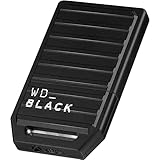
Storage capacity is the most obvious specification, but it must be balanced against physical dimensions and integration with your home theater setup. Xbox expansion cards are incredibly compact, measuring approximately 1.2 inches wide, 2.0 inches long, and a mere 0.3 inches thick, with a weight of about 0.28 ounces (8 grams). They slide directly into a dedicated slot on the back of the console, keeping your media cabinet completely free of dangling cables and bulky external enclosures.
Capacity options generally fall into three categories: 512GB, 1TB, and 2TB. A 512GB card (such as the Sandisk 512GB Optimus GX C50 Storage Expansion Card for Xbox, priced at $119.99) adds roughly 450GB of usable space. This is ideal for adding 4 to 6 AAA titles to your library. A 1TB card (like the Sandisk 1TB Optimus GX C50 at $239.99 or the WD_Black 1TB C50) provides around 920GB of usable space, easily holding 10 to 12 large games. For hardcore enthusiasts, a 2TB card (such as the Sandisk 2TB Optimus GX C50 at $479.99) offers over 1.8TB of usable space, accommodating 20 to 25 massive titles. When calculating your needs, remember that system formatting and file allocation tables consume about 10% of the advertised space on any drive.
2. Material Quality and Heat Dissipation
Modern NVMe SSDs generate a tremendous amount of heat when transferring data at gigabytes per second. If an expansion card gets too hot, it will trigger “thermal throttling,” a protective measure that drastically slows down transfer speeds to prevent hardware damage. When analyzing construction, look for cards built with premium, thermally conductive materials.
The connector end of the card should feature a nickel-plated or heavy-duty aluminum casing, which acts as a miniature heatsink to pull warmth away from the internal flash memory chips. The outer grip is typically constructed of high-grade, matte polycarbonate to ensure it is cool to the touch when you remove it. A quality card is engineered to operate safely within a temperature range of 32 degrees Fahrenheit to 158 degrees Fahrenheit (0 degrees Celsius to 70 degrees Celsius). Avoid cheap, unbranded plastic adapters that lack metal shielding, as they can trap heat and degrade the lifespan of the memory cells within a matter of months.
3. Interface and Custom Connector Engineering
The Xbox Series X|S does not use standard USB or standard M.2 NVMe slots on the outside of the machine. Instead, Microsoft designed a custom, proprietary port based on the CFexpress physical form factor, utilizing a PCIe Gen 4 x2 protocol. This custom interface links the expansion card directly to the console’s processor, bypassing the latency issues inherent in USB connections.
When shopping, the card must specify compatibility with this custom PCIe Gen 4 x2 interface. The physical connector should be rated for at least 10,000 insertion cycles, meaning you can plug and unplug the card daily for years without wearing down the gold-plated pins. Additionally, the physical casing must provide a flush, secure fit. A loose connection can cause instant game crashes or file corruption if the console is bumped or moved slightly inside your entertainment center.
4. Performance, Read/Write Speeds, and Wattage
To run modern Xbox Series X|S games, an expansion card must match the exact performance profile of the console’s internal SSD. This ecosystem is known as the Xbox Velocity Architecture. If a card cannot match these speeds, the console will relegate it to storing older Xbox One or Xbox 360 games, defeating the purpose of your purchase.
The critical performance specification is raw read speed, which must reach at least 2.4 GB/s (gigabytes per second), with compressed data speeds scaling up to 4.8 GB/s. This allows the card to support “Quick Resume,” a feature that lets you switch between multiple active games in under 8 seconds without losing your progress. Power efficiency is another key factor: a quality expansion card should draw minimal wattage from the console’s power supply, typically operating between 1.5 watts during idle states and a maximum of 3.5 watts during peak write operations. Excessive power draw can heat up the console’s internal components and tax its power delivery system.
5. Price Tiers and Cost-Per-Gigabyte Value
Because these cards use proprietary technology, they command a premium price compared to standard computer SSDs. Understanding the price tiers will help you evaluate whether a card is priced fairly or marked up excessively.
- Budget Tier ($80 – $130): This tier consists almost exclusively of 512GB cards. At this level, you are paying roughly $0.20 to $0.25 per gigabyte. It is a highly accessible entry point for casual gamers but offers the lowest overall value per gigabyte.
- Mid-Range Tier ($140 – $240): This is the sweet spot for most households, featuring 1TB cards. The cost-per-gigabyte drops significantly here, often landing between $0.14 and $0.24 per gigabyte. These cards offer the best balance of price, longevity, and storage capacity.
- Premium Tier ($280 – $480): This tier is reserved for 2TB cards. While the upfront cost is high, it offers unparalleled convenience for power users. The cost-per-gigabyte remains around $0.20 to $0.24 due to the high density of the memory chips required to pack 2TB into such a tiny physical footprint.
6. Warranty, Reliability, and Write Endurance
Solid-state memory has a finite lifespan determined by how many times data can be written to and erased from the drive. This is measured in Terabytes Written (TBW). While manufacturers do not always publish TBW figures for consumer expansion cards, a reliable 1TB drive should carry an endurance rating of at least 150 to 300 TBW, meaning you can completely fill and erase the card hundreds of times over.
To protect your investment, look for a manufacturer’s warranty of at least 3 years, though premium options often extend this to a 5-year limited warranty. Avoid any brand that offers less than a 1-year warranty, as this is a clear indicator of low-grade flash memory chips that are prone to sudden failure.
7. Delivery, Packaging, and Installation Specs
Because these cards are incredibly sensitive to electrostatic discharge (ESD), the packaging and delivery specifications matter. A quality expansion card should ship in a rigid, anti-static plastic clamshell container, nestled inside a padded cardboard box.
Crucially, the package should include a plastic protective cap that slips over the delicate gold-plated connector pins. This cap is vital if you plan to transport your card to a friend’s house, preventing pocket lint, dust, and static electricity from ruining the drive. Installation should require absolutely zero tools, cables, or external power blocks; it should be a pure plug-and-play experience that takes under 5 seconds to insert into the back of your console.
Spec Checklist
Use this quick-reference table to compare the specifications of budget, mid-range, and premium Xbox expansion cards before making your final decision:
| Specification | Budget Tier | Mid-Range Tier | Premium Tier |
|---|---|---|---|
| Target Capacity | 512GB | 1TB | 2TB |
| Price Range | $80 – $130 | $140 – $240 | $280 – $480 |
| Raw Read Speed | Min. 2.4 GB/s | Min. 2.4 GB/s | Min. 2.4 GB/s |
| Interface Protocol | PCIe Gen 4 x2 Custom | PCIe Gen 4 x2 Custom | PCIe Gen 4 x2 Custom |
| Average Weight | 0.28 oz (8g) | 0.28 oz (8g) | 0.28 oz (8g) |
| Connector Casing | Polycarbonate / Metal | Nickel-Plated Aluminum | Premium Aluminum Alloy |
| Warranty Length | 1 to 3 Years | 3 to 5 Years | 5 Years |
| Quick Resume Support | Yes | Yes | Yes |
Red Flags
When navigating online marketplaces, keep an eye out for these warning signs to avoid purchasing a useless or damaging product:
- The “USB Adapter” Trap: If a listing claims to be an “Xbox Series X|S Expansion Card” but connects via a USB-A or USB-C cable, it is a standard external drive. It cannot run Series X|S optimized games directly.
- DIY Conversion Shells: Some sellers offer cheap, empty metal cartridges claiming you can slide your own M.2 2230 SSD inside to save money. These often lack proper thermal pads, do not fit the port correctly, and can easily short out your console’s motherboard.
- Unusually Low Prices: If you see a “2TB expansion card” priced under $100, it is a scam. These counterfeit drives use hacked firmware to display a fake capacity on your console, but they will corrupt and overwrite your data the moment you try to load actual games onto them.
- No “Xbox Velocity Architecture” Certification: Ensure the packaging or product description explicitly states that the drive is officially licensed or certified to work with the Xbox Velocity Architecture. Without this, the console may block the drive from running next-generation games.
FAQ
Can I play Xbox Series X|S games directly from a standard external USB hard drive?
No. Standard external hard drives and USB SSDs do not have the necessary bandwidth or custom PCIe Gen 4 x2 interface required by the Xbox Velocity Architecture. You can use external USB drives to store (“cold storage”) your Series X|S games, but you must transfer them back to the internal console storage or an official expansion card to actually play them.
What is the difference between Seagate and Western Digital/SanDisk expansion cards?
Both brands are officially licensed by Microsoft and offer identical performance specs, including the required 2.4 GB/s read speeds and full Quick Resume support. The primary differences lie in the physical casing design, aesthetic styling, price promotions, and the specific warranty terms offered by each manufacturer. They are functionally interchangeable.
Does using an expansion card slow down game load times compared to the internal SSD?
No. Because the expansion card plugs directly into the console’s PCIe Gen 4 bus, it matches the internal SSD performance perfectly. In real-world testing, load times and asset streaming speeds on an officially licensed expansion card are identical to, and sometimes marginally faster than, the console’s built-in storage.
Do I need to turn off my Xbox before plugging in or removing the expansion card?
No, the expansion card interface is fully hot-swappable. You can plug it in or remove it while the console is powered on, and the system will instantly update your game library interface. However, you must make sure that no games or updates are actively downloading or running from the card when you pull it out to prevent file corruption.