Key takeaways
- Peak cooling capacity: A good 360mm AIO still pulls ahead on 250W+ sustained loads; a dual-tower air cooler typically matches a 240mm AIO and trails a 360mm by a handful of degrees.
- Reliability: Air coolers have one wear item — the fan. AIOs add a pump, which is the single most common point of failure and usually the reason a five-year-old loop starts running hot.
- Noise profile: Air coolers produce a broad, easily-ignored whoosh. AIOs add pump whine, which some ears find far more intrusive even at lower measured decibels.
- Installation: Air coolers mount to the motherboard in minutes but can obstruct RAM and the top PCIe slot. AIOs need radiator clearance, case-specific fan planning and tube routing.
- Weight and transport: A 1.3kg tower hanging off your socket is a real consideration for LAN builds; AIOs shift that mass to the chassis instead.
- Aesthetics: AIOs win on clean sightlines and screen-equipped pump caps, though models like the Peerless Assassin 120 Vision MAX ARGB now bring a 5-inch IPS display to the air side too.
What's inside
Few build decisions generate more forum arguments than the cooler question. On one side sits the all-in-one liquid cooler — a pump block, flexible tubing and a radiator that hangs off your case roof or front panel. On the other sits the tower air cooler: a slab of aluminium fins, a handful of copper heat pipes and one or two fans doing the same job with no liquid, no pump and no failure-prone moving parts beyond the fan bearings.
In 2026 the choice matters more than it used to. Modern CPUs from both AMD and Intel behave like power-limit sponges — give them more thermal headroom and they simply boost harder, so cooling directly influences frame pacing in CPU-bound titles and sustained clocks in streaming or content workloads. At the same time, mid-range air coolers have closed most of the performance gap that once justified the AIO premium. Here’s how the two approaches genuinely compare.
As an Amazon Associate we earn from qualifying purchases.


⚡ Save on Your Next PC — Amazon Prime
Prime members get fast free shipping on the systems above, plus early access to Prime Day & Black Friday PC deals. New members get a 30-day free trial.
Watch: AIO vs Air Cooler: Which Is Best in 2026? — Video Review
Quick Verdict
Buy a 240mm or 360mm AIO if you’re running a high-wattage flagship CPU, want a clean top-mounted look, or need clearance for tall RAM and a wide GPU backplate. Buy a dual-tower air cooler if you want the best thermal performance per dollar, the lowest long-term failure risk, and near-silent operation on anything short of an overclocked flagship — which is where the Thermalright Peerless Assassin 120 SE has spent the last few years quietly embarrassing coolers costing three times as much.
Key Differences
- Peak cooling capacity: A good 360mm AIO still pulls ahead on 250W+ sustained loads; a dual-tower air cooler typically matches a 240mm AIO and trails a 360mm by a handful of degrees.
- Reliability: Air coolers have one wear item — the fan. AIOs add a pump, which is the single most common point of failure and usually the reason a five-year-old loop starts running hot.
- Noise profile: Air coolers produce a broad, easily-ignored whoosh. AIOs add pump whine, which some ears find far more intrusive even at lower measured decibels.
- Installation: Air coolers mount to the motherboard in minutes but can obstruct RAM and the top PCIe slot. AIOs need radiator clearance, case-specific fan planning and tube routing.
- Weight and transport: A 1.3kg tower hanging off your socket is a real consideration for LAN builds; AIOs shift that mass to the chassis instead.
- Aesthetics: AIOs win on clean sightlines and screen-equipped pump caps, though models like the Peerless Assassin 120 Vision MAX ARGB now bring a 5-inch IPS display to the air side too.
All-In-One Liquid Coolers
An AIO moves heat away from the socket before dissipating it, which is its structural advantage. Instead of dumping several hundred watts into the air two inches above your VRMs and RAM, it carries that energy to a radiator at the edge of the chassis where fresh air is waiting. On a 200W-plus CPU under a long render or a heavy simulation load, that separation shows up as lower package temperatures and less heat soak for everything else in the case.
The trade-offs are honest ones. You’re paying for a pump, and that pump has a finite lifespan measured in years rather than decades. You need a case that can actually mount the radiator you bought, with enough top clearance not to collide with the motherboard’s VRM heatsinks. And in gaming — where CPU loads are bursty rather than sustained — the measurable advantage over a strong air cooler often shrinks to a few degrees that never translate into a single extra frame.
Tower Air Coolers
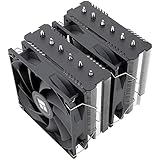
The dual-tower air cooler is the value champion of PC building, and Thermalright is the reason why. The Peerless Assassin 120 SE pairs six heat pipes with two 120mm PWM fans and delivers cooling that competes directly with mainstream 240mm liquid coolers, for a fraction of the outlay. The ARGB version adds lighting and a tidy aluminium heatsink cover without changing the underlying thermal design, while the Vision MAX ARGB — available in black or white — pushes fans to 2150RPM and bolts a 5-inch IPS screen on top for builders who want the AIO aesthetic without the pump.
Not every build needs a dual tower. Single-tower designs like the Assassin X120 Refined SE handle 65W to 125W chips comfortably in compact cases and leave RAM clearance untouched. If acoustics are your priority above all else, the be quiet! Pure Rock Pro 3 Black is the more refined option — six HDT heat pipes and a genuinely quiet 120mm PWM fan, tuned by a company whose entire reputation rests on noise control.
Which Should You Buy?
- For a mid-range gaming build: Pick the Peerless Assassin 120 SE. Nothing in its class offers better performance per dollar, and it will outlast the CPU it’s cooling.
- For an overclocked flagship or heavy production work: Pick a 360mm AIO — sustained high-wattage loads are where liquid genuinely earns its price.
- For a showcase build with a glass side panel: Pick the Peerless Assassin 120 Vision MAX ARGB in black or white if you want the screen without the pump, or a screened AIO if you want an uncluttered socket area.
- For a small or budget system: Pick the Assassin X120 Refined SE — four heat pipes, low profile, minimal clearance headaches.
- For the quietest possible desktop: Pick the be quiet! Pure Rock Pro 3 Black and avoid pump noise entirely.
Frequently Asked Questions
Do AIOs leak?
Modern sealed units rarely leak. The realistic failure mode is pump degradation or coolant permeation over several years, which shows up as rising temperatures rather than a catastrophic spill.
Will a big air cooler block my RAM?
Dual-tower coolers can interfere with tall heat spreaders. The Peerless Assassin 120 SE offers reasonable clearance when the front fan is raised slightly, but low-profile RAM removes the question entirely.
Is a 240mm AIO better than a dual-tower air cooler?
Not meaningfully. Testing consistently places good dual-tower coolers within a couple of degrees of 240mm units, often at lower noise and always at lower cost.
Do these coolers support the latest sockets?
Yes. All the Thermalright models listed ship with mounting hardware for AMD AM4/AM5 and Intel LGA 1700, 115x, 1200 and 1851, so a socket change doesn’t mean a new cooler.
Final Verdict
For the overwhelming majority of gaming builds in 2026, a quality dual-tower air cooler is the smarter purchase: it matches mainstream AIOs thermally, costs dramatically less, and has no pump to fail. Reserve liquid cooling for genuinely high-wattage CPUs, sustained professional workloads, or builds where the aesthetic is worth the premium.