
Key takeaways
- Refresh rate: Aim for at least 144Hz; competitive players benefit from the 200Hz and 240Hz options now common under $200, while single-player fans can spend that headroom on resolution instead.
- Panel type: IPS delivers wider viewing angles and truer color, VA gives deeper contrast for dark scenes, and curved VA panels add immersion for wraparound single-player titles.
- Response time and sync: Look for 1ms MPRT and AMD FreeSync (or FreeSync Premium) to keep motion sharp and tearing-free without pushing the price up.
- Resolution vs. size: 1080p is the sweet spot at 24-27 inches; jumping to a 27-inch QHD panel is worth it only if your GPU can feed the extra pixels.
- Connectivity and mounting: Confirm the monitor has DisplayPort for full refresh rates and a VESA mount (usually 75×75) if you plan to use an arm.
What's inside
A great gaming monitor no longer demands a premium price. In 2026 the sub-$200 category has quietly become one of the most competitive segments in PC gaming, packing high refresh rates, fast response times, and genuinely good color into panels that cost less than a new AAA release. Whether you are building your first battlestation or upgrading an aging 60Hz display, the value on offer this year is remarkable.
We compared curved and flat panels, VA and IPS technology, and refresh rates from 160Hz all the way to 240Hz to find the screens that punch far above their price. Below you will find our hands-on picks, followed by a practical buying framework and answers to the questions shoppers ask most.
As an Amazon Associate we earn from qualifying purchases.



⚡ Save on Your Next PC — Amazon Prime
Prime members get fast free shipping on the systems above, plus early access to Prime Day & Black Friday PC deals. New members get a 30-day free trial.
Watch: Best Gaming Monitors Under 200 2026 — Video Review
How to Choose a Budget Gaming Monitor
- Refresh rate: Aim for at least 144Hz; competitive players benefit from the 200Hz and 240Hz options now common under $200, while single-player fans can spend that headroom on resolution instead.
- Panel type: IPS delivers wider viewing angles and truer color, VA gives deeper contrast for dark scenes, and curved VA panels add immersion for wraparound single-player titles.
- Response time and sync: Look for 1ms MPRT and AMD FreeSync (or FreeSync Premium) to keep motion sharp and tearing-free without pushing the price up.
- Resolution vs. size: 1080p is the sweet spot at 24-27 inches; jumping to a 27-inch QHD panel is worth it only if your GPU can feed the extra pixels.
- Connectivity and mounting: Confirm the monitor has DisplayPort for full refresh rates and a VESA mount (usually 75×75) if you plan to use an arm.
The Best Gaming Monitors Under $200 Reviewed
SANSUI 27-Inch Curved 160Hz
The SANSUI 27-inch curved 160Hz monitor is the immersion pick of the group. Its 1500R curve and 4000:1 contrast make dark, atmospheric games pop, and 110% sRGB coverage keeps colors lively. At this size and price, the combination of FHD sharpness, HDR support, and MPRT 1ms response is hard to beat for cinematic single-player sessions.
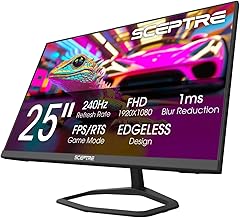
Sceptre 24.5-Inch 240Hz (E255B-FWD240)
If frames win firefights, the new Sceptre 24.5-inch 240Hz is the esports champion of the budget bracket. Dual DisplayPort and dual HDMI inputs, 1ms response, and 100% sRGB give competitive shooter players buttery motion clarity, and the built-in speakers mean you can play out of the box without extra gear.
KTC 27-Inch QHD 200Hz (H27T22C-3)
For players who want resolution and speed, the KTC 27-inch QHD 200Hz uses a Fast IPS panel that overclocks to 220Hz. HDR400, adaptive sync, and a genuine 2K resolution make it the sharpest all-rounder here, comfortably handling fast shooters and detailed RPGs alike while staying near the $200 ceiling.
Gawfolk 24.5-Inch 200Hz
The Gawfolk 24.5-inch 200Hz is the frameless value play. With 99% sRGB, FreeSync, 1ms response, and a bezel-light design ideal for dual-monitor setups, it delivers smooth high-refresh gaming and included speakers for the lowest sticker in our lineup.
Sceptre Prime Curved 30-Inch Ultrawide (C305B)
Want more screen real estate? The Sceptre Prime 30-inch curved ultrawide runs above 200Hz at 2560×1080, giving racing and simulation fans a panoramic view without breaking $200. FreeSync and built-in speakers round out a surprisingly complete immersive package.
Frequently Asked Questions
Is 144Hz or 240Hz better on a budget monitor?
Both are excellent upgrades over 60Hz. Choose 240Hz panels like the Sceptre E255B if you mainly play competitive shooters; pick 144-165Hz if you value resolution or contrast more than raw frame counts.
Is a curved monitor worth it under $200?
Yes, for single-player and immersive games. A 1500R curve like the SANSUI’s fills your peripheral vision and reduces eye travel on larger 27-30 inch screens, though it matters less for competitive play.
Do I need HDR at this price?
Budget HDR is modest but still adds a little punch to highlights. Treat it as a bonus rather than a deciding factor, and prioritize refresh rate, response time, and panel quality first.
Will these monitors work with a console?
Yes. All of these include HDMI, so they pair fine with a PS5 or Xbox, though consoles cap out around 120Hz, so their extra refresh headroom is best enjoyed on PC.
Final Thoughts
The under-$200 monitor market in 2026 offers something for every kind of gamer. Chase frames with the Sceptre 240Hz, chase pixels with the KTC QHD, or chase immersion with the SANSUI curved panel. Match the panel to how you actually play and you will get a display that feels far more expensive than it is.


