Key takeaways
- Choose magnification based on typical distance, not just the highest number printed on the box.
- Favor a larger objective if dim-light viewing is frequent and carrying weight is manageable.
- Check eye relief, focus feel, and edge clarity; optical comfort is personal.
- Budget for a stable tripod and head, especially if you plan to use high magnification.
- Compare the total carry weight of scope, tripod, head, and accessories—not the scope alone.
Best Birding Spotting Scopes for Clear Field Views
The best birding spotting scopes balance enough magnification for the distances you actually watch, a bright objective lens, manageable weight, and a tripod sturdy enough to keep the image steady. For most birders, a 20–60x zoom scope with a 65–85 mm objective is the most versatile starting point: choose 65 mm for easier carrying, or 80–85 mm for dim light and long sessions at high power.
Choose by viewing distance and conditions
Magnification is useful only while the image remains bright, sharp, and stable. At a nearby pond, 20–30x is often easier to use than 60x. Across a broad marsh or canyon, more power can help identify distant details—but heat shimmer, haze, and vibration may limit the view before the scope reaches its maximum magnification.
Our top picks
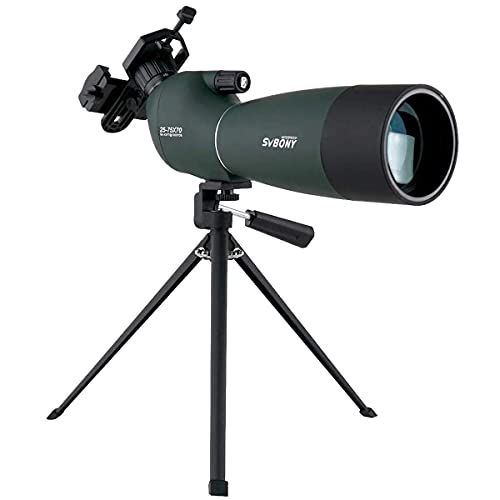


As an Amazon Associate we earn from qualifying purchases at no extra cost to you. Ratings are shown as listed on Amazon.
| Birding situation | Useful magnification | Objective size | Practical setup |
|---|---|---|---|
| Woodland edges and nearby feeders | 15–30x | 50–65 mm | Compact scope; lightweight tripod or monopod where appropriate |
| Ponds, shorebirds, and general use | 20–45x | 65–80 mm | Stable travel tripod with a smooth pan-and-tilt head |
| Open wetlands and distant waterfowl | 30–60x, conditions permitting | 80–95 mm | Sturdier tripod; use lower power when shimmer or wind softens detail |
| Backpacking or long hikes | 15–45x | 50–65 mm | Compact scope and a tripod whose weight fits the whole carrying plan |
What matters beyond the magnification label
Magnification and usable detail
A common 20–60x zoom gives flexibility, but its top setting is not automatically its best setting. Start at about 20–30x to find a bird, then increase power until fine details become useful. If feather edges look wavy, the image darkens noticeably, or the bird becomes difficult to track, dial back. Atmospheric distortion, poor focus, and a shaky support can all erase the benefit of extra magnification.
Fixed-power eyepieces can offer a simpler view and may suit birders who know the distance and magnification they prefer. A zoom is more adaptable when the subject’s distance changes, though the view may be less bright at its highest setting.
Objective lens size and low-light performance
The objective lens gathers light. Larger lenses can make high magnification and early-morning viewing more comfortable, but they add bulk and may require a larger tripod. A 65 mm scope is a strong compromise for mixed hiking and car-based birding. An 80–85 mm model is often more comfortable for long watches at dawn, dusk, or high power.
Lens size alone does not guarantee a clear image. Glass quality, coatings, alignment, and stray-light control also affect contrast and color. When comparing scopes in person, check a high-contrast subject, inspect fine detail near the edge as well as the center, and look for color fringing around bright objects against a dark background.
Optical clarity and viewing comfort
ED (extra-low dispersion) glass can reduce color fringing, especially on high-contrast edges. Fully multi-coated optics help transmit light and control reflections. These features are useful, but they do not replace good overall optical design or careful focus.
An angled eyepiece is usually comfortable for extended viewing and makes it easier for people of different heights to share a scope. A straight eyepiece can be faster to point at a bird when scanning from a standing position or looking down from a vehicle. If possible, try the eyepiece before choosing: eye relief and how easily your eye finds the full field matter, particularly for glasses wearers.
Match the scope to its support
A scope at high power magnifies tripod movement along with the bird. A lightweight tripod may be adequate at low magnification in calm conditions, but wind, a long observation, or 50–60x viewing calls for a firmer setup. Check the tripod’s load capacity against the scope’s weight, and prioritize a head that pans smoothly without suddenly dropping when you let go.
As a rough field check, aim at a distant sign or branch, focus at your intended power, and watch for image bounce after touching the focus wheel. If the image keeps oscillating, the support is too flexible for comfortable high-power viewing. A heavier tripod can improve stability, but it also changes whether a large scope remains practical to carry.
Worked example: is 60x worth it?
Exit pupil gives a quick way to compare how much light reaches your eye at a particular magnification:
Exit pupil = objective diameter ÷ magnification
For an 80 mm scope at 60x, the exit pupil is 80 ÷ 60 = about 1.3 mm. At 40x, it is 80 ÷ 40 = 2 mm. For a 65 mm scope at 60x, it falls to about 1.1 mm. These figures do not predict image quality by themselves, but they show why a smaller objective can look dim at maximum power, especially in low light. If you often watch at dawn, a larger objective—or using lower magnification—can make the view more comfortable.
Shortlist by the kind of birder you are
| Your priority | Look for | Trade-off to accept |
|---|---|---|
| One scope for varied habitats | 65–80 mm objective, 20–60x zoom, ED glass, angled body | Zoom convenience may come with a less bright view at maximum power |
| Early and late light | 80–95 mm objective, strong coatings, stable full-size tripod | More weight and a larger carrying footprint |
| Long hikes | 50–65 mm objective, compact body, moderate zoom range | Less comfortable high-power viewing in dim conditions |
| Highest clarity per dollar | A reputable midrange scope with ED glass and a good tripod | May lack the light-gathering capacity or refinement of premium models |
Established options include the Vortex Diamondback HD 20–60×85, the Nikon MONARCH Fieldscope 82ED-A, and the Swarovski ATX 85. They represent different size, optical, and budget tiers; verify the current configuration and availability before buying, since product lines and included eyepieces can vary by market. For many shoppers, quality 65–85 mm scopes across the broader market commonly range from several hundred dollars to well over $2,000, with premium systems costing more.
Final buying checklist
- Choose magnification based on typical distance, not just the highest number printed on the box.
- Favor a larger objective if dim-light viewing is frequent and carrying weight is manageable.
- Check eye relief, focus feel, and edge clarity; optical comfort is personal.
- Budget for a stable tripod and head, especially if you plan to use high magnification.
- Compare the total carry weight of scope, tripod, head, and accessories—not the scope alone.
For a first all-purpose setup, a 65–80 mm ED scope with a 20–60x zoom and a stable travel tripod is a sensible target. Move toward a larger objective for low-light, long-distance watches; choose a compact scope when every ounce matters.