Key takeaways
- Non-skid rubber tips: essential on smooth flooring and useful when the user pushes against the arms.
- Cross-brace or reinforced frame: generally improves rigidity, particularly on wider models.
- Removable padded seat: more comfortable, but it must be firmly secured and easy to disinfect.
- Drop arms with visible locks: valuable for side transfers only when the mechanism cannot release accidentally.
- Splash guard: helpful for reducing spills, especially when the commode is used over a toilet.
- Replacement bucket availability: important because buckets and seats are consumable components.
The best bedside commodes are the ones that match the user’s weight, body size, transfer ability, and available floor space—not simply the model with the highest weight rating.
For most bedrooms, a height-adjustable 3-in-1 commode with a 300 lb (136 kg) or higher capacity is the best starting point. Choose a bariatric frame when the user needs more than 18 inches of usable seat width, requires a capacity above 300 lb, or benefits from wider armrests and a more stable base. If the commode must fit beside a narrow bed, prioritize the closed-frame width and clearance around the bucket over extra features.
Our top picks

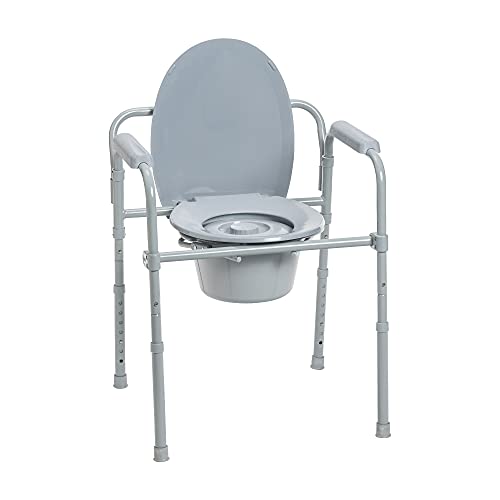

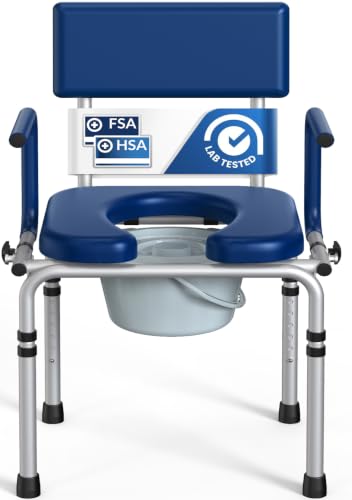
As an Amazon Associate we earn from qualifying purchases at no extra cost to you. Ratings are shown as listed on Amazon.
Best bedside commodes compared
| Type | Typical capacity | Usable seat width | Height range | Cleaning effort | Best suited to |
|---|---|---|---|---|---|
| Compact fixed-height commode | 250–300 lb | 16–17 inches | 16–19 inches | Low to moderate | Small rooms and short-term use |
| Adjustable 3-in-1 commode | 300–350 lb | 16–18 inches | 17–23 inches | Moderate | Most bedrooms and transfers from bed |
| Drop-arm commode | 300–350 lb | 16–19 inches | 17–23 inches | Moderate | Side transfers or wheelchair access |
| Bariatric commode | 400–1,000 lb | 20–30 inches | 17–23 inches | Moderate to high | Higher-weight users and maximum stability |
| Rolling shower-commode chair | 250–600 lb | 17–24 inches | 18–22 inches | High | Caregiver-assisted transfers and bathroom use |
These are representative specification ranges rather than a substitute for the exact manufacturer label. Weight ratings, seat dimensions, and accessories vary between models, so confirm the current product documentation before purchase.
What to compare before buying
1. Weight capacity: leave a safety margin
Do not select a commode whose rating merely equals the user’s body weight. A person may lean heavily on the arms during a transfer, creating a sudden load greater than their standing weight. A practical target is a rating at least 50–100 lb above the user’s weight, especially when balance is limited.
For example, if the user weighs 245 lb, a 300 lb commode technically exceeds the requirement, but a 350 lb model provides a more useful margin. If the user is close to 300 lb, choose a bariatric model rather than treating a 300 lb rating as an exact limit.
The rating also applies to the frame, seat, armrests, and locking hardware as an assembled system. Never assume that a replacement seat or elevated toilet frame has the same capacity as the commode base.
2. Seat dimensions: width is not the same as comfort
Measure the actual flat sitting area, not the outside width of the frame. A standard seat around 16–18 inches wide suits many adults, while a user with wider hips or difficulty repositioning may need a 20-inch or wider bariatric seat. The opening itself should also be checked: an overly large opening can be uncomfortable, while a small one may make positioning difficult.
Seat depth matters when the user has short legs or reduced trunk control. A deep seat can force the knees forward and make standing harder. For a smaller adult, a 16–17 inch depth may be easier to manage than a large bariatric seat. Armrests should be high enough to support a push-up without forcing the shoulders upward.
3. Adjustability: set the correct sitting height
A height-adjustable commode is usually more useful than a fixed-height model because the correct setting improves both comfort and transfer safety. When seated, the user’s feet should rest flat on the floor, with the knees roughly level with or slightly below the hips. If the seat is too high, the feet may dangle and the user loses leverage when standing. If it is too low, the user must exert more force to rise.
Most adjustable frames use push-button legs or telescoping holes. Check that every leg is set to the same hole and that the buttons fully protrude. Uneven leg settings can make the chair rock, even on a level floor.
4. Cleaning effort: bucket design matters
A basic open bucket is inexpensive and easy to replace, but it requires more direct cleaning. A bucket with a lid and splash guard reduces spills during removal. Look for a smooth, nonporous plastic interior, a secure handle, and a bucket that can be lifted without reaching between the user’s legs.
Disposable liners can reduce daily washing, but they add ongoing cost and should be used only when approved for the commode. A liner must sit below the seat and remain clear of moving parts. Pouring disinfectant into the bucket does not replace cleaning: empty it promptly, wash with detergent, then use a compatible disinfectant according to its label.
Drop-arm models can simplify personal care and cleaning because the arm moves out of the way, but the hinges and release mechanisms add places where residue can collect. Inspect the latch after cleaning and before every use.
5. Bedroom footprint: measure the entire setup
A commode that fits on paper may still be impractical once the user, caregiver, and door swing are included. Measure the available width from the bed to the nearest wall or furniture, then add clearance for the user’s knees and the caregiver’s hands.
As a planning example, suppose the available gap beside a bed is 28 inches. A 22-inch-wide commode leaves only 6 inches total, or approximately 3 inches per side if centered. That may be enough for storage but is usually too tight for a safe assisted transfer. A 19-inch compact frame leaves 9 inches total, but it still may not provide enough room for a wheelchair or caregiver.
Do not confuse folded width with operating width. Folding commodes save storage space, but they still require their full footprint when occupied. Also check whether the bucket can be removed without moving the frame away from the bed.
Decision matrix: which style fits your situation?
| User situation | Recommended specification | Why | Trade-off |
|---|---|---|---|
| Less than 24 inches beside the bed | Compact frame, 16–17 inch seat, removable bucket | Maximizes maneuvering room | Less seating room and usually a lower capacity |
| User needs help rising | Adjustable height, fixed armrests, non-skid feet | Provides stable push points and correct leg leverage | May be harder to use for a side transfer |
| Wheelchair-to-commode transfer | Drop-arm design with positive locking hardware | Removes one side barrier during transfer | More moving parts to inspect and clean |
| User weighs 280 lb | At least 350 lb capacity; consider 20-inch seat | Leaves a useful capacity margin | Wider frame needs more room |
| Caregiver provides frequent hygiene assistance | Drop-arm or rolling shower-commode chair | Improves access and reduces lifting | Higher price and more involved maintenance |
| Occasional overnight use | Simple 3-in-1 model with covered bucket | Balances cost, stability, and storage | Not as supportive as a specialized transfer chair |
Features worth paying for
- Non-skid rubber tips: essential on smooth flooring and useful when the user pushes against the arms.
- Cross-brace or reinforced frame: generally improves rigidity, particularly on wider models.
- Removable padded seat: more comfortable, but it must be firmly secured and easy to disinfect.
- Drop arms with visible locks: valuable for side transfers only when the mechanism cannot release accidentally.
- Splash guard: helpful for reducing spills, especially when the commode is used over a toilet.
- Replacement bucket availability: important because buckets and seats are consumable components.
Wheels should be treated cautiously. A rolling commode is not automatically safer than a stationary one. It needs lockable casters, a stable brake system, and a caregiver who can control the chair. Never transfer onto a rolling chair unless the casters are locked and the model’s instructions allow that procedure.
Installation and safety checks
- Assemble the frame on a level surface and tighten every fastener without over-tightening plastic parts.
- Set all legs to the same height, then press down on each corner to confirm that the frame does not rock.
- Place the commode on a dry, flat floor; avoid loose rugs that can slide under the feet.
- Check that the bucket, seat, lid, and armrests are fully seated before use.
- Have the user sit slowly while holding the designated arm supports, not the bucket or lid.
- Recheck screws, leg buttons, arm locks, and rubber tips regularly, particularly after moving the frame.
For a person with falls, severe weakness, confusion, or unpredictable movement, a bedside commode should be selected with advice from a nurse, occupational therapist, or other qualified clinician. A properly rated product still cannot compensate for an unsafe transfer technique or an unsuitable room layout.
Bottom line
The best bedside commodes for most people are adjustable 3-in-1 models with a 300–350 lb capacity, a 16–18 inch usable seat, stable armrests, and a removable covered bucket. Choose a compact frame when every inch matters, a drop-arm model for side transfers, and a bariatric frame when width, stability, or capacity is the main concern. Measure the bedroom first, select a capacity with a margin, and treat cleaning access and transfer clearance as equally important as the headline weight rating.