Key takeaways
- Depth: the listed lengths range from 140mm (SX1200P) to 200mm (HX1200i). Measure the space between the case rear and the drive cage or fans.
- Cables: modular cables are specific to each manufacturer and often each series. Never mix cables between brands, even when the connectors look identical.
- Connector count: count the 8-pin PCIe leads your graphics card needs if it does not use 12V-2×6.
- Fan mode: semi-passive and zero RPM modes keep fans off at light loads, so desktop use stays near silent.
- Efficiency: 80 PLUS and Cybenetics are separate certification programmes, so Gold and Platinum labels from different programmes are not strictly like for like.
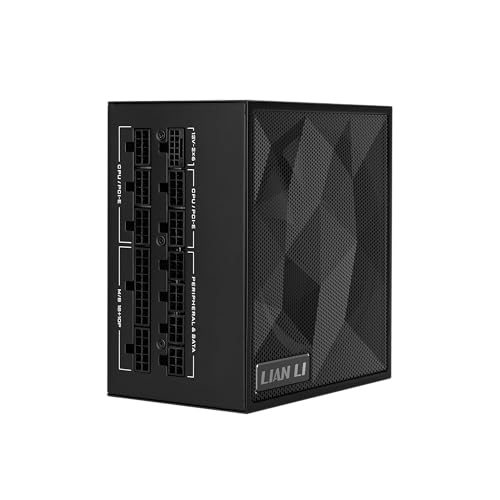
A 1200W power supply suits a gaming PC built around a high-end graphics card, a power-hungry CPU, or both, and the strongest 2026 choices are the ATX 3.1 units with a native 12V-2×6 cable: the Lian Li SX1200P for compact premium builds, the Corsair HX1200i for quiet operation in a roomy case, the Seasonic Vertex GX-1200 for a long-term, conservative build, and the NZXT C1200 for a mid-range option. Everything below is based on maker-listed specifications and published reviewer findings, so read it as a shortlist rather than a ranking.
Our top picks



As an Amazon Associate we earn from qualifying purchases at no extra cost to you.
Who Actually Needs 1200W
Most single-GPU gaming PCs run comfortably on much less. A 1200W unit makes sense when the graphics card alone is rated around 450W to 575W, when the CPU is overclocked, or when the build includes several drives, many fans and a custom loop. It also gives headroom for short power spikes, which is one reason the ATX 3.1 revision exists. If your parts list adds up to well under 800W, a lower-wattage unit from the same families is usually the sensible choice, since power supplies tend to be most efficient in the middle of their load range.
At a Glance
| Model | Best for | Key stated specs | Limits |
|---|---|---|---|
| Lian Li SX1200P | Compact premium builds | ATX 3.1, fully modular, Cybenetics Platinum, native 600W graphics connector, 120mm fluid dynamic bearing fan with selectable semi-passive mode, 10-year warranty, 150 x 85 x 140mm | The reviewer at Hardware Busters says noise results and minor rails deserve a closer look; only 120mm fan |
| Corsair HX1200i | Quiet operation, monitoring software | 80 PLUS Platinum, ATX 3.1, fully modular, 140mm fluid dynamic bearing fan with zero RPM mode, 1x 12V-2×6 cable, 4x PCIe 8-pin, iCUE support, 10-year warranty | Long body at 200mm; may not fit compact cases |
| Seasonic Vertex GX-1200 | Long-term reliability focus | 80 PLUS Gold, Cybenetics Gold, Cybenetics noise rating A-, 135mm fluid dynamic bearing fan, 160 x 150 x 86mm, fully modular | Gold rather than Platinum; older listings carry different warranty terms than the current maker page |
| NZXT C1200 | Mid-range ATX 3.1 pick | Fully modular, Cybenetics Gold, noise rating A- (25-30 dB[A]), 135mm fluid dynamic bearing fan, 3x PCIe 6+2 plus one 12+4 pin, 10-year warranty | Fewer PCIe 8-pin leads than the HX1200i |
| Enermax PlatiGemini 1200W | Voltage regulation and performance | 80 PLUS Platinum, ATX 3.1 compatible, fully modular, 150 x 150 x 86mm | Reviewers describe it as a higher-cost unit |
| XPG Core Reactor II 1200W | Budget tier | 80 PLUS Gold, fully modular, listed as ATX 3.0, 160 x 150 x 86mm | No hybrid fan mode and hard-sleeved cables per Tech4Gamers; older standard |
What ATX 3.1 and 12V-2×6 Mean for You
The ATX 3.1 standard updated the earlier 3.0 design and moved graphics cards to the 12V-2×6 connector, which is the successor to the 12VHPWR plug. A power supply with a native cable avoids adapters, which is why reviewers highlight units such as the SX1200P and HX1200i. If your power supply is an ATX 3.0 model, such as the XPG listing above, it may ship with an older cable design, so read the box and the maker page for what is included. Whatever the cable, push it in fully, avoid sharp bends right at the plug, and follow the graphics card maker’s manual.
The Picks in Detail
Lian Li SX1200P: the compact premium choice
Hardware Busters scored this model 8.8 out of 10, citing 1200W output, Cybenetics Platinum efficiency, a native 600W graphics connector, solid 12V rail behaviour and an efficient standby circuit. Its 140mm depth is short for a 1200W unit, which helps in smaller cases or builds with a rear-mounted radiator. The same review points out that noise measurements and the minor rails need a closer look, so very noise-sensitive buyers should read the full results. Lian Li lists five PCIe 6+2 connectors and two EPS leads, which covers dual-CPU-power motherboards.
Corsair HX1200i: quiet running with software control
Corsair lists the HX1200i as 80 PLUS Platinum, ATX 3.1 and PCIe 5.1 compliant, with Japanese 105C capacitors, a 140mm fluid dynamic bearing fan and a zero RPM mode that keeps the fan off at low and medium loads. The 12V rail is rated for 100A. It includes one 12V-2×6 cable, four PCIe 8-pin leads, two EPS connectors and an option to switch between single and multi-rail overcurrent protection. The cost of all that is size: at 200mm long it needs a case with room behind the motherboard tray. Tech4Gamers names it the quiet pick among 1200W units.
Seasonic Vertex GX-1200: the conservative long-term pick
Seasonic lists Cybenetics Gold efficiency and a Cybenetics A- noise rating for the 1200W model, a 100A 12V rail and a 135mm fluid dynamic bearing fan with digital fan control. Tech4Gamers names it best overall for its component quality and quiet operation, though it notes that the Gold rating comes at a premium. The maker’s current page lists a longer warranty than older listings did, and the older ATX 3.0 version used a 12VHPWR cable, so check which revision is in the box. The independent review found in this research covers the earlier ATX 3.0 version, not the current ATX 3.1 revision.
NZXT C1200: a balanced mid-range option
Hardware Busters scored the C1200 8.5 out of 10. It is fully modular with Cybenetics Gold efficiency at 115V, a 135mm fluid dynamic bearing fan, semi-passive operation, no in-cable capacitors and a 10-year warranty. Its noise rating is A- at 25 to 30 dB(A). It carries a 12+4 pin 600W cable and three PCIe 6+2 leads, enough for one high-end card but fewer than the Corsair offers for multi-cable builds. Some user comments quoted in that review mention stability complaints with particular configurations, which is anecdotal but worth reading before you buy.
Fit and Compatibility Notes
- Depth: the listed lengths range from 140mm (SX1200P) to 200mm (HX1200i). Measure the space between the case rear and the drive cage or fans.
- Cables: modular cables are specific to each manufacturer and often each series. Never mix cables between brands, even when the connectors look identical.
- Connector count: count the 8-pin PCIe leads your graphics card needs if it does not use 12V-2×6.
- Fan mode: semi-passive and zero RPM modes keep fans off at light loads, so desktop use stays near silent.
- Efficiency: 80 PLUS and Cybenetics are separate certification programmes, so Gold and Platinum labels from different programmes are not strictly like for like.
Budget Tiers by Hardware Class
Budget: Gold-rated units such as the XPG Core Reactor II fit a build where the graphics card needs 8-pin leads and the buyer wants headroom for later upgrades. Mid-range: the NZXT C1200 and the Seasonic Vertex GX-1200 add ATX 3.1 support, better noise ratings and long warranties. Premium: the Lian Li SX1200P, Corsair HX1200i and Enermax PlatiGemini bring Platinum efficiency, native high-power graphics cables and, in Corsair’s case, software monitoring.
Pick X If
| Your situation | Pick |
|---|---|
| Small or mid-size case, high-end GPU | Lian Li SX1200P |
| Large case, noise matters most | Corsair HX1200i |
| Want a long-standing, conservative design | Seasonic Vertex GX-1200 |
| Want ATX 3.1 without going premium | NZXT C1200 |
| Care most about regulation and efficiency | Enermax PlatiGemini 1200W |
| Cost is the limit and the GPU uses 8-pin leads | XPG Core Reactor II 1200W |
Alternatives Worth Considering
- Lian Li RS1200G and SilverStone Extreme 1200R Platinum SFX-L: Tom’s Hardware lists both in its 2026 power supply guide, the first as a fully modular ATX 3.1 unit and the second as a compact SFX-L option for small cases.
- A 1000W unit: if the CPU and GPU together stay well below the limit, a 1000W model in the same family saves space and often cost.
- Thermaltake Toughpower GF A3 1200W: one retail-style roundup names it as a value choice, but the research found less independent test data for it than for the models above.
Frequently Asked Questions
Is 1200W overkill for a gaming PC?
For many builds it is. A mainstream GPU and mid-range CPU rarely approach that load. It makes sense for cards in the 450W to 575W class, overclocked processors or heavily expanded systems.
Does a bigger power supply waste electricity?
Not much. A larger unit may sit in a less efficient part of its curve at idle, but modern units with semi-passive fans keep standby losses small. The difference rarely matters compared with buying the wrong size case.
Do I need a power supply with a native 12V-2×6 cable?
It is the cleaner solution if your graphics card uses that connector, because it avoids adapters. Cards that use 8-pin connectors do not need it, and many ATX 3.0 units work fine with them.
Platinum or Gold, does it matter?
The efficiency gap is a few percentage points at typical loads. Noise, warranty, size and cable layout usually matter more than the badge for a gaming desktop.
How long should a power supply last?
Makers list warranties of 10 years or longer on the units above, which signals the intended service life. Replace a unit that shows coil whine, random shutdowns or swollen capacitors, and consult an electrician for any wiring concerns at the wall.
Can I reuse my old modular cables?
No. Modular cable pinouts differ between brands and sometimes between models from the same brand. Use only the cables supplied with the unit, and check the maker’s manual before connecting anything.
FAQ
Is 1200W overkill for a gaming PC?
Does a bigger power supply waste electricity?
Do I need a power supply with a native 12V-2×6 cable?
Platinum or Gold, does it matter?
How long should a power supply last?
Can I reuse my old modular cables?
More from Amazon
Programs that pair well with the guide above. Offers and eligibility are set by Amazon and may change.
Free shipping on eligible items, Prime Video and more. Eligible new members can start with a free trial.
Start a Prime free trialAd-free music streaming. Eligible new subscribers can start with a free trial.
Try Music Unlimited freeA Prime membership for ages 18-24 with a trial period. Eligibility is set by Amazon.
See Prime for Young AdultsAudiobooks and podcasts to listen to on the go. Eligible new members can start with a free trial.
Try Audible freeAs an Amazon Associate we earn from qualifying purchases.