Key takeaways
- Coverage: Usually about 50–90 feet in diameter at suitable pressure.
- Adjustment: Prefer models with positive trip collars rather than loose friction tabs.
- Connection: A 1/2-inch inlet suits standard garden-hose adapters and many residential risers.
- Durability: Brass lasts longer around sunlight, impacts, and repeated seasonal use than thin plastic.
The best impact sprinklers for most home lawns are adjustable brass-or-plastic models with a 1/2-inch connection, a 20–360° spray pattern, and a published operating range of roughly 25–60 psi; choose a larger full-metal sprinkler when you need long-distance coverage or frequent use.
Our top picks



As an Amazon Associate we earn from qualifying purchases at no extra cost to you. Ratings are shown as listed on Amazon.
Best Impact Sprinklers Compared
Impact sprinklers remain a strong choice when you want a broad circular pattern, visible adjustment controls, and better resistance to dirty water than many gear-drive sprinklers. The right model depends less on brand than on five practical specifications: coverage diameter, spray adjustment, flow rate, connection size, and construction.
| Sprinkler type | Typical coverage diameter | Spray adjustment | Typical flow rate | Connection | Best use |
|---|---|---|---|---|---|
| Compact plastic impact | 35–70 ft | 20–360° | 1.5–4 gpm | 1/2-inch female or hose thread | Small lawns and garden beds |
| Brass impact on spike | 50–90 ft | 20–360° | 2–7 gpm | 1/2-inch inlet | Medium lawns and home irrigation zones |
| Heavy-duty brass or stainless impact | 70–130 ft | 20–360° or full circle | 4–12 gpm | 3/4-inch or 1-inch inlet | Large properties and agricultural-style watering |
| Tripod-mounted impact | 50–100 ft | 20–360° | 2–8 gpm | 3/4-inch hose connection | Portable coverage and uneven terrain |
These are useful selection ranges rather than guarantees. Actual diameter and flow depend on nozzle size, water pressure, hose length, elevation, and whether other fixtures are running at the same time.
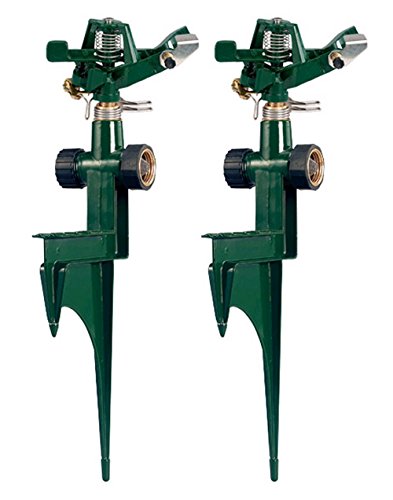
Best Overall for Typical Lawns: Adjustable Brass Impact on a Spike
A brass impact sprinkler mounted on a ground spike is the most versatile choice for a typical suburban lawn. It normally offers a 1/2-inch inlet, adjustable partial-circle and full-circle operation, and enough range to cover a large section without requiring a permanent irrigation installation.
Examples include the Orbit brass impact sprinkler range and similar models from Nelson. Look for a deflector shield or diffuser pin if you need to shorten the throw near flower beds. A flow-control feature is also valuable because it lets you reduce overspray without shutting off the zone.
- Coverage: Usually about 50–90 feet in diameter at suitable pressure.
- Adjustment: Prefer models with positive trip collars rather than loose friction tabs.
- Connection: A 1/2-inch inlet suits standard garden-hose adapters and many residential risers.
- Durability: Brass lasts longer around sunlight, impacts, and repeated seasonal use than thin plastic.
Best for Smaller Lawns and Garden Beds: Compact Adjustable Impact
A compact plastic impact sprinkler is often the better buy when the watering area is less than about 2,500 square feet. It costs less, weighs less, and is easier to reposition. Rain Bird’s 25PJ-series plastic impact sprinklers are an example of this category, with adjustable arc control and a 1/2-inch connection on applicable versions.
Plastic is not automatically poor quality. A well-designed plastic body can work for years when it is protected from freezing and is not repeatedly dragged across concrete. However, compact models usually have a shorter maximum throw and smaller internal passages, so they are less tolerant of low pressure or debris.
Choose this type when you need a 90° or 180° pattern along a fence, a narrow strip beside a driveway, or occasional garden watering. Avoid buying a full-circle model for a corner: half the water may land outside the property.
Best for Large Properties: Heavy-Duty Metal Impact
For acreage, large lawns, orchards, or dusty water sources, choose a heavy-duty brass or stainless impact sprinkler with a 3/4-inch or 1-inch connection. These models accept larger nozzles and can deliver substantially more water, but they also require a pump or supply line capable of maintaining pressure under load.
The important distinction is not simply “metal versus plastic.” Check the nozzle options, rated flow range, pressure range, and bearing design. A large sprinkler that needs 50 psi and 8 gallons per minute will perform poorly if connected to a long 1/2-inch hose from a low-flow outdoor spigot.
How to Match the Sprinkler to Your Water Supply
Use this quick calculation before buying. Measure the flow from the intended tap by filling a bucket:
Available gallons per minute = bucket size in gallons × 60 ÷ filling time in seconds.
For example, a 5-gallon bucket that fills in 45 seconds provides approximately 6.7 gallons per minute:
5 × 60 ÷ 45 = 6.7 gpm.
Do not select a sprinkler rated at 7 gpm for that supply. Allow roughly 20 percent for pressure loss through the faucet, hose, connector, and elevation. In this example, a practical target is about 5.3 gpm. A sprinkler using 4–5 gpm is a safer match than one requiring its maximum advertised flow.
| Your measured flow | Recommended sprinkler demand | Suitable target area |
|---|---|---|
| 2–3 gpm | 1.5–2.5 gpm | Small beds or narrow lawn sections |
| 4–6 gpm | 3–5 gpm | Most residential lawn zones |
| 7–10 gpm | 5.5–8 gpm | Large lawns or two smaller sprinklers |
| 11+ gpm | 8–12 gpm | Heavy-duty sprinkler or multiple zones |
Spray Adjustment: What Matters in Practice
Impact sprinklers commonly use two trip collars to set a partial-circle pattern. Move one collar to the starting point and the other to the stopping point. Flip the small adjustment pin or lever to change between partial-circle and full-circle operation.
For a rectangular lawn, do not aim for maximum diameter. Set the sprinkler near a corner and use a 90° arc. Place it near an edge for a 180° arc. This reduces water waste and makes pressure more consistent. For a long narrow strip, a 180° setting with a diffuser pin may be more efficient than a wide full-circle spray.
Connection Size and Installation Advice
- 1/2-inch inlet: Best for ordinary garden hoses, short risers, and modest flow rates.
- 3/4-inch inlet: Better for high-flow hoses and larger nozzles, though the faucet and hose must also support that flow.
- 1-inch inlet: Intended for permanent pipework, pumps, or high-capacity irrigation systems rather than a basic household tap.
Use a short, large-diameter supply hose when possible. A 100-foot, 1/2-inch hose can lose much more pressure than a 50-foot, 5/8-inch or 3/4-inch hose at the same flow. If the sprinkler pulses, rotates slowly, or produces a noticeably smaller circle than expected, the restriction may be upstream rather than a defect in the sprinkler.
Durability Features Worth Paying For
Prioritize a stainless-steel or brass spring, a metal bearing area, a sturdy spike, and a replaceable nozzle. A screened inlet is useful when water comes from a rain barrel, pond, or older outdoor plumbing. Avoid leaving any impact sprinkler outdoors during freezing weather: trapped water can crack the body even when the exterior appears undamaged.
Plastic is suitable for seasonal residential use, while brass or stainless construction makes more sense for daily operation, commercial grounds, or locations where the sprinkler may be struck by equipment. A tripod is convenient on hard or uneven ground but is less stable than a spike in soft soil.
Decision Guide
- Small lawn under 2,500 square feet: Choose a compact adjustable plastic impact sprinkler using 1.5–3 gpm.
- Average lawn with a standard outdoor faucet: Choose a brass impact on a spike with a 1/2-inch inlet and a 20–360° adjustment.
- Garden beds beside walls or paths: Choose an adjustable partial-circle model with a diffuser or distance-control pin.
- Large lawn or acreage: Choose a heavy-duty metal model with a 3/4-inch or 1-inch connection, but confirm available gpm first.
- Portable watering across several areas: Choose a tripod-mounted model with a stable base and standard hose connection.
- Dirty or untreated water: Choose a sprinkler with a removable inlet screen and accessible nozzle.
Final Recommendation
For the widest range of lawn and garden jobs, the best impact sprinkler is an adjustable brass model on a spike, provided your supply can deliver its required flow. Choose a compact plastic Rain Bird-style unit for small areas and lower flow, or step up to a heavy-duty 3/4-inch or 1-inch metal sprinkler for large properties. Measure flow before buying, select the smallest nozzle that reaches the target area, and set the arc to match the lawn rather than watering a full circle by default.