Key takeaways
- Select the correct chemistry and cell count; for a standard LiPo, choose the charger’s LiPo program, not LiHV or another chemistry.
- Set the current no higher than the battery maker’s limit; when unclear, use 1C or less.
- Connect both the main lead and balance plug for balance charging, following the charger manual’s connection order.
- Place the pack on a noncombustible surface in a suitable LiPo-safe charging area, and stay nearby while it charges.
- Stop if the pack swells, heats abnormally, smells unusual, or the charger reports a cell or connection error. Do not bypass warnings to force a charge.
Best LiPo Battery Chargers for RC Cars
The best LiPo battery charger for most RC car owners is a programmable balance charger rated for at least 100 W, with a balance port for your pack’s cell count, adjustable charge current, and a storage-charge mode. For larger 4S–6S packs or faster charging, choose a higher-wattage model—while checking its per-channel power limit, not just the headline wattage.
There isn’t one best charger for every setup. A charger must match the pack’s cell count and connector, and its output power determines how quickly it can charge at a safe current. The picks below are established charger models; confirm the exact version’s input voltage, channel limits, and included leads before buying, since specifications and bundles can differ by region.
Our top picks

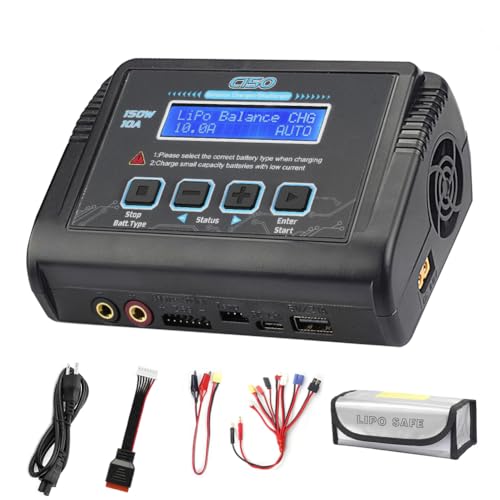


As an Amazon Associate we earn from qualifying purchases at no extra cost to you. Ratings are shown as listed on Amazon.
Charger picks by RC setup
| Charger | Best fit | Power class | What to check |
|---|---|---|---|
| SkyRC B6AC V2 | Beginners and modest packs | Up to 50 W charging output | Its limited output power makes it slower on high-capacity or high-cell-count packs. |
| Hitec X2 AC Plus Black Edition | Two-pack charging from household AC | Dual-channel charger; verify power available per channel | Two channels are useful only if each channel’s power suits your packs. |
| SkyRC T100 | Owners who want two independent outputs | Dual-channel AC/DC class | Check the channel power rating and supported cell counts for the exact version. |
| ISDT K2 Air | Higher-power charging with an external DC supply | Dual-channel DC charger | Budget for a suitable power supply and compatible charge leads. |
These models are starting points, not a substitute for checking the manual. A charger advertised with a high combined wattage may divide that power between channels, and AC-powered models often have different limits from their DC input ratings.
Choose by pack, not by the charger’s headline number
1. Match the cell count
Look at the battery label: common RC car LiPo packs are 2S, 3S, and 4S, while some vehicles use 6S. The charger must explicitly support the pack’s cell count and balance charging. A 2S pack has two cells in series; a 3S pack has three. Never select a cell count by guessing from the connector or vehicle speed.
2. Choose an appropriate charge current
Unless the battery maker specifies otherwise, 1C is a conservative starting point. “C” is the pack capacity expressed in amp-hours: for a 5,000 mAh (5 Ah) battery, 1C equals 5 A. Use the lower limit if the label or manual specifies a lower maximum. Higher current can reduce charging time, but it also increases the power the charger and power supply must deliver.
3. Check power and estimate charging time
A charger’s wattage sets a practical ceiling on current, especially as cell count rises. The estimate is:
Current available in amps ≈ charger output in watts ÷ pack voltage in volts.
For a 4S pack near its nominal 14.8 V, a 100 W channel can supply about 6.8 A in ideal conditions. That is enough for a 5 Ah pack at 1C, but not necessarily at 2C. The real limit may be lower because of charger efficiency, input supply limits, or channel-sharing rules.
At 1C, a 5 Ah pack needs roughly 5 A during the constant-current portion of charging. A simple estimate is about one hour, but balance charging typically takes longer because the charger tapers current near full and may pause to bring cells into balance. Do not treat a fast-charge estimate as a guaranteed completion time.
4. Confirm balance accuracy and connector support
Balance charging monitors individual cell voltages through the small balance plug, helping prevent one cell from drifting too high while the pack charges. A charger that displays individual cell voltages makes it easier to spot a persistent imbalance; follow the manufacturer’s stated accuracy rather than assuming every display digit is meaningful.
Also identify both connections: the main discharge connector (often XT60, XT90, EC3, or EC5) and the balance plug (commonly JST-XH on many RC packs). The charger may have a different main output connector, so you may need a correctly rated charge lead. Use a proper balance board only as directed by its maker; avoid improvised adapters or connecting packs in series or parallel without a charger and setup designed for that configuration.
5. Decide whether dual channels matter
Two channels can charge two packs independently, which is convenient between driving sessions. They do not automatically double charging speed: each channel has its own limit, and some chargers also have a total power ceiling shared across both. For one pack at a time, a stronger single channel may be better value than two weak ones.
Match the charger to your situation
| Your setup | Prioritize | Likely direction |
|---|---|---|
| One 2S or 3S pack, charged at home | Simple balance charging, clear cell display, built-in AC input | Entry-level AC balance charger such as the SkyRC B6AC V2, if its output power meets your capacity and charging-time needs. |
| Two packs between runs | Independent channels and adequate power per channel | A dual-channel AC charger such as the Hitec X2 AC Plus Black Edition or SkyRC T100, after checking channel limits. |
| Large 4S–6S packs or frequent fast turnaround | Higher per-channel wattage, suitable DC supply, robust leads | A DC model such as the ISDT K2 Air, paired with a power supply sized for the charger’s input requirements. |
| Long breaks between driving sessions | Dedicated LiPo storage mode | Any compatible balance charger with an explicitly supported storage program and correct cell-count detection. |
Why storage mode is worth having
A LiPo pack should not be left fully charged or deeply discharged for long periods. Storage mode moves the cells toward the storage voltage specified by the battery maker—often around 3.8 V per cell, but the pack instructions take priority. It may charge or discharge the pack to reach that level, so use it in a fire-resistant, supervised location and allow time for the process to finish.
After driving, let a warm battery cool before charging. If the pack is swollen, damaged, unusually hot, or has a punctured wrapper, do not charge or use it. Follow local rules for safe disposal.
Safety checks before pressing Start
- Select the correct chemistry and cell count; for a standard LiPo, choose the charger’s LiPo program, not LiHV or another chemistry.
- Set the current no higher than the battery maker’s limit; when unclear, use 1C or less.
- Connect both the main lead and balance plug for balance charging, following the charger manual’s connection order.
- Place the pack on a noncombustible surface in a suitable LiPo-safe charging area, and stay nearby while it charges.
- Stop if the pack swells, heats abnormally, smells unusual, or the charger reports a cell or connection error. Do not bypass warnings to force a charge.
Bottom line
For a first RC car charger, prioritize correct cell-count support, balance charging, an adjustable current setting, and storage mode over maximum advertised amperage. If you charge large packs or two batteries at once, compare real per-channel wattage and power-supply requirements. The right charger is the one that safely supports your actual packs and charging routine—not simply the one with the biggest number on its box.