Key takeaways
- Match output to the device: Check the laptop’s USB-C input requirement and the bank’s output profile. A phone’s fast-charge rate can also depend on protocol support, not just the maximum wattage printed on the bank.
- Use a suitable cable: For high-power laptop charging, use a USB-C cable rated for the required wattage. Some high-power configurations require an electronically marked cable; an ordinary cable may limit output.
- Read the input rating for recharging: The bank’s own recharge time depends on its maximum USB-C input and the charger used. A 74Wh bank supplied with 60W could not recharge in less than about 1.2 hours even under ideal conditions; charging losses, heat management, and tapering make the actual time longer.
- Check port sharing: A bank advertising 100W may reserve that figure for one port. When a second device is attached, the power allocation can change. Consult the exact model’s port-combination table if simultaneous laptop and phone charging matters.
Best Baseus Power Banks for Phones and Laptops
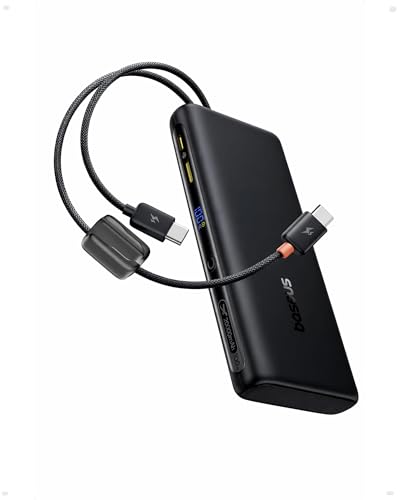
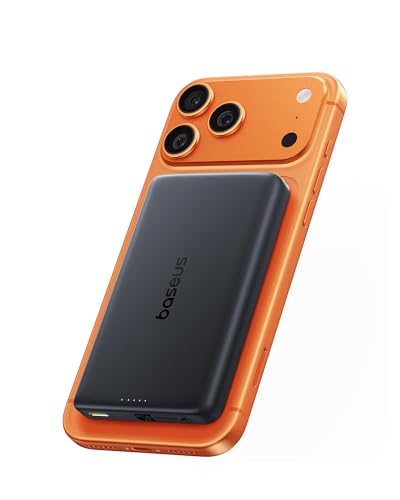
The best Baseus power bank for most people is the 20,000mAh, 100W-class option: it offers a useful balance of laptop-capable USB-C output, phone recharges, and carry-on-friendly size. Choose a 65W model if your devices need less power, or a 140W-class model if you regularly charge a demanding laptop and can accept a heavier pack.
Baseus sells multiple generations and regional versions, so check the exact model name and printed specifications before buying. Capacity alone does not tell you how many charges you will get: USB output, conversion losses, cable capability, and the device’s own charging limits all matter.
Our top picks


As an Amazon Associate we earn from qualifying purchases at no extra cost to you. Ratings are shown as listed on Amazon.
Quick comparison
| Power-bank class | Typical rated capacity | Maximum USB-C output | Best fit | Carry-on practicality |
|---|---|---|---|---|
| Compact Baseus 10,000mAh | About 10,000mAh / 37Wh | Usually 20–30W, depending on model | Phones, earbuds, small tablets | Lightest choice; limited laptop usefulness |
| Baseus 20,000mAh, 65W class | About 20,000mAh / 74Wh | Up to 65W | Phones, tablets, many ultrabooks | Generally below the common 100Wh airline threshold |
| Baseus 20,000mAh, 100W class | About 20,000mAh / 74Wh | Up to 100W | Fast-charging phones and USB-C laptops | Strong balance of output and capacity |
| Baseus 20,000mAh, 140W class | About 20,000mAh / 74Wh | Up to 140W on compatible models | Higher-draw laptops and multiple devices | Still often under 100Wh; typically heavier and bulkier |
These are specification classes, not a promise that every Baseus model has those exact figures. Confirm the watt-hours printed on the specific unit. A laptop also has to support USB-C Power Delivery at a compatible voltage and wattage; a high-output bank cannot make an incompatible laptop charge over USB-C.
Choose by the device you need to keep running
Phone-only travel: 10,000mAh and 20–30W
A compact 10,000mAh bank is usually the better everyday carry if the main goal is topping up a phone. A 20–30W USB-C output can fast-charge many recent phones, provided the phone supports the relevant charging protocol. It is lighter than a 20,000mAh unit, but expect less total energy and fewer full recharges than the capacity label might suggest.
Tablet or lightweight laptop: 20,000mAh and 65W
A 65W Baseus bank is a sensible lower-cost, lower-output choice for a tablet or a USB-C ultrabook whose charger is rated at 65W or less. It can also charge a phone, but check the output when multiple ports are in use: many power banks share their total power across connected devices, reducing the wattage available to each.
One bank for phone and laptop: 20,000mAh and 100W
The 100W class is the most versatile choice for mixed-device travel. It can power many USB-C laptops at useful speeds while retaining enough capacity for phone top-ups. It is not automatically a full-speed match for every laptop: some larger models require more than 100W under heavy workloads, and others accept less power through USB-C than their included charger provides.
Higher-power laptop: 140W class
Consider a Baseus 140W-class bank only when the laptop can accept that level of USB-C Power Delivery and the cable supports the required power. The extra output can help with compatible high-demand machines, but it does not increase the bank’s stored energy when capacity is unchanged. You may gain charging speed, not extra runtime.
What “usable capacity” means in practice
Power banks store energy internally and convert it to the voltage used by USB devices. That conversion loses some energy, so a 20,000mAh label does not mean 20,000mAh will arrive at a phone’s battery. A more useful comparison is watt-hours: 20,000mAh at a nominal 3.7V is roughly 74Wh. At an illustrative 80% delivery efficiency, about 59Wh reaches devices.
For example, assume a phone battery stores 19Wh. Dividing 59Wh by 19Wh gives about 3.1 battery-equivalents. In real use, expect fewer than three complete recharges if the phone is being used while charging, the bank is cold or hot, or the phone’s charging circuitry is inefficient. This is a planning estimate, not a guaranteed charge count.
USB-C output, cables, and recharge time
- Match output to the device: Check the laptop’s USB-C input requirement and the bank’s output profile. A phone’s fast-charge rate can also depend on protocol support, not just the maximum wattage printed on the bank.
- Use a suitable cable: For high-power laptop charging, use a USB-C cable rated for the required wattage. Some high-power configurations require an electronically marked cable; an ordinary cable may limit output.
- Read the input rating for recharging: The bank’s own recharge time depends on its maximum USB-C input and the charger used. A 74Wh bank supplied with 60W could not recharge in less than about 1.2 hours even under ideal conditions; charging losses, heat management, and tapering make the actual time longer.
- Check port sharing: A bank advertising 100W may reserve that figure for one port. When a second device is attached, the power allocation can change. Consult the exact model’s port-combination table if simultaneous laptop and phone charging matters.
Decision matrix: which Baseus class fits?
| Your situation | Best starting point | What to verify |
|---|---|---|
| Commute with a phone; minimum bag weight matters | 10,000mAh, 20–30W | Phone fast-charge protocol and bank dimensions |
| Tablet plus phone on a day trip | 20,000mAh, 65W | Tablet input wattage and shared-port output |
| USB-C ultrabook and phone; one travel bank | 20,000mAh, 100W | Laptop USB-C charging support, cable rating, and port sharing |
| Higher-power USB-C laptop used away from outlets | 20,000mAh, 140W class | Laptop Power Delivery support, actual sustained draw, and weight |
| Air travel with a power bank | Usually a model below 100Wh | Wh marking and the airline’s current rules |
Carry-on rules and practical trade-offs
Many airlines allow power banks in carry-on baggage, not checked baggage, and commonly permit batteries up to 100Wh without prior approval. Rules vary by airline and country, so confirm before flying. A 20,000mAh bank rated around 74Wh is typically below that threshold, but use the watt-hour figure printed on the product rather than relying on a capacity conversion.
Capacity also affects comfort: a 20,000mAh unit can be a substantial pocket or bag item, especially in a rugged or multi-port design. If you will carry it all day, compare weight and dimensions alongside wattage. A smaller bank that is actually with you can be more useful than a heavier, higher-output model left at home.
Bottom line
For most people balancing phone charging, laptop compatibility, usable capacity, and airline practicality, start with a Baseus 20,000mAh model rated for 100W USB-C output. Pick 65W to save money or bulk if your laptop needs less, 140W if your compatible laptop can use the extra output, and 10,000mAh for a lighter phone-first setup. Before purchase, verify the exact model’s watt-hours, USB-C input and output ratings, cable requirements, and simultaneous-port behavior.