
Key takeaways
- Latency: Wired is deterministic at roughly 1ms; premium 2.4GHz wireless is now statistically indistinguishable, while Bluetooth remains noticeably slower and is best reserved for productivity use.
- Weight: Wired mice avoid battery mass entirely, but cable drag adds perceived resistance — a well-designed 80g wireless like the G57 often feels lighter in the hand than a 70g corded mouse.
- Price per feature: At any given budget, a wired mouse buys you a better sensor and switches. Wireless charges a premium for the radio and cell.
- Maintenance: Wired mice have one failure point in the cable; wireless adds battery degradation, dongle storage, and firmware pairing to the list.
- Desk ergonomics: Low-sensitivity players who sweep large arcs benefit most from going wireless, since cable snag is the single biggest source of inconsistent low-DPI aim.
- Portability: Wireless models with USB-C and onboard memory travel far better between a laptop, console dock, and desktop.
What's inside
For the better part of a decade, the wired versus wireless debate in gaming mice had an easy answer: if you cared about winning, you plugged in. That answer expired some time ago, and by 2026 it is genuinely obsolete. Modern 2.4GHz gaming receivers push click-to-screen latency below the threshold of human perception, batteries measured in hundreds of hours have replaced the nightly charging ritual, and sub-60g wireless shells now weigh less than the wired flagships they replaced. The gap that once justified the cable has narrowed to a rounding error.
That does not make the decision trivial — it makes it a question of priorities rather than performance. Wired mice remain the cheapest route to a high-end sensor, and they never ask you to think about charge state mid-match. Wireless mice buy you freedom of movement, a cleaner desk, and — increasingly — features like wireless charging and multi-device Bluetooth pairing that a cable simply cannot offer. Below, we break down where each option still wins, and which models are worth your money this year.
As an Amazon Associate we earn from qualifying purchases.




⚡ Save on Your Next PC — Amazon Prime
Prime members get fast free shipping on the systems above, plus early access to Prime Day & Black Friday PC deals. New members get a 30-day free trial.
Watch: Wired vs Wireless Gaming Mouse in 2026 — Video Review
Quick Verdict
Buy wired if you want maximum sensor performance per dollar, you play on a tournament rig or shared machine, or you simply refuse to manage another battery. Buy wireless if you value low-drag movement, a clean setup, and portability — and know that a modern Lightspeed or 2.4GHz dongle mouse like the Logitech G305 or G502 X Plus will not cost you meaningful latency in any realistic scenario.
Key Differences
- Latency: Wired is deterministic at roughly 1ms; premium 2.4GHz wireless is now statistically indistinguishable, while Bluetooth remains noticeably slower and is best reserved for productivity use.
- Weight: Wired mice avoid battery mass entirely, but cable drag adds perceived resistance — a well-designed 80g wireless like the G57 often feels lighter in the hand than a 70g corded mouse.
- Price per feature: At any given budget, a wired mouse buys you a better sensor and switches. Wireless charges a premium for the radio and cell.
- Maintenance: Wired mice have one failure point in the cable; wireless adds battery degradation, dongle storage, and firmware pairing to the list.
- Desk ergonomics: Low-sensitivity players who sweep large arcs benefit most from going wireless, since cable snag is the single biggest source of inconsistent low-DPI aim.
- Portability: Wireless models with USB-C and onboard memory travel far better between a laptop, console dock, and desktop.
Wired Gaming Mice: Still the Value Champion
The strongest argument for a cable in 2026 is economic. Strip out the transmitter, receiver, and lithium cell, and manufacturers can spend that budget on the parts that actually affect aim — flagship optical sensors, optical switches rated for 100 million clicks, and better skate material. A wired mouse at a given price will almost always out-spec its wireless equivalent, which matters enormously if you are building a rig on a fixed budget.
Reliability is the second argument. There is no pairing, no dongle to lose in a bag, no low-battery warning appearing in the third round of a ranked match. For LAN events, esports venues, and shared family PCs, wired remains the default for exactly this reason. The trade-off is real, though: even a lightweight paracord cable exerts variable tension across a mousepad, and players who use very low sensitivity will feel it on wide flick shots.
Wireless Gaming Mice: The Modern Default
Wireless has won the mainstream, and the field is deep. The Logitech G305 Lightspeed, available in black or white, remains the benchmark for value — a HERO sensor at 12,000 DPI, six programmable buttons, onboard memory for profiles, and a genuinely remarkable 250 hours of battery from a single AA. It is the mouse we recommend most often to players making the jump. Above it, the Logitech G502 X Plus is the fully loaded option: optical switches, 13 buttons, RGB, an infinite-scroll toggle, USB-C, and Powerplay-compatible wireless charging, with battery life rated up to 130 hours.
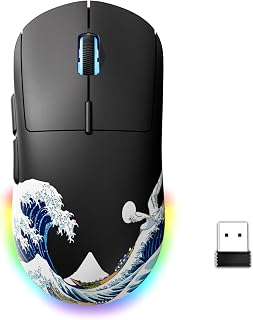
Budget and specialist options have matured too. The Redragon M810 PRO delivers 10,000 DPI, remappable keys, and rapid-fire macro binds with zero perceptible delay, while the Redragon M913 steps up to a 16,000 DPI sensor with an MMO-oriented button cluster that doubles nicely for FPS keybind stacking. If pure weight is your obsession, the G57 hits 80g with 8,000 DPI and triple connectivity — 2.4GHz for gaming, Bluetooth for laptops, and USB-C for charge-and-play.
Which Should You Buy?
- For competitive FPS on a budget: pick the G305 Lightspeed — the sensor and latency punch far above its class, and 250 hours means you charge it seasonally, not weekly.
- For MMO, MOBA, or macro-heavy play: pick the Redragon M913 or the G502 X Plus for their extended button clusters and remapping depth.
- For maximum features regardless of cost: pick the G502 X Plus — wireless charging and optical switches make it the most future-proof option here.
- For a laptop or travel setup: pick the G57, whose 2.4GHz/Bluetooth/USB-C flexibility and 80g body suit a bag better than anything else on this list.
- For a shared or LAN machine: stay wired — no pairing, no charging, no variables.
Frequently Asked Questions
Is wireless still slower than wired in 2026?
Not in any way you can perceive. A quality 2.4GHz dongle adds well under a millisecond over USB. Bluetooth is a different story and should be treated as a convenience mode, not a gaming mode.
How long do gaming mouse batteries actually last?
It varies hugely by design. The G305 uses a single AA and stretches to around 250 hours; RGB-heavy rechargeables like the G502 X Plus land nearer 130 hours with lighting off, and considerably less with it on.
Does DPI above 12,000 matter?
Almost never. Most competitive players sit between 400 and 1,600 DPI. High DPI ceilings indicate a modern sensor, but the number itself is a marketing figure, not a performance one.
Can I use a wireless gaming mouse while it charges?
Yes — any USB-C model, including the G502 X Plus and the G57, functions as a wired mouse while plugged in, which effectively eliminates the risk of being caught at zero percent.
Final Verdict
Wireless is the correct default for most players in 2026, and the Logitech G305 Lightspeed is the easiest recommendation on this page — it delivers flagship-adjacent tracking and absurd battery life for a fraction of what premium wireless once cost. Step up to the G502 X Plus if you want every feature in one shell, look at the Redragon M810 PRO or M913 if button count and macro flexibility drive your decision, and consider the G57 if portability and low weight top your list. Reach for a cable only when budget is tight or absolute reliability outranks freedom of movement.


