Key takeaways
- Latency: Wired is effectively instantaneous. Modern 2.4GHz wireless sits around 20–40ms — the NUBWO 100-Hour model advertises 23ms sync — which is imperceptible to most players. Bluetooth, by contrast, is still too slow for competitive FPS.
- Audio quality: At the same price, wired usually sounds better because no budget goes toward radios, batteries and DACs. Above roughly the mid-range, wireless closes the gap; Ozeino’s lossless-audio link and the Nova 5’s neodymium drivers both hold up fine.
- Battery and upkeep: Wired needs nothing. Wireless needs charging, though 2026 figures are generous — 80 hours from the NUBWO 7.1 and Stealth 600, 100 from the NUBWO Orange.
- Weight and comfort: Wired headsets are lighter by default. Wireless has caught up: the NUBWO 7.1 is 270g, comparable to many cabled sets.
- Compatibility: Wired 3.5mm works with almost anything with a jack. Wireless is more flexible in a different way — tri-mode sets like the Acer 2.4GHz can jump between USB dongle, Bluetooth and cable.
- Microphone: Wired mics are typically cleaner because there’s no compression. Wireless mics — ClearCast Gen2.X, flip-to-mute booms — are now good enough for Discord and party chat.
What's inside
For years the answer was simple: if you cared about latency and audio fidelity, you plugged in. Wireless was for convenience; wired was for competition. In 2026 that line has all but disappeared. Low-latency 2.4GHz dongles, lossless-capable links and battery lives measured in days rather than hours have pushed wireless headsets into territory that used to belong exclusively to cables — while wired models have quietly become the value-focused, zero-maintenance option rather than the default premium pick.
That makes the decision more interesting, not less. A wireless headset buys you freedom of movement, multi-device switching and, increasingly, latency low enough that competitive players stop noticing it. A wired headset buys you a lower price, one less thing to charge, and a connection that will never drop mid-raid. Here’s how the two really compare this year, and which models are worth your money.
As an Amazon Associate we earn from qualifying purchases.


⚡ Save on Your Next PC — Amazon Prime
Prime members get fast free shipping on the systems above, plus early access to Prime Day & Black Friday PC deals. New members get a 30-day free trial.
Watch: Wireless vs Wired Gaming Headset in 2026 — Video Review
Quick Verdict
Wireless is the right default for most gamers in 2026. If you play on a console in the living room, switch between a PC and a phone, or simply hate cable drag, something like the SteelSeries Arctis Nova 5 or the Turtle Beach Stealth 600 will serve you better than any cable. Wired still wins on one axis that matters: cost. If your budget is tight, or you sit at a desk and never move, a wired headset gets you more driver and build quality for the money — and it will still be working in five years.
Key Differences
- Latency: Wired is effectively instantaneous. Modern 2.4GHz wireless sits around 20–40ms — the NUBWO 100-Hour model advertises 23ms sync — which is imperceptible to most players. Bluetooth, by contrast, is still too slow for competitive FPS.
- Audio quality: At the same price, wired usually sounds better because no budget goes toward radios, batteries and DACs. Above roughly the mid-range, wireless closes the gap; Ozeino’s lossless-audio link and the Nova 5’s neodymium drivers both hold up fine.
- Battery and upkeep: Wired needs nothing. Wireless needs charging, though 2026 figures are generous — 80 hours from the NUBWO 7.1 and Stealth 600, 100 from the NUBWO Orange.
- Weight and comfort: Wired headsets are lighter by default. Wireless has caught up: the NUBWO 7.1 is 270g, comparable to many cabled sets.
- Compatibility: Wired 3.5mm works with almost anything with a jack. Wireless is more flexible in a different way — tri-mode sets like the Acer 2.4GHz can jump between USB dongle, Bluetooth and cable.
- Microphone: Wired mics are typically cleaner because there’s no compression. Wireless mics — ClearCast Gen2.X, flip-to-mute booms — are now good enough for Discord and party chat.
The Case for Wireless Gaming Headsets
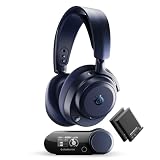
The practical argument is overwhelming. You can stand up, grab a drink, answer the door and keep listening. On PS5 or Xbox you’re not running a cable to a controller that then tugs at your head every time you shift. Multi-device users benefit most: the Acer Tri-Mode and Arctis Nova 5 hold a 2.4GHz link to your console while staying paired to a phone, so a call or a Spotify queue doesn’t mean unplugging anything.
Battery anxiety is largely solved. The NUBWO Orange claims 100 hours, the NUBWO 7.1 and Stealth 600 around 80, and the Ozeino supports play-and-charge over USB-C so a dead battery costs you nothing but a cable. Feature sets have grown too — 7.1 surround, mic monitoring, foldable frames, and the Nova 5’s 100+ audio presets tuned per game. The trade-off is that you are buying electronics, and electronics age.
The Case for Wired Gaming Headsets
Wired headsets remain the honest value play. Strip out the wireless hardware and every pound goes into drivers, earcups and headband. At the entry level the difference is stark: a wired set will usually out-perform a wireless one at the same price, sometimes by a wide margin. There is also nothing to pair, no dongle to lose and no firmware to update.
Reliability is the other draw. A cable does not suffer interference in a crowded LAN hall or a flat full of Wi-Fi. It does not die at 2am in ranked. For desk-bound PC players, streamers who need the cleanest possible mic feed, and anyone who wants to buy once and forget about it, wired is still entirely defensible in 2026 — it’s just no longer the obvious choice.
Which Should You Buy?
- For competitive FPS: pick a low-latency 2.4GHz set — the NUBWO 100-Hour or Arctis Nova 5 — or a wired headset if you want zero doubt.
- For console living-room play: pick wireless. The Turtle Beach Stealth 600 covers Xbox, PlayStation, PC and mobile in one purchase.
- For the tightest budget: pick wired, or the NUBWO 7.1 if you want wireless without stretching.
- For phone, Switch and PC in one day: pick tri-mode wireless like the Acer or Ozeino.
- For long sessions: pick the lightest option you can afford — 270g wireless or a comfortable wired set beats a heavy premium model every time.
Frequently Asked Questions
Is wireless latency still a problem in 2026?
Not over 2.4GHz. Figures in the 20–40ms range are typical and sit below the threshold most players can detect. Bluetooth remains noticeably laggy, so use the dongle for gaming and save Bluetooth for music and calls.
Do wireless headsets sound worse than wired?
At budget prices, usually yes. From the mid-range upward the difference is small, and lossless-capable links narrow it further. Driver quality, tuning and earcup seal matter far more than the connection type.
How long do headset batteries last before degrading?
Expect meaningful capacity loss after roughly two to three years of heavy use. Models supporting play-and-charge, like the Ozeino, remain usable indefinitely even once the cell weakens.
Can one wireless headset cover PS5, Xbox and PC?
Some can, but check carefully — Xbox uses a different wireless standard. The Stealth 600 is explicitly multiplatform; many others cover PlayStation, PC and Switch but not Xbox wirelessly.
Final Verdict
Buy wireless unless price is your binding constraint. The convenience is real, the latency penalty is now negligible on a 2.4GHz connection, and battery life has stopped being a daily concern. Wired remains the smarter spend at the lowest budgets and the safer choice for desk-bound purists — but for most players in 2026, cutting the cable costs you almost nothing and gives you back a great deal.