Key takeaways
- Reference-grade image quality across virtually every retro console
- Near-zero input lag suitable for competitive play
- Frequent free firmware updates that add features over time
- Extensive scanline, mask, and aspect-ratio controls
For purists who grew up staring at CRT scanlines, nothing kills the nostalgia faster than a muddy, laggy image on a modern 4K television. The RetroTink 4K arrives in 2026 as the flagship answer to that problem, promising pixel-perfect scaling from decades-old consoles straight into a crisp, low-latency signal your OLED can actually respect. It is not cheap, and it is not aimed at casual players, but it has quietly become the reference point every other upscaler is measured against.
In this review we look at whether the RetroTink 4K earns its premium price, how it handles everything from a Super Nintendo to a Dreamcast, and where more affordable converters make more sense. If you care about accuracy above all else, read on before you spend.
Our top picks



As an Amazon Associate we earn from qualifying purchases at no extra cost to you. Ratings are shown as listed on Amazon.
⚡ Save on Your Next PC — Amazon Prime
Prime members get fast free shipping on the systems above, plus early access to Prime Day & Black Friday PC deals. New members get a 30-day free trial.
Watch: Retrotink 4K Review — Video Review
Design & Build
The RetroTink 4K is a compact, fan-cooled aluminum box that feels far more like professional broadcast gear than a hobbyist gadget. A front-panel screen and a dedicated remote let you tweak scanline intensity, aspect ratio, and processing profiles without diving into cryptic menus. Every major analog input is covered, and the firmware is updated regularly via SD card, so the hardware you buy in 2026 keeps gaining features long after purchase. Build quality is genuinely excellent, with tight tolerances and connectors that grip cleanly.
Performance
Performance is where the RetroTink 4K justifies its reputation. Processing latency is effectively imperceptible, so twitch-reaction platformers and fighting games feel exactly as responsive as they did on original hardware. The scaling engine handles 240p, 480i, and 480p sources with sharp, artifact-free results, and the optional scanline and mask filters recreate a CRT look convincingly on a large panel. Compared to budget RCA-to-HDMI adapters that simply stretch the picture, the difference in clarity and color accuracy is night and day.
Pros & Cons
- Reference-grade image quality across virtually every retro console
- Near-zero input lag suitable for competitive play
- Frequent free firmware updates that add features over time
- Extensive scanline, mask, and aspect-ratio controls
- High price that only serious collectors will justify
- Steep learning curve to master every processing option
- Overkill for anyone who owns only one or two consoles
Alternatives to Consider
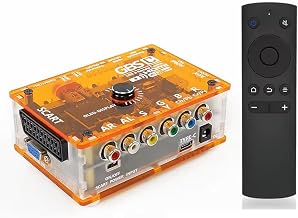
Not everyone needs flagship performance. The Kaico OSSC 1.8 Open Source Scan Converter is a proven line-multiplier that delivers superb zero-lag RGB output for a fraction of the cost, while the TicKnot ODV-GBS-C mini converter and Mcbazel ODV-GBS-C handle SCART, RGBS, and component sources for players who mostly want a clean, low-effort hookup. For single-console setups, the Retro-Bit Prism HDMI Adapter for GameCube gives excellent plug-and-play 1080p, and simple RCA-to-HDMI boxes like the Tengchi converter or the RetroScaler2x line doubler cover casual VHS and PS2-era needs cheaply.
Frequently Asked Questions
Is the RetroTink 4K worth it in 2026?
If you own a large retro library and demand the best possible image with no compromises, yes. For one or two consoles, a cheaper scan converter will satisfy most players.
Does it work with light-gun games?
Light-gun compatibility depends on the display, not the upscaler. The RetroTink passes the signal cleanly, but you still need a CRT or a light-gun-compatible solution for those titles.
Do I need special cables?
You will get the best results with quality RGB SCART, component, or console-specific cables. The device accepts a wide range of analog inputs, but garbage-in still means a weaker result.
How is the input lag?
Latency is effectively negligible, low enough that competitive fighting-game and shmup players use it without complaint.
Verdict
The RetroTink 4K is the gold standard for retro upscaling in 2026, delivering flawless image quality and imperceptible lag that no budget converter can match. It is an easy recommendation for dedicated collectors, but if your setup is modest, one of the affordable alternatives above will serve you well without the premium outlay.