Key takeaways
- Dual-band support with a 5GHz band rated high enough for HD streaming and large downloads.
- Proven TP-Link driver stability with long-term firmware support.
- Requires a USB port near the back of a case where metal shielding can dampen the signal.
Most desktop PCs ship without a WiFi card, and the ones that include one are often locked to an outdated standard. Running an ethernet cable across a room is a solution until you move your desk or your router lives on another floor. A USB adapter fixes this in seconds, but the market is flooded with options that look identical on a spec sheet and deliver wildly different experiences once you connect to a congested apartment network or try to game with any consistency. The difference between a good pick and a bad one in network adapters wifi usually comes down to three things: the wireless generation the chipset actually supports, whether the antenna design suits your distance from the router, and whether drivers stay stable across Windows updates.
This roundup compares eight current options on their published specifications, real pricing, and recurring themes from owner reviews. The price range is broad, from under eight dollars to nearly thirty, and the performance tiers are not evenly distributed. Some adapters deliver genuine WiFi 6 throughput advantages, while others are WiFi 5 devices priced like budget picks that barely outperform older single-band dongles. Matching the adapter to your actual use case matters more than chasing the highest number on the box.
Our top picks


As an Amazon Associate we earn from qualifying purchases at no extra cost to you. Ratings are shown as listed on Amazon.
Quick Picks
| Product | Best For | Price |
|---|---|---|
| TP-Link AC1300 | Best overall dual-band value | $15.96 |
| TP-Link AC600 | Light browsing on a budget | $14.99 |
| Nineplus 1300Mbps | Maximum range and signal strength | $25.96 |
| TP-Link Nano AC600 | Tight spaces and laptop use | $10.23 |
| UGREEN AX900 | Affordable WiFi 6 entry | $12.99 |
| Tenda AX900 | Cheapest WiFi 6 adapter | $7.99 |
| TP-Link Nano AC1300 | Compact adapter with real speed | $9.96 |
| TP-Link AX1800 | Gaming and heavy bandwidth | $28.16 |
How We Picked
We filtered this category on four criteria. First, chipset generation: WiFi 6 adapters handle network congestion noticeably better than WiFi 5 in multi-device households, so that distinction drove our tiering. Second, published throughput combined with band support, because a dual-band adapter that only saturates one band at a time is less useful than its name suggests. Third, antenna design and form factor, since a nano dongle three rooms from your router is a different product than one with external high-gain antennas regardless of rated speed. Fourth, owner feedback on driver stability and connection reliability, which separates adapters that work on day one from those that break after a Windows update.
The 8 Best Network Adapters Wifi in 2026
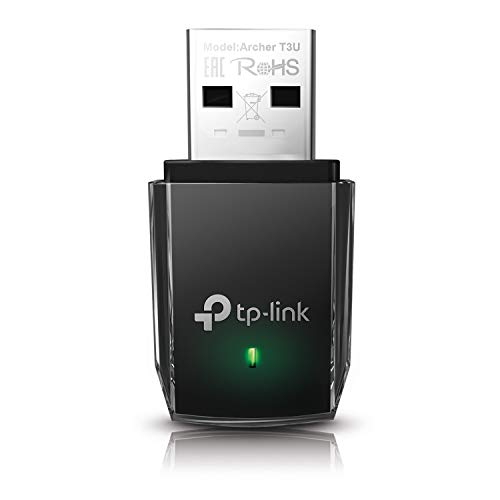
TP-Link AC1300 USB WiFi Adapter
This is the sensible middle-ground choice for anyone whose router supports 5GHz and who needs a connection that holds up for video calls and moderate file transfers. The AC1300 rating means 867Mbps on the 5GHz band and 400Mbps on 2.4GHz, a balanced split that suits most home networks. Owners consistently praise its plug-and-play simplicity on Windows 10 and 11 without hunting for drivers. The single external antenna keeps cost down while providing more range than nano alternatives.
- Dual-band support with a 5GHz band rated high enough for HD streaming and large downloads.
- Proven TP-Link driver stability with long-term firmware support.
- Requires a USB port near the back of a case where metal shielding can dampen the signal.
Skip it if your network is congested enough to benefit from WiFi 6, or if you need maximum range through multiple walls.
TP-Link AC600 USB WiFi Adapter
At $14.99, this adapter is the odd entry in the lineup because it costs more than faster options. The 433Mbps ceiling on 5GHz and 150Mbps on 2.4GHz are adequate for web browsing and occasional video, but the price does not reflect a meaningful advantage over the Nano AC600 that costs less than half as much. It suits buyers who specifically want TP-Link brand confidence and a slightly larger antenna for better reception than nano models without paying for full AC1300 throughput.
- Reliable single-antenna design with good reception for its rated speed class.
- Minimal driver issues and straightforward setup across recent Windows versions.
- Poor value relative to the Nano AC600, which delivers identical specs for $10.23.
Skip it unless you already own TP-Link software tooling and want this exact form factor. The Nano AC600 is strictly better at its price point.
Nineplus Wireless USB WiFi Adapter 1300Mbps
This adapter targets buyers who need the longest range from a USB solution. Two 5dBi external antennas on a swivel base are the most aggressive antenna configuration in this group, and the 1300Mbps combined rating matches the TP-Link AC1300. The $25.96 price makes it the second most expensive option here, and it earns that premium through raw signal reach rather than wireless generation. Owners report solid connections through two interior walls, which many nano alternatives cannot maintain.
- Best-in-class antenna array for range and wall penetration at this price tier.
- Full AC1300 dual-band throughput without requiring a PCIe slot or internal installation.
- WiFi 5 only, so it cannot leverage OFDMA or target wake time in congested environments.
Skip it if your router is in the same room or behind one thin wall. You are paying for range you will not use.
TP-Link Nano AC600 USB WiFi Adapter
The Nano AC600 is the cheapest way to get dual-band WiFi into a desktop at $10.23. Its compact profile means it will not obstruct neighboring USB ports, making it a practical choice for laptops or cases with tight front-panel spacing. The tradeoff is range: a single integrated antenna rated for 433Mbps on 5GHz works well in one room but degrades noticeably through walls. It is ideal as a secondary adapter for a home theater PC or a quick fix for a forgotten ethernet run.
- Smallest physical footprint in the lineup with no antenna protruding from the case.
- Dual-band at the lowest price of any WiFi 5 option here.
- Limited range makes it unreliable for rooms distant from the router.
Skip it if your router sits across the house or behind multiple walls. Signal loss is the physical reality of a nano antenna.
UGREEN AX900 USB WiFi 6 Adapter
At $12.99, this is the most accessible WiFi 6 adapter for buyers who want the generation upgrade without paying nearly double. The 600Mbps on 5GHz and 287Mbps on 2.4GHz are modest absolute numbers, but WiFi 6 brings efficiency features that matter most in crowded networks with many connected devices. Owners frequently note it works well as a replacement for a slow built-in laptop adapter. UGREEN builds solid peripherals and its driver packaging here is no exception.
- WiFi 6 at a WiFi 5 price, making generation-level improvements accessible to budget buyers.
- Compact single-antenna design that balances range against port obstruction.
- AX900 throughput is lower than AC1300, so peak transfer speed on an empty network will not match faster WiFi 5 adapters.
Skip it if your network is quiet and you only care about raw file transfer speed to a single device. The AC1300 class delivers higher ceilings.
Tenda AX900 WiFi 6 USB WiFi Adapter
At $7.99, this is the least expensive way to add WiFi 6 to a desktop or laptop in 2026. The specification matches the UGREEN AX900 almost exactly, so you are paying roughly five dollars less for equivalent generation-level features. Tenda as a brand has a shorter track record in the US adapter market than TP-Link, and some owners mention slightly less polished driver updates over time. Still, for a backup machine or a one-off fix, it delivers impressive value.
- Absolute lowest price for WiFi 6 connectivity in this comparison.
- Matches UGREEN AX900 specifications while saving $5 in a category where price sensitivity matters.
- Less established driver support history compared to TP-Link and UGREEN alternatives.
Skip it if you need long-term reliability and plan to keep this adapter for several years without occasional reinstallation. The price difference is small enough to consider the UGREEN instead.
TP-Link Nano USB WiFi Adapter AC1300
This is the best nano adapter in the group and arguably the best value in the entire lineup at $9.96. Full AC1300 dual-band throughput in a package smaller than a thumbnail means you get the speed of the first TP-Link on this list without paying more or sacrificing port space. The obvious physical limitation of any nano design applies: range is reduced compared to external antenna models. But for a desktop sitting two feet from the router or a laptop on a desk near an access point, nothing else in this list offers faster speed per dollar.
- Highest rated throughput of any nano adapter in this comparison, at under ten dollars.
- TP-Link brand reliability and driver support without the bulk of a standard dongle.
- Physical size limits antenna gain, making it unreliable beyond one room.
Skip it if your router is anywhere other than the same room or the room directly adjacent. Range is the single defining weakness of the nano form factor.
TP-Link USB WiFi 6 Adapter AX1800
At $28.16, this adapter is the premium option and the only AX1800 in the group. The 1201Mbps on 5GHz plus 574Mbps on 2.4GHz gives it the highest total rated throughput here. WiFi 6 with OFDMA means it handles many simultaneous devices better than any WiFi 5 adapter above, and owners report it as a reliable substitute for a PCIe card in small-form-factor builds. Two external antennas and a folding design let you angle reception without the bulk of the Nineplus.
- Highest combined throughput and the most robust WiFi 6 feature set in this comparison.
- Folding antenna design offers both range and portability without fixed protrusion.
- Priced nearly double the TP-Link AC1300 for throughput gains that only matter on congested networks or with fast routers.
Skip it if your router does not support WiFi 6 or if you operate on a simple network with few connected devices. The AC1300 class handles that workload perfectly well.
Buying Guide
WiFi Generation and Network Congestion
WiFi 6 introduces OFDMA and target wake time, which improve efficiency when multiple devices share the network. If your household has smartphones, smart TVs, and other devices all competing for airtime, a WiFi 6 adapter maintains steadier throughput under load than any WiFi 5 model here. On a quiet network with one or two devices, the difference nearly disappears, and a high-throughput AC1300 will transfer large files faster than an AX900. Choose by environment, not by spec sheet number alone.
Antenna Design Determines Real-World Range
Nano adapters concentrate all their gain into a single integrated element, which works fine within one room and fails quickly beyond two walls. External 5dBi antennas on the Nineplus and the folding pair on the AX1800 push usable range significantly further. A USB port on the back of a metal case also creates a signal shadow. If you cannot use a USB extension dock or a front-panel port, factor antenna quality more heavily than rated speed.
Driver Stability Across Windows Updates
Every adapter in this list supports Windows 10 and 11, but driver quality over time varies. TP-Link and UGREEN maintain update channels that address issues after major Windows feature updates. Tenda and Nineplus have thinner support histories, meaning a driver that works today may need manual reinstallation after the next system update. If you want to install once and forget, brand driver track record is a legitimate differentiator worth paying five dollars for.
Our Verdict
The TP-Link Nano AC1300 is our top pick for most buyers. At $9.96 it delivers the highest throughput-per-dollar in this list, and its nano form factor suits the majority of desktop and laptop setups where the router is nearby. If you need WiFi 6 and want to spend as little as possible, the Tenda AX900 at $7.99 is the budget recommendation, provided you accept slightly thinner long-term driver support. If your adapter sits far from the router or you game on a congested network, the TP-Link AX1800 at $28.16 wins on both range and efficiency regardless of its premium.
FAQ
Is WiFi 6 worth it over WiFi 5 for a USB adapter?
Yes, if your network has multiple active devices or your router supports WiFi 6. OFDMA and target wake time reduce latency under load. On a quiet network with one or two devices, a fast AC1300 adapter can still deliver higher peak transfer rates than an entry-level AX900, so the upgrade is situational.
Can a USB WiFi adapter match a built-in PCIe card?
A high-end USB adapter with external antennas can match most PCIe cards in raw throughput, but PCIe cards typically maintain more stable connections under sustained load because they draw power from the board and are not subject to USB bus contention. For gaming and large file transfers on a busy machine, PCIe still holds an edge.
Do external antennas make a real difference?
Yes, particularly in range and wall penetration. A 5dBi external antenna can roughly double effective range compared to an integrated nano antenna. If your router is beyond a single wall or several rooms away, the difference is immediately noticeable in signal strength and transfer reliability.
Why do some adapters get much hotter than others?
Higher throughput chips draw more power and generate more heat, especially in compact nano packages with less surface area to dissipate it. Mild warmth is normal. If an adapter becomes too hot to touch during sustained transfers, it may be throttling or sitting in a poorly ventilated port that is also blocked by neighboring devices.