Key takeaways
- Piece sizes: Look for a graduated set that covers a 20cm/8-inch cake or brownie pan, a 28-32cm/11-13-inch roasting or sheet pan, and a mid-size 24-26cm pie or shallow roaster. Sets that only include large roasters force you to use an oversized pan for small tasks, which wastes heat and causes uneven baking.
- Steel thickness: 0.8mm is light and prone to warping above 220C/425F. 1.0mm to 1.2mm holds its shape, distributes heat more evenly, and resists denting when stacked.
- Enamel durability: Double-dipped enamel with a vitreous glass finish resists chipping at rims and corners far better than single-coat spray enamel. Check for rolled rims and fully coated undersides.
- Oven suitability: All true enamelware is oven-safe, but max temperature and broiler compatibility depend on the enamel formulation. Most European-made enamelware is rated to 270C/530F, while thinner import sets are often limited to 230C/450F.
- Storage value: The best everyday sets nest completely. A 5-piece set that nests to the height of one large roaster saves 60-70% of cabinet space compared to non-nesting ceramic or glass bakeware.
The best enamelware baking set for everyday use in 2026 is a 4-to-5 piece heavy-gauge steel set with a 1.0mm+ steel core and double-coated porcelain enamel, such as the Falcon Enamelware Bake Set, because it balances usable pan sizes for daily roasting and baking, durability under high heat, and nesting storage that sheet-pan sets cannot match.
Our top picks


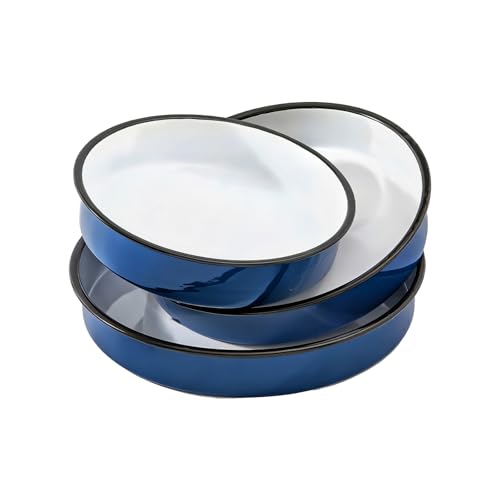

As an Amazon Associate we earn from qualifying purchases at no extra cost to you. Ratings are shown as listed on Amazon.
How to Choose the Right Enamelware Baking Set
Enamelware for baking is not the same as enameled cast iron. These sets use pressed carbon steel coated in glass-fused porcelain enamel. That construction is what gives you lightweight handling, even browning, and easy cleanup, but the quality varies widely with steel gauge and enamel thickness. Use these five criteria to decide:
- Piece sizes: Look for a graduated set that covers a 20cm/8-inch cake or brownie pan, a 28-32cm/11-13-inch roasting or sheet pan, and a mid-size 24-26cm pie or shallow roaster. Sets that only include large roasters force you to use an oversized pan for small tasks, which wastes heat and causes uneven baking.
- Steel thickness: 0.8mm is light and prone to warping above 220C/425F. 1.0mm to 1.2mm holds its shape, distributes heat more evenly, and resists denting when stacked.
- Enamel durability: Double-dipped enamel with a vitreous glass finish resists chipping at rims and corners far better than single-coat spray enamel. Check for rolled rims and fully coated undersides.
- Oven suitability: All true enamelware is oven-safe, but max temperature and broiler compatibility depend on the enamel formulation. Most European-made enamelware is rated to 270C/530F, while thinner import sets are often limited to 230C/450F.
- Storage value: The best everyday sets nest completely. A 5-piece set that nests to the height of one large roaster saves 60-70% of cabinet space compared to non-nesting ceramic or glass bakeware.
Best Enamelware Baking Sets Compared
These three spec classes represent the most common options available from established enamelware manufacturers as of 2026. They are distinct by origin, thickness, and piece configuration.
| Set / Spec Class | Pieces Included (Typical) | Steel Core Thickness | Enamel Type | Max Oven Temp | Weight (Total Set) | Nesting Height |
|---|---|---|---|---|---|---|
| Falcon Enamelware Bake Set (UK) | 5 pcs: 20cm bake pan, 24cm pie dish, 28cm bake pan, 31cm bake pan, 37cm bake pan | 1.0mm – 1.1mm | Double-dip porcelain enamel | 270C / 530F (broiler safe) | ~3.4 kg | ~9.5 cm nested |
| Crow Canyon Home Enamel Bake/Roast Set (USA) | 4 pcs: 9×13 inch roaster, 11×7 inch baker, 8-inch pie plate, 12-inch jelly roll / sheet | 0.9mm – 1.0mm | Double-coat porcelain enamel with stainless rim | 260C / 500F | ~2.9 kg | ~10.2 cm nested |
| Riess Classic Enamel Baking Set (Austria) | 3 pcs: 26cm round cake pan, 30cm rectangular roaster, 34cm rectangular roaster | 1.1mm – 1.2mm | Two-layer glass enamel | 270C / 530F (broiler and induction safe) | ~3.1 kg | ~8.8 cm nested |
1. Falcon Enamelware Bake Set – Best Overall for Everyday Use
This is the benchmark for daily baking because the size progression is the most practical. The 20cm and 24cm pans handle cakes, brownies, small roasts and gratins for 1-2 people, while the 31cm and 37cm pans cover family roasts, lasagna, and batch baking. The 1.0mm+ steel resists warping when moved from stovetop to hot oven, and the double-dipped enamel is notably chip-resistant at the rim, where most enamelware fails first. All pieces are freezer and dishwasher safe, though hand washing extends gloss life. Usually $70–$110 for a 5-piece set.
Downside: The traditional white with colored rim shows baked-on oil more than speckled patterns, so it requires a baking soda soak if you roast above 240C frequently.
2. Crow Canyon Home – Best for Color and Lightweight Handling
Crow Canyon sets use a slightly thinner steel than Falcon or Riess, which makes them lighter to lift when full and easier to maneuver for users who prefer not to handle heavy bakeware. The signature splatter and solid-color porcelains are double-coated and have rolled stainless rims that protect against rim chips. The 4-piece configuration is ideal if you mostly need rectangular roasters and a pie plate and do not need a small round cake pan. Usually $60–$95.
Downside: The thinner gauge can flex slightly with heavy doughs and will warp more readily under a broiler than 1.1mm+ steel. Rated to 260C/500F, so not ideal for sustained high-heat pizza or bread baking.
3. Riess Classic – Best for Heavy-Gauge Durability
Riess manufactures its enamelware in Austria with a thicker 1.1-1.2mm steel and two-layer glass enamel fired at high temperature. It is the most warp-resistant and has the hardest enamel surface of the three, making it suitable for daily high-heat roasting and for use on induction or gas hobs as well as in the oven. The 3-piece set focuses on larger rectangular and round roasters, so it suits cooks who batch-cook or roast whole chickens and vegetables regularly. Usually $80–$130.
Downside: Fewer small pans in the standard set and higher weight per piece. You may need to add a separate 20cm pan for small bakes.
Decision Matrix: Which Set Fits Your Kitchen?
Match your primary use case to the right spec class instead of buying by piece count alone.
| If You Primarily… | Choose This Type | Why |
|---|---|---|
| Bake and roast daily for 1-4 people, need cake, pie, and roasting sizes | 5-piece 20-37cm graduated set (Falcon-type) | Covers small to large without gaps; best size-per-dollar value |
| Want light weight, easy storage, and decorative colors | 4-piece rectangular-focused set (Crow Canyon-type) | Lighter lift, stainless rim protection, nests well in shallow cabinets |
| Roast at high heat, use broiler, or need stovetop-to-oven flexibility | Heavy-gauge 1.1mm+ set (Riess-type) | Thicker steel prevents warping; enamel rated to 270C sustained |
| Have limited cabinet space (apartment, RV, small kitchen) | Any fully nesting 5-piece set under 10cm tall | Nesting height is more important than material weight |
| Bake bread, pizza, or large batches weekly | Set with at least one 31cm+ large pan in 1.0mm+ steel | Large flat base gives better crust and even browning |
Worked Calculation: Storage Value and Oven Efficiency
Enamelware’s main practical advantage is nesting. Here is how that translates to real cabinet and energy savings:
Storage volume: A typical 5-piece non-nesting ceramic bakeware set occupies about 45cm (W) x 32cm (D) x 28cm (H) = ~40,320 cubic cm. A 5-piece Falcon-type enamel set nested measures 37cm x 27cm x 9.5cm = ~9,490 cubic cm. That is a 76% reduction in occupied volume, which is the difference between needing an entire shelf and fitting the set into a single drawer.
Oven heat load: Enamelware on 1.0mm steel weighs 0.6-0.8 kg per large pan versus 2.5-3.5 kg for enameled cast iron of the same size. Heating 0.7 kg of steel + enamel from 20C to 200C requires roughly 0.07 kWh of energy, compared to ~0.24 kWh for a 2.8 kg cast iron roaster. Using enamelware for a 45-minute roast at 200C saves approximately 0.15-0.18 kWh per bake, which adds up for daily use and also means faster preheat response and quicker cooling for handling.
Enamel Durability and Care Rules
Enamel is glass, not non-stick. It will chip if struck on a hard edge and it will craze if thermally shocked.
- Do not heat an empty enamel pan on high on the stovetop. Always add fat, liquid, or food before placing over direct flame. Empty heating can exceed 300C at the base and cause enamel stress cracks.
- Avoid sudden temperature shock. Do not transfer a pan from a 250C oven directly into cold water. Let it cool to below 100C first.
- Use wood, silicone, or nylon utensils. Metal is safe for serving but will dull the gloss over time if you cut directly in the pan.
- For stuck-on residue, soak with 2 tablespoons baking soda per liter of hot water for 30 minutes before scrubbing with a non-abrasive pad. Avoid steel wool and caustic oven cleaners.
- Small rim chips do not make the pan unusable but expose steel. Dry thoroughly after washing and rub a drop of neutral oil on any chip to prevent rust.
Oven Suitability by Task
Check the manufacturer’s rating on the base stamp, but general guidance by task is:
- Cakes, brownies, gratins (160-190C): All enamelware types perform well. Light-colored enamel gives more even browning than dark non-stick.
- Roasting meat and vegetables (200-230C): Requires 1.0mm+ steel for flat stability. Thinner pans will oil-pool to the center if warped.
- Bread and pizza (250-270C): Only use sets rated to 270C/530F with double-dip enamel. Single-coat enamel can discolor or craze at sustained top temperatures.
- Broiler / grill (close radiant heat): Keep enamel at least 10-12cm from the element. Heavy-gauge Austrian and British enamelware handles this; lightweight import sets often warn against broiler use entirely.
FAQ
Is enamelware non-stick?
No. Porcelain enamel is naturally stick-resistant when greased but not non-stick. For cakes, grease and line with parchment. For roasting, preheat the pan with oil for 3-4 minutes to improve release.
Can enamelware go on induction or gas?
Yes, if the base is flat magnetic steel, which most European-made sets like Falcon and Riess are. Many US decorative sets have slightly bowed bases intended for oven-only use. Check the base for an induction symbol.
Does enamelware rust?
The steel will rust only where enamel is chipped down to bare metal. Keep the enamel intact, dry pans immediately after washing, and store nested with a thin cloth or paper between pans to prevent rim abrasion.
What size should I buy if I can only buy one pan?
A 31cm / 12-inch rectangular pan in 1.0mm steel is the most versatile single piece. It fits a standard 60cm oven, holds a 3-4 lb chicken, bakes a 9×13 inch cake equivalent, and still nests if you expand to a set later.