Key takeaways
- Headphone output: Essential for quiet practice. Check whether the jack is 3.5 mm or 6.35 mm so you have the correct adapter.
- Bluetooth audio: Convenient for playing along with a phone. It is not the same as Bluetooth MIDI, and wireless audio can introduce enough delay to bother some players.
- USB MIDI: Sends performance data to a computer or tablet. This is useful for drum instruments, notation, lessons, and recording.
- USB audio: Sends the module’s sound directly to a computer. It can reduce the need for a separate audio interface.
- Dedicated outputs: Important for live work if the sound engineer needs separate control of kick, snare, and other channels rather than one stereo feed.
- Trigger expansion: Check the number and type of spare inputs before planning to add a second crash, extra tom, or acoustic-style kick trigger.
The best electric drum sets for most players are the Roland TD-17KVX2 for realistic practice and gigging, the Yamaha DTX6K3-X for expressive playing and dependable sounds, and the Alesis Nitro Max for an affordable, compact starter setup.
Choosing between them is less about the number of pads and more about four practical questions: how natural the pads feel, whether the module sounds suit your music, how much floor space you have, and how easily the kit connects to headphones, phones, computers, and live equipment.
Our top picks



As an Amazon Associate we earn from qualifying purchases at no extra cost to you. Ratings are shown as listed on Amazon.
Best electric drum sets at a glance
| Kit | Best for | Pad and playing feel | Connectivity strengths | Typical market range |
|---|---|---|---|---|
| Roland TD-17KVX2 | Practice, recording, and small-stage performance | Mesh heads, strong positional and dynamic response | USB audio/MIDI, Bluetooth audio, MIDI Bluetooth | Usually $1,500–$2,000 |
| Yamaha DTX6K3-X | Expressive practice and reliable live use | Silicone toms with Yamaha’s controlled rebound | USB MIDI, audio inputs, practical module controls | Usually $1,300–$1,800 |
| Roland TD-27KV2 | Serious recording and professional performance | Large digital snare and ride with detailed articulation | USB audio/MIDI, Bluetooth, multiple trigger inputs, digital pads | Usually $2,800–$3,500 |
| Alesis Nitro Max | Beginners, apartments, and low-cost practice | Mesh heads with a compact, lighter-duty rack | USB MIDI, Bluetooth audio, trigger expansion | Usually $400–$600 |
| Alesis Strata Prime | Players wanting a computer-like sound library in a standalone kit | Large mesh surfaces and highly configurable triggering | Large touchscreen module, USB audio/MIDI, Bluetooth | Usually $2,000–$2,500 |
Our top picks by playing situation
Best all-rounder: Roland TD-17KVX2
The TD-17KVX2 is the safest choice when one kit must cover quiet practice, home recording, lessons, and occasional live work. Its mesh-head layout feels closer to an acoustic kit than small rubber-pad sets, while the TD-17 module provides useful acoustic, electronic, and percussion sounds without requiring a computer.
Bluetooth audio lets you play along with a phone through headphones, and USB audio/MIDI makes it suitable for recording. That combination matters: Bluetooth is convenient for backing tracks, but USB is the better connection when you need stable multitrack recording or want to use drum software.
The main limitation is physical scale. The kit is more compact than a full acoustic set, but the rack and cymbal positions still need a dedicated area. It is also a substantial investment if you only need basic rhythm practice.
Best for expressive dynamics: Yamaha DTX6K3-X
The Yamaha DTX6K3-X is a strong choice for players who care about controlled rebound, detailed velocity response, and a module that is quick to operate. Yamaha’s silicone pads have a distinct feel rather than trying to imitate a conventional mesh head. Some drummers prefer that firmer, more consistent surface for fast passages and repeated practice.
The DTX-PRO module includes acoustic-style kits, electronic sounds, editing tools, and recording-oriented features. Its controls are useful when changing sounds during rehearsal because important parameters are accessible without navigating a deep touchscreen menu.
Choose this kit over the Roland TD-17KVX2 if you prefer Yamaha’s pad response and sound character. Choose the Roland if Bluetooth play-along and a more familiar mesh-head feel are higher priorities.
Best premium option: Roland TD-27KV2
The TD-27KV2 is aimed at players who need a convincing performance instrument rather than merely a practice aid. Its larger digital snare and ride provide more detailed positional sensing and articulation than ordinary single-zone pads. That extra information can affect rimshots, cross-sticks, bell sounds, edge hits, and subtle playing dynamics.
Its module is also better suited to a more complex setup, with extensive editing, multiple outputs and inputs, USB audio/MIDI, Bluetooth, and support for digital trigger components. This makes it a sensible centerpiece for a home studio or a live rig where dependable control over individual drum sounds matters.
The premium price is not justified for every player. If you mainly use headphones and a single stereo output, the TD-17KVX2 may deliver nearly all the convenience you need for considerably less money.
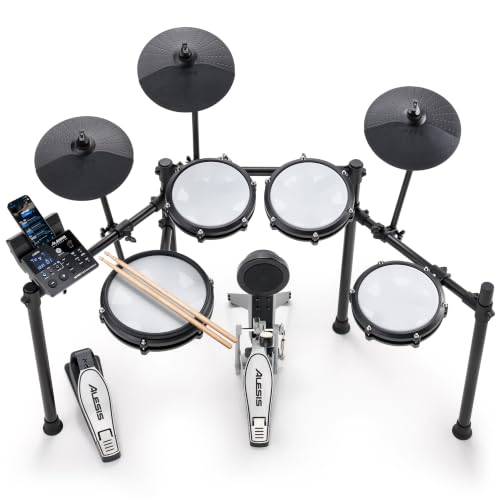
Best budget kit: Alesis Nitro Max
The Alesis Nitro Max is one of the more practical low-cost routes into electric drums. Mesh heads are quieter and generally more comfortable than hard rubber pads, and the module includes built-in kits, USB MIDI, Bluetooth audio, and expansion capability.
It is well suited to beginners, apartment practice, and players who expect to replace or upgrade components gradually. However, its rack, cymbal surfaces, and module are designed around affordability. Heavy hitters may outgrow the physical stability or the range of editing options sooner than they would with a midrange Roland or Yamaha.
For quiet practice, budget for a proper kick-pedal mat and isolation solution. The beater impact is often the loudest part of an electronic kit, and a mesh head does not eliminate vibration traveling through a floor.
Best computer-free sound flexibility: Alesis Strata Prime
The Strata Prime targets drummers who want extensive sound editing and a large display without building a computer-based rig. Its module is closer to a dedicated sound workstation than a basic trigger brain, with a broad library and detailed controls.
This makes it attractive for recording ideas, creating custom kits, and switching between genres. It is a better fit for players who enjoy editing sounds than for someone who wants the simplest possible module. Before buying, confirm that your preferred recording software supports its USB audio/MIDI workflow and that your computer has enough available USB bandwidth and ports.
Pad feel: mesh versus silicone
Mesh heads usually provide adjustable tension and a familiar stick response. They can feel closer to acoustic drums, but an overly loose head may produce inconsistent rebounds and false triggers. Start with moderate tension, then tighten in small, even turns around the head rather than tightening one lug completely at a time.
Silicone pads, used prominently in Yamaha’s DTX range, offer a controlled and relatively quiet response. They do not feel identical to mesh, but their rebound can be predictable for practice. Neither material automatically makes a kit professional: the trigger sensor, cross-talk rejection, pad size, rack stability, and module processing are equally important.
For acoustic-style technique, prioritize a real-feeling snare with separate head and rim zones, a larger kick pad, and a ride that supports bell and edge sounds. A kit with many small pads is not necessarily more expressive.
Connectivity decisions that affect real use
- Headphone output: Essential for quiet practice. Check whether the jack is 3.5 mm or 6.35 mm so you have the correct adapter.
- Bluetooth audio: Convenient for playing along with a phone. It is not the same as Bluetooth MIDI, and wireless audio can introduce enough delay to bother some players.
- USB MIDI: Sends performance data to a computer or tablet. This is useful for drum instruments, notation, lessons, and recording.
- USB audio: Sends the module’s sound directly to a computer. It can reduce the need for a separate audio interface.
- Dedicated outputs: Important for live work if the sound engineer needs separate control of kick, snare, and other channels rather than one stereo feed.
- Trigger expansion: Check the number and type of spare inputs before planning to add a second crash, extra tom, or acoustic-style kick trigger.
How much space and power do you need?
Allow approximately 1.5 by 1.2 meters for a compact kit, and roughly 1.8 by 1.5 meters for a larger midrange or premium setup. These are working clearances, not just rack dimensions: the throne, kick pedal, headphone cable, and room to move your arms need to be included.
A simple power calculation helps when building a practice corner. Suppose a module uses 12 watts, a small monitor uses 30 watts, and an LED music light uses 8 watts. The total is:
12 W + 30 W + 8 W = 50 W.
Adding a 25 percent reserve gives 62.5 watts. A power strip rated well above that figure is sufficient for those devices, but do not use the calculation to overload an extension cable or place power equipment where it can be struck by a pedal. For headphones alone, the monitor can be omitted entirely.
Which kit should you buy?
| Your priority | Recommended direction | Why | Trade-off |
|---|---|---|---|
| Lowest sensible cost | Alesis Nitro Max | Mesh playing surfaces, Bluetooth audio, USB MIDI | Less robust rack and simpler sound editing |
| One kit for practice and gigs | Roland TD-17KVX2 | Balanced feel, sounds, editing, and connections | Costs more than entry-level kits |
| Maximum articulation | Roland TD-27KV2 | Digital snare and ride provide detailed control | High price and larger footprint |
| Firm, controlled pad response | Yamaha DTX6K3-X | Expressive silicone pads and accessible controls | Feel differs from mesh and may not suit every drummer |
| Deep standalone editing | Alesis Strata Prime | Large interface and extensive sound capabilities | More features to learn and a substantial investment |
Final buying advice
For most people searching for the best electric drum sets, the Roland TD-17KVX2 is the most balanced recommendation. Pick the Yamaha DTX6K3-X when pad response and fast module control matter more than a traditional mesh feel. Move to the Roland TD-27KV2 when detailed articulation, recording flexibility, and live control justify the cost. If the budget is tight, the Alesis Nitro Max provides the essential practice connections without requiring a premium investment.
Before ordering, measure the complete playing area, confirm the module’s exact USB and audio connections, check whether the included kick pad accepts your pedal, and plan for floor isolation. Those practical details often determine whether an electric kit becomes a daily instrument or an inconvenient piece of equipment.