Key takeaways
- Dimensions: Full-size boards produce the familiar tournament distance and shot angles.
- Surface material: Wood usually offers the most predictable slide after proper sealing; composite is easier to maintain.
- Frame stability: Braced legs and a rigid perimeter reduce flex and movement.
- Folding design: Hinged legs save space, but the hardware should lock firmly and fold flat.
- Weather resistance: Outdoor finishes protect against moisture, but no wood board should be left permanently exposed.
The best cornhole boards for most backyard players are regulation-size 4-by-2-foot boards with a smooth sealed wood or composite playing surface, a rigid frame, folding legs, and weather-resistant construction; choose a lighter 3-by-2-foot set only when storage and portability matter more than tournament-style play.
Our top picks


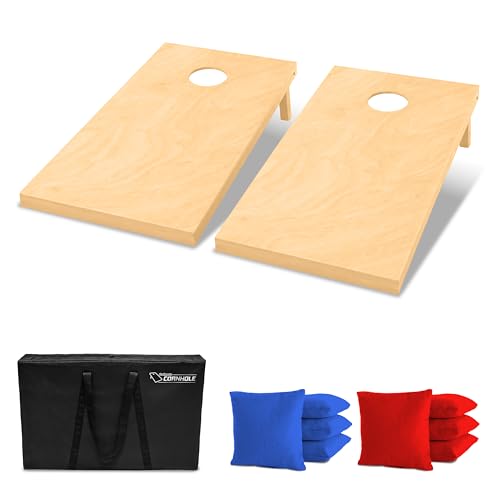

As an Amazon Associate we earn from qualifying purchases at no extra cost to you. Ratings are shown as listed on Amazon.
Best Cornhole Boards at a Glance
| Best for | Recommended board type | Key dimensions | Typical market range | Main trade-off |
|---|---|---|---|---|
| Casual backyard games | Regulation-size wood set with folding legs | 48 x 24 inches; 6-inch hole | Usually $150–$300 | Heavier than compact sets |
| Frequent travel | Portable composite or lightweight wood set | 36 x 24 or 48 x 24 inches | Usually $100–$250 | May feel less stable in wind |
| Regulation-style play | Full-size boards with plywood tops and reinforced frames | 47.5–48 x 23.5–24 inches | Usually $250–$600 | Requires more storage and careful leveling |
| Rain-prone locations | Sealed wood or molded composite boards | Usually 48 x 24 inches | Usually $180–$450 | Composite can have a different slide feel |
What Makes a Cornhole Board “Best”?
A cornhole board is more than a painted top. The playing surface controls bag speed, the frame determines whether shots bounce or shift the board, and the folding system affects how easily the set can be stored without damaging it.
For a useful comparison, evaluate five areas:
- Dimensions: Full-size boards produce the familiar tournament distance and shot angles.
- Surface material: Wood usually offers the most predictable slide after proper sealing; composite is easier to maintain.
- Frame stability: Braced legs and a rigid perimeter reduce flex and movement.
- Folding design: Hinged legs save space, but the hardware should lock firmly and fold flat.
- Weather resistance: Outdoor finishes protect against moisture, but no wood board should be left permanently exposed.
Head-to-Head: Regulation Wood Versus Portable Composite
Regulation-size wood boards
Wood boards are the best choice when you want a traditional playing feel or plan to practice for regulation-style games. A standard board is approximately 48 inches long and 24 inches wide. The front edge is normally about 3 to 4 inches high, while the rear edge is about 12 inches high. The hole is 6 inches in diameter and is positioned near the upper end of the board.
A 1/2-inch plywood top is a practical minimum for serious backyard use. Thicker tops can reduce flex, but they also add weight. Look for a frame made from solid wood or heavy-gauge composite components, with at least one cross brace beneath the top. Without bracing, a large board can sag slightly or vibrate when a bag lands near the hole.
The advantages are a familiar slide, better resistance to movement, and compatibility with standard distances. The disadvantages are weight, bulk, and greater sensitivity to neglected maintenance. A painted or sealed plywood top should be stored indoors or under a genuinely waterproof cover, rather than left on wet grass.
Portable composite boards
Composite boards are attractive for players who carry equipment to parks, campsites, tailgates, or community events. Molded plastic and synthetic tops resist moisture better than unfinished plywood and can usually be wiped clean after use.
The important distinction is between a rigid composite board and a thin roll-up or fabric-backed game surface. A rigid composite set can work well for casual games. Thin portable surfaces are convenient, but they may move, wrinkle, or change their bounce when placed on uneven ground. They are best when portability matters more than a regulation-like feel.
Composite tops can also play faster or more consistently in humid weather than poorly maintained wood. However, the finish may feel less like traditional painted plywood, so experienced players should prioritize the surface texture and not material alone.
Dimensions: Full Size or Compact?
Choose full-size boards if adults will play regularly, if you want standard scoring and spacing, or if players may later join regulation-style events. Choose compact boards when children, limited storage, or frequent transport is the priority.
| Feature | Full-size set | Compact set |
|---|---|---|
| Typical board size | 48 x 24 inches | 36 x 24 inches or smaller |
| Hole diameter | 6 inches | Often 6 inches, but verify before buying |
| Regulation-style suitability | Yes, if other specifications also match | No; useful for casual play |
| Approximate playing footprint | About 45 feet long with boards and clearance | Can fit in a shorter yard |
| Storage burden | High | Low to moderate |
For a regulation-style layout, the front edges of the boards are placed 27 feet apart. Add roughly 9 feet of clearance behind each board for players and equipment, plus side room for walking. The calculation is: 27 feet between front edges + 9 feet behind the first board + 9 feet behind the second board = approximately 45 feet of usable length. If your yard cannot provide that distance, compact boards or a shortened casual layout will be more practical.
Surface Material and Slide Speed
The smoothest-looking finish is not automatically the best finish. A very glossy surface can become unexpectedly fast, particularly with slick bags, while a rough or heavily textured coating can make bags stop abruptly and wear their fabric.
- Painted plywood: Traditional feel and easy to refinish. Inspect for sealed edges, since exposed plywood absorbs water quickly.
- Clear-coated wood: Shows the grain and can be durable, but the coating must be even and free from raised dust or bubbles.
- Molded composite: Low maintenance and good moisture resistance. Surface speed varies considerably between manufacturers.
- Vinyl graphics: Attractive designs can play well, but poorly applied graphics may peel or create seams that affect sliding bags.
For casual play, consistency matters more than a specific speed. If a board feels too fast, use bags with a slower side or a less slick fabric rather than sanding the top immediately. If the surface is visibly rough, clean it first; grit and pollen can make a board seem defective when the problem is contamination.
Frame Stability and Folding Legs
Check the underside before focusing on artwork. A strong frame should sit flat, resist twisting when lifted by one corner, and keep the legs from wobbling. Wide leg hinges, metal locking brackets, and a central support are useful signs of a durable design.
Folding legs are usually worth choosing because they reduce storage space and protect the legs during transport. The best folding systems have positive stops or locking braces so the legs cannot gradually collapse during play. Avoid relying on friction alone, especially if several people will lean against the boards while retrieving bags.
Weight is also a stability clue, but heavier is not always better. A very heavy board may be difficult for one person to carry, while a lightweight board can work well if it has non-slip feet and a rigid frame. For windy locations, prioritize a low center of gravity, broad feet, and the ability to place approved weights beneath the board without touching the playing surface.
Decision Matrix: Which Board Fits Your Situation?
| Your situation | Best choice | Specifications to prioritize |
|---|---|---|
| Games twice a month at home | Full-size folding wood set | 1/2-inch top, cross brace, sealed edges |
| Board travels in a small vehicle | Lightweight composite or compact set | Carrying handles, low folded thickness, rigid top |
| Preparing for regulation-style events | Full-size competition-oriented wood set | 48 x 24 inches, 6-inch hole, stable 12-inch rear height |
| Frequent dew, humidity, or accidental splashes | Sealed wood or molded composite | Water-resistant coating, sealed edges, quick-dry storage |
| Young children are playing | Compact or full-size set with rounded edges | Stable feet, moderate weight, smooth corners |
Weather Resistance: What the Label Does Not Tell You
“Weather-resistant” usually means a board can tolerate outdoor use, not that it can remain outside indefinitely. Water enters most easily through plywood edges, screw holes, unfinished undersides, and scratches in the coating.
After a damp game, stand wood boards vertically in a dry, ventilated place with the playing surfaces separated. Do not stack wet boards face-to-face. Once dry, check for raised edges, soft spots, peeling finish, or swollen plywood. Composite boards need less care, but their metal hinges and fasteners can still corrode if stored wet.
A waterproof cover helps with dust and short-term exposure, but it can trap condensation. For long-term storage, a dry garage, shed, or indoor closet is safer than a covered set on a patio.
Buying Checklist for the Best Cornhole Boards
- Confirm the actual board dimensions rather than relying on “regulation-style” wording.
- Look for a 6-inch hole if standard scoring and bag behavior matter.
- Prefer a rigid top of approximately 1/2 inch or thicker for regular adult play.
- Inspect whether the frame has a cross brace and whether the legs lock open.
- Check that the underside and plywood edges are sealed, not only the decorated top.
- Measure the folded boards and compare them with your vehicle and storage space.
- Choose handles or a carry bag if one person will transport the set.
- Consider surface speed alongside the bags you already own.
Final Verdict
For the broadest range of backyard games, a full-size folding wood set with a sealed 1/2-inch plywood top, reinforced frame, locking legs, and protected edges is the best all-around choice. Select composite boards when rain resistance and easy transport outrank traditional feel, and select compact boards only when space or portability makes regulation dimensions impractical. The right set is the one whose size fits your yard, whose frame stays still during play, and whose surface remains consistent after repeated outdoor use.