Key takeaways
- S-shaped blade: for chopping, mincing, mixing, pesto, hummus, and many purées.
- Emulsifying blade or disc: useful for mayonnaise, vinaigrettes, and stable dressings, if supported by the model.
- Slicing discs: choose thickness based on the menu; one general-purpose disc rarely covers tomatoes, potatoes, onions, and slaw equally well.
- Grating discs: essential for cheese, carrots, potatoes, and breadcrumbs, with coarse and fine options serving different recipes.
- Julienne or baton discs: valuable for vegetable garnishes, fries, slaws, and stir-fry preparation, but unnecessary if those foods arrive pre-cut.
- Dough blade: useful for some soft mixtures, but do not assume a food processor replaces a spiral mixer or planetary mixer for regular bread production.
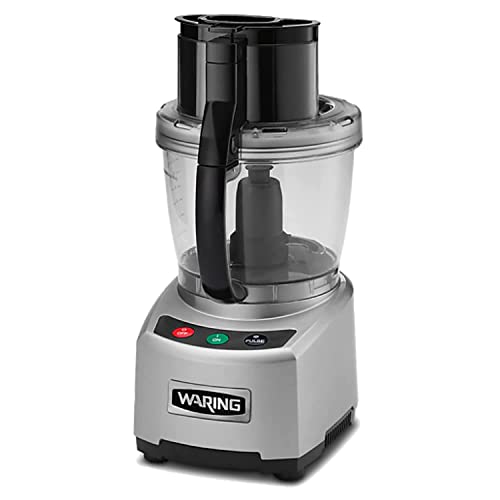
The best commercial food processor for a restaurant is usually the Robot Coupe R3 for a small-to-mid-size kitchen, the Robot Coupe R4 for heavier batch prep, or the Waring WFP16S when a large bowl, strong motor, and broad attachment package matter more than a compact footprint.
The right choice depends less on peak horsepower than on how much food you process per batch, whether you slice or shred continuously, and how quickly staff can clean the machine between allergens, menu items, and service periods. The comparison below focuses on those practical limits rather than treating a specification sheet as the whole decision.
Our top picks


As an Amazon Associate we earn from qualifying purchases at no extra cost to you. Ratings are shown as listed on Amazon.
Quick comparison
| Model or class | Approximate bowl capacity | Motor class | Best restaurant workload | Main trade-off |
|---|---|---|---|---|
| Robot Coupe R2N | About 2.9 L | Commercial induction motor, roughly 3 hp class | Sauces, emulsions, chopped vegetables, smaller prep lists | Limited batch size for high-volume slicing |
| Robot Coupe R3 | About 3.7 L | Commercial motor, roughly 3 hp class | Independent restaurants needing both bowl and slicing functions | Costs more and occupies more counter space than an entry unit |
| Robot Coupe R4 | About 4.5 L | Heavy-duty motor, commonly listed around 5 hp class | Frequent chopping, puréeing, dough-like mixtures, and larger batches | More machine than a low-volume café needs |
| Waring WFP16S | About 4 qt, or 3.8 L | About 3.5 peak-horsepower class | Large-batch prep with a useful accessory system | Attachment and storage planning are important |
| Heavy-duty continuous-feed class | Feed hopper rather than a working bowl | Approximately 1.5–3 hp commercial range | Large quantities of cabbage, onions, potatoes, and cheese | Less convenient for sauces and small batches |
Capacities and motor descriptions can vary by regional version, electrical configuration, and included kit. Confirm the exact specification before ordering, particularly if the machine must run on a dedicated circuit.
Head-to-head: which processor fits each prep pattern?
Small restaurant, café, or limited prep menu: Robot Coupe R2N
The R2N is a sensible choice when the processor will make pesto, hummus, mayonnaise, dressings, chopped herbs, mirepoix, and small vegetable batches rather than process entire cases of produce. Its smaller bowl reduces waste when a recipe needs only 1–2 litres, and the compact format is easier to position near a cook line.
Its limitation appears when the kitchen regularly prepares several kilograms of sliced onions, shredded cabbage, or grated cheese. A smaller bowl means more loading and unloading, so a machine with a stronger motor may still save less time than a larger bowl.
General-purpose prep: Robot Coupe R3
For many independent restaurants, the R3 is the best balance. It is large enough for common sauce, filling, soup-garnish, and vegetable-prep batches while remaining more manageable than a high-capacity production machine. Look for a kit that includes both an S-shaped processing blade and the slicing or grating discs your menu actually uses.
The R3 is particularly suitable when one machine must switch between chopping roasted vegetables in the morning, shredding cheese for lunch, and producing a purée or dressing later. It is not the fastest solution for continuous case processing, but it is more versatile than a dedicated vegetable cutter.
Heavy batch work: Robot Coupe R4
The R4 earns its space when the kitchen repeatedly makes large batches of salsa, soup bases, stuffing, pâté, hummus, compound butter, or purées. Its larger bowl and heavier motor reduce the need to divide dense mixtures into several small loads.
Do not buy it solely because the horsepower number is higher. If the menu mostly requires uniform slices, a larger feed hopper and the correct disc can improve output more than extra motor power. The R4 is strongest where the blade must repeatedly move dense or semi-solid food.
Large bowl and attachment flexibility: Waring WFP16S
The Waring WFP16S is a strong alternative for operators who want a roughly four-quart working bowl and a broad accessory ecosystem. It suits batch chopping, emulsifying, shredding, and slicing, provided the selected package includes the discs needed for the menu.
Before purchase, price the machine with its actual attachments rather than comparing bare units. A processor that appears less expensive can become the costlier option after adding a fine grating disc, a thin slicing disc, a julienne disc, and spare blade assemblies.
Choose by workload, not bowl size alone
| Restaurant situation | Recommended direction | Why |
|---|---|---|
| Up to roughly 10–15 litres of processed food per shift | 2.9–3.7 L batch processor | Lower waste, easier small-batch control, simpler storage |
| Several sauce or vegetable batches plus daily cheese or cabbage prep | 3.7–4.5 L combination processor | Better balance between bowl work and disc work |
| More than 20–30 litres of sliced or shredded produce per shift | Continuous-feed vegetable processor | Less stopping to empty a bowl; hopper design becomes decisive |
| Dense purées, fillings, or emulsions in repeated large batches | Heavy-duty 4–5 L batch processor | Motor torque and thermal durability matter more than throughput alone |
Feed-tube size can matter more than horsepower
A wide feed tube reduces pre-cutting and keeps slices more consistent. This is valuable for whole onions, potatoes, cucumbers, carrots, and cabbage wedges. A narrow tube may force staff to cut every item into sticks before loading, adding labour that does not appear in the machine’s wattage or horsepower rating.
For a pizzeria, compare the tube with the size of the onions and blocks of mozzarella used in daily prep. For a sandwich shop, check whether a cabbage wedge or whole pepper fits securely. For a fine-dining kitchen, a narrower tube may be acceptable because presentation and small-batch precision matter more than maximum throughput.
Attachments: buy for the menu
- S-shaped blade: for chopping, mincing, mixing, pesto, hummus, and many purées.
- Emulsifying blade or disc: useful for mayonnaise, vinaigrettes, and stable dressings, if supported by the model.
- Slicing discs: choose thickness based on the menu; one general-purpose disc rarely covers tomatoes, potatoes, onions, and slaw equally well.
- Grating discs: essential for cheese, carrots, potatoes, and breadcrumbs, with coarse and fine options serving different recipes.
- Julienne or baton discs: valuable for vegetable garnishes, fries, slaws, and stir-fry preparation, but unnecessary if those foods arrive pre-cut.
- Dough blade: useful for some soft mixtures, but do not assume a food processor replaces a spiral mixer or planetary mixer for regular bread production.
A practical rule is to calculate attachment payback. If a disc saves 20 minutes per prep day and labour is valued at $20 per hour, it saves about $6.67 per day. Used 250 days annually, that is approximately $1,668 of labour value before maintenance and ingredient savings.
Cleaning and sanitation: the overlooked capacity limit
A processor that takes 12 minutes to dismantle, wash, sanitise, dry, and reassemble may be slower in a busy kitchen than a slightly smaller machine that takes 6 minutes. Check whether the bowl, lid, pusher, blade, and discs can be removed without tools and whether the manufacturer permits them to go through the dishwasher.
For allergen control, plan separate storage or clearly identified blades and bowls for nuts, gluten, dairy, and raw proteins. Do not rely on a quick wipe between recipes. The machine should be unplugged before disassembly, food residue removed promptly, and all food-contact parts washed and sanitised according to the restaurant’s food-safety procedure.
Disc hubs and the underside of lids deserve special attention because wet food can lodge around them. Dry components fully before storage to reduce odours, corrosion, and microbial growth. Keep a spare blade and critical gasket available if the processor is central to service.
Electrical and space checks before buying
A motor rated in horsepower does not tell you the complete power requirement. As a rough planning example, a 1,500-watt processor operating from a 120-volt circuit draws about 12.5 amps at its rated electrical input: 1,500 ÷ 120 = 12.5. Because commercial equipment has starting surges and kitchens share circuits with refrigerators, warmers, and blenders, a unit near the circuit limit should not be treated as a casual plug-in appliance.
Measure clearance above the bowl and behind the motor, not just the countertop footprint. Staff need room to remove the lid, lift the bowl, load produce, and place dirty components in a bus tub. If the processor must be stored after use, measure the shelf height with the feed attachment installed.
Price expectations in 2026
Commercial processors generally range from about $400–$800 for smaller professional units, $800–$1,500 for versatile mid-capacity machines, and roughly $1,500–$3,500 or more for heavy-duty processors or complete attachment packages. Continuous-feed systems and large accessory kits can raise the total further.
For most restaurants, the best value is not the cheapest motor or the largest bowl. It is the model whose feed tube, attachments, cleaning routine, and batch size match the work performed every day. Choose the R2N for compact small-batch prep, the R3 for balanced general use, the R4 for dense heavy batches, and a continuous-feed design when slicing and shredding volume dominates the prep list.