Key takeaways
- Rode NT-USB Mini review: a compact cardioid USB mic with built-in pop filter, magnetic stand and zero-latency monitoring, compared with three close rivals.
Quick Answer
The Rode NT-USB Mini is worth buying if you want clear, focused voice recordings from a tiny desk footprint: its cardioid condenser capsule, built-in pop filter and zero-latency headphone output cover streaming, gaming chat and podcasting without an audio interface. It gives up onboard gain and mute controls, so choose it for sound quality and simplicity rather than for physical controls during a live session.


Picking a first serious USB microphone usually comes down to one uncomfortable trade: the mics that sound the most polished often bury you in dials, modes and software, while the simplest plug-and-play models can leave your voice thin and roomy. The NT-USB Mini sits deliberately on the simple side of that line, betting that a well-tuned capsule and a directional pattern matter more than a control panel. Deciding whether that bet pays off means looking closely at what Rode kept, what it removed, and who actually feels those removals.
This review is for gamers who are tired of headset microphones, new podcasters recording at a desk, streamers with limited space, and remote workers who want meetings to sound deliberate rather than accidental. Every product below was selected from its Amazon listing details — capsule type, pickup pattern, monitoring options and included hardware — so the comparison reflects what each box genuinely contains, not marketing shorthand or borrowed impressions from other roundups.
Quick Picks
As an Amazon Associate we earn from qualifying purchases
| Product | Best for | Key spec from title |
|---|---|---|
| Rode NT-USB Mini | Creators who want polished voice with zero setup fuss | Cardioid condenser, built-in pop filter |
| HyperX SoloCast | Gamers who mute often during matches | Tap-to-mute sensor, cardioid pattern |
| Razer Seiren Mini | The smallest possible streaming desk | 14mm capsule, supercardioid pattern |
| Blue Yeti Nano | Solo and two-person recording on one mic | Cardioid and omni pickup patterns |
How to Choose
Pickup pattern decides how much room you hear
A cardioid microphone listens mainly to what sits in front of it and rejects sound from the sides and rear, which is why nearly every model in this article uses some version of that pattern for voice work. The NT-USB Mini and SoloCast are both cardioid, the Seiren Mini tightens things further with a supercardioid pattern that suits noisy rooms, and the Yeti Nano adds an omnidirectional mode that hears all around it for two people sharing one microphone. Match the pattern to your space before anything else: a tight pattern forgives an untreated room, while omni only shines in a quiet one.
Monitoring is the feature beginners skip and regret
Zero-latency headphone monitoring lets you hear your own voice through the microphone itself, with no echo or delay, so you notice clipping, plosives and drifting distance before your audience does. The NT-USB Mini includes a headphone output with onboard volume control for exactly this, and the Yeti Nano offers no-latency monitoring as well. The SoloCast and Seiren Mini omit a headphone jack entirely, which keeps them cheaper and simpler but means you monitor through your software instead, accepting a small delay. If you record long sessions, direct monitoring is worth prioritising.
Controls on the body versus controls in software
Think about what your hand needs to reach mid-session. The SoloCast puts a tap-to-mute sensor on top with an LED indicator, the Yeti Nano carries physical controls on its body, and the Seiren Mini strips controls back almost completely. The NT-USB Mini takes a middle path: it has a headphone volume control but no mute button and no gain dial, because Rode expects level setting to happen in your recording app or through the free RØDE Connect software, which also unlocks a compressor, noise gate and APHEX processing. Desk tidy-minded users love this; live streamers who mute reflexively may not.
Stand, mounting and footprint shape your desk
A compact microphone only helps if it sits at the right height and angle. The NT-USB Mini ships with a detachable magnetic desk stand, so it lifts off its base and attaches to a boom arm or mic stand when your setup grows, and its small body leaves room for a keyboard in front of it. The Seiren Mini uses a tilting stand built for tight desks, while the SoloCast and Yeti Nano both include their own bases, the Yeti Nano adding cable management in its stand. Check the thread adapter situation before assuming any mic fits your existing arm.
The 4 Best Options
Rode NT-USB Mini
The NT-USB Mini is the microphone this review centres on because it resolves the beginner’s dilemma most cleanly: plug it into a USB port and the recording already sounds considered. Its cardioid condenser capsule is tuned with a smooth frequency response for vocals and instruments, the pop filter is built into the grille rather than clipped on, and the magnetic stand detaches in a second when you move to an arm. Through RØDE Connect it also supports up to four units on one computer, which quietly turns it into a small podcast system. For a single voice at a desk, this is the balanced pick.
Specs
- Model number NTUSBMINI, manufactured by RODE
- Cardioid (unidirectional) condenser capsule
- Frequency range 20 Hz – 20 kHz
- Signal-to-noise ratio 82 dB
- USB-C connection, powered over USB
- Built-in pop filter and detachable magnetic desk stand included
- 3.5mm headphone output with zero-latency monitoring and volume control
- Compatible with PC, Mac and tablet; works with RØDE Connect software
- Item dimensions 7.28 x 2.36 x 1.97 inches; weight 585 grams
- 2-year manufacturer warranty
Best for: Streamers, gamers and podcasters who want a refined voice recording from a compact, fuss-free desk mic.
Watch out for: There is no mute button or gain dial on the body, so levels and muting live in your software.
ASIN: B084P1CXFD
HyperX SoloCast
The SoloCast is the gamer-first alternative, built around one gesture competitive players actually use: tapping the top of the microphone to mute instantly, with an LED that shows your status at a glance. Its cardioid condenser capsule and USB-C plug-and-play connection cover PC, PlayStation and Mac without drivers, and the included stand and generous cable make it a genuine open-the-box-and-play option. It cannot match the Rode for monitoring, because there is no headphone output, but for Discord, Twitch and YouTube commentary where quick muting matters more than studio habits, it makes a persuasive case.
Specs
- Model number HMIS1X-XX-BK/G, from HyperX
- USB condenser microphone with cardioid polar pattern
- Tap-to-mute sensor with LED status indicator
- USB-C connection, plug and play with no drivers
- Compatible with PC, PS4, PS5 and Mac
- Includes microphone stand and USB Type-C to USB-A cable (2 m)
- Positioned for streaming, podcasts, Twitch, YouTube and Discord
Best for: Gamers and streamers who mute constantly and want that control on the microphone itself.
Watch out for: No headphone jack means no direct monitoring, so you hear yourself through software with slight delay.
ASIN: B08KFL3SFV
Razer Seiren Mini

Razer’s Seiren Mini is the minimalist of this group, an ultra-compact condenser microphone that assumes your desk space is the scarcest resource you own. Its 14mm capsule sits behind a supercardioid pickup pattern, a tighter focus than standard cardioid that helps it ignore keyboards and room noise off to the sides, which suits streamers broadcasting from bedrooms and shared spaces. The tilting stand angles the capsule toward your mouth, and the build is described as shock resistant for desk bumps. What you give up is everything extra: no headphone monitoring, no mute control, just a microphone that records and stays out of the way.
Specs
- Model number RZ19-03450100-R3U1, from Razer
- 14mm condenser capsule with supercardioid pickup pattern
- Ultra-compact mini form factor for small desks
- Heavy-duty tilting stand included
- Shock-resistant build for desk knocks
- Includes desk stand base, support rod and Micro-USB to USB Type-A cable
- Item dimensions 3.55 x 3.55 x 6.35 inches
- Colour option listed: Classic Black
Best for: Streamers with very small desks or portable setups who want the tightest noise rejection here.
Watch out for: The supercardioid pattern is less forgiving if you move off-axis, and there are no onboard controls at all.
ASIN: B08HH3FTYT
Blue Yeti Nano
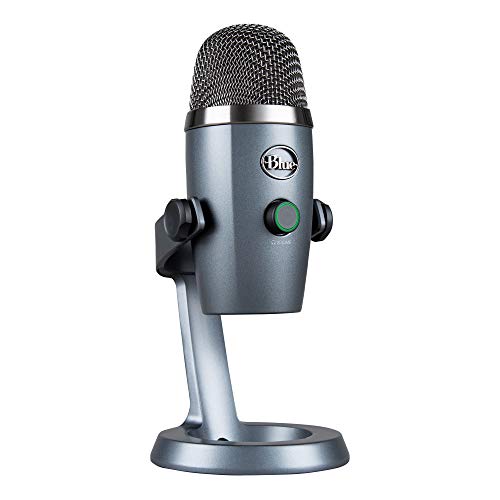
The Yeti Nano is the flexible alternative, and its defining trick is offering two pickup patterns where the others offer one. Cardioid handles the usual solo voice work, while omnidirectional mode opens the microphone up to the whole room, useful for an interview across a desk or a small group call recorded on a single device. It adds Blue VO!CE effects through its software, no-latency monitoring for checking yourself as you record, and a custom base with cable management to keep a desk tidy. It is the largest personality here, suiting creators whose recording format changes from week to week.
Specs
- Model number 988-000088, Logitech for Creators Blue Yeti Nano
- Premium USB condenser microphone for PC and Mac
- Two pickup patterns: cardioid and omnidirectional
- Blue VO!CE effects support
- No-latency headphone monitoring
- Includes Yeti Nano mic, custom base with cable management and USB cable
- Includes 1/4-inch to 5/8-inch adapter for stand mounting
- Colour option listed: Shadow Grey
Best for: Creators who alternate between solo commentary and two-person or group recording.
Watch out for: The omni mode will expose a noisy room, and the extra flexibility is wasted if you only ever record alone.
ASIN: B07DTTGZ7M
Which One Fits Your Situation
You stream or record alone at a small desk
Choose the Rode NT-USB Mini. Its cardioid capsule keeps the focus on your voice, the built-in pop filter removes one accessory from your shopping list, and the detachable magnetic stand means the same microphone later mounts on a boom arm without an adapter hunt. Add the headphone monitoring and this is the most complete solo package here.
You play competitive games and mute constantly
Choose the HyperX SoloCast. The tap-to-mute sensor answers the one action gaming sessions demand every few minutes, the LED removes any doubt about whether your team can hear you, and USB-C plug-and-play across PC and PlayStation keeps setup trivial. You trade away direct monitoring, which matters less mid-match than a reliable mute.
Your recording corner is genuinely tiny
Choose the Razer Seiren Mini. Nothing else in this comparison takes up less room, and its supercardioid pattern is an asset when a small space also means nearby walls, keyboards and housemates. Angle it carefully toward your mouth, keep a consistent distance, and its stripped-back design becomes a strength rather than a limitation.
You record interviews or group calls on one microphone
Choose the Blue Yeti Nano. Switching to omnidirectional mode lets two people share it naturally, something none of the fixed-pattern rivals can do, and its monitoring and software effects round out a creator toolkit. In cardioid mode it still handles solo work properly, so it is the safest pick when your format is not settled yet.
Common Mistakes
- Placing any cardioid microphone at the far edge of the desk, then blaming the mic for a roomy, echoing voice instead of moving it closer.
- Skipping headphone monitoring on microphones that offer it, and only discovering clipping or plosives after the recording is finished.
- Buying a supercardioid model for its noise rejection, then sitting off to its side where the tighter pattern actually hears you worst.
- Assuming every included stand fits every boom arm, without checking the thread size and whether an adapter is in the box.
- Leaving the microphone’s level to chance in software defaults, rather than setting gain so normal speech peaks comfortably below distortion.
Frequently Asked Questions
Is the Rode NT-USB Mini good for podcasting?
Yes, for solo and remote podcasting it is a strong fit. The cardioid capsule focuses on one voice, the built-in pop filter softens harsh consonants, and the free RØDE Connect software adds a compressor and noise gate while supporting up to four of these microphones on a single computer for in-person panel recordings.
Does the NT-USB Mini need an audio interface or phantom power?
No. It is a USB microphone that draws its power from the USB connection itself and sends digital audio straight to a computer or tablet, so there is no interface, mixer or phantom power supply in the chain. That simplicity is the entire point of the design, and setup is essentially plug in and select it as your input.
How does the NT-USB Mini compare with the HyperX SoloCast?
Both are compact cardioid USB microphones for voice, but they prioritise differently. The Rode adds a headphone output with zero-latency monitoring, a built-in pop filter and a detachable magnetic stand, while the SoloCast answers with a tap-to-mute sensor and LED indicator. Choose the Rode for recording discipline, the SoloCast for gaming convenience.
Can the NT-USB Mini be mounted on a boom arm?
Yes. The microphone separates from its magnetic desk stand, and the listing notes it can then be mounted on mic stands or studio arms, which makes it a sensible long-term buy for a growing setup. Confirm your arm’s thread size before ordering, and keep the desk stand for travel or a second recording spot.
FAQ
Is the Rode NT-USB Mini good for podcasting?
Does the NT-USB Mini need an audio interface or phantom power?
How does the NT-USB Mini compare with the HyperX SoloCast?
Can the NT-USB Mini be mounted on a boom arm?
More from Amazon
Programs that pair well with the guide above. Offers and eligibility are set by Amazon and may change.
Free shipping on eligible items, Prime Video and more. Eligible new members can start with a free trial.
Start a Prime free trialAd-free music streaming. Eligible new subscribers can start with a free trial.
Try Music Unlimited freeA Prime membership for ages 18-24 with a trial period. Eligibility is set by Amazon.
See Prime for Young AdultsAudiobooks and podcasts to listen to on the go. Eligible new members can start with a free trial.
Try Audible freeAs an Amazon Associate we earn from qualifying purchases.