Key takeaways
- Use a LiPo-compatible charger with balance charging.
- Stop running when the low-voltage warning activates or when the pack reaches the manufacturer’s safe limit.
- Allow the motor, electronic speed controller, and battery to cool before the next run.
- Store LiPo batteries at storage voltage rather than fully charged for long periods.
Best RC Boats for Speed, Stability, and Range in 2026
The best RC boat for most buyers is the Pro Boat Sonicwake 36 V2 if you want a fast, self-righting boat with useful range and strong stability; choose the Traxxas Spartan for maximum straight-line speed, the Pro Boat Blackjack 24 for compact lake running, and a smaller brushed model such as the Pro Boat Recoil 18 for lower-cost fun.
There is no single winner across every pond. Hull shape, battery voltage, water temperature, wind, propeller load, and whether the boat can recover from a capsize matter as much as the advertised top speed. The comparison below focuses on the practical differences that spec sheets often leave out: usable runtime, control confidence, water conditions, and how much preparation each boat needs.
Our top picks

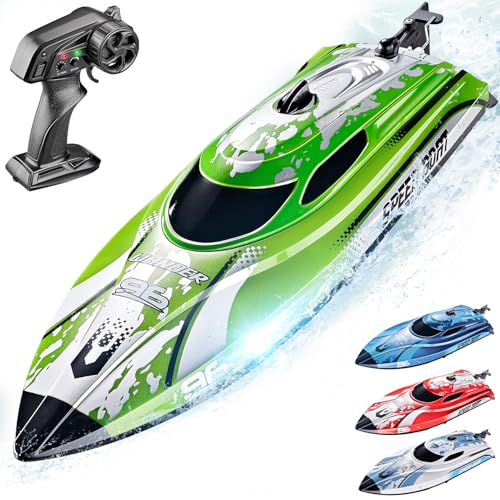
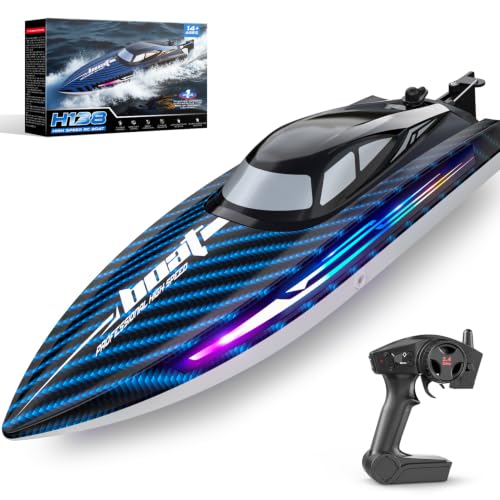

As an Amazon Associate we earn from qualifying purchases at no extra cost to you. Ratings are shown as listed on Amazon.
Quick comparison of the best RC boats
| Model | Power class | Typical speed class | Practical runtime | Control range | Best water conditions | Useful advantage |
|---|---|---|---|---|---|---|
| Pro Boat Sonicwake 36 V2 | Brushless, 4S-capable | About 45–50 mph | 6–10 minutes | About 300 m typical | Large ponds and calm lakes | Self-righting and strong stability |
| Traxxas Spartan | Brushless, 6S-capable | About 45–50 mph | 5–8 minutes | About 250–300 m typical | Large, open water | High speed and robust driveline |
| Pro Boat Blackjack 24 | Brushless, 3S-capable | About 30–35 mph | 7–10 minutes | About 200–300 m typical | Small to medium calm lakes | Portable and agile |
| Pro Boat Recoil 18 | Brushed or entry-level brushless, depending on version | About 15–25 mph | 6–10 minutes | About 100–200 m typical | Small ponds and sheltered water | Easy entry point and self-righting on equipped versions |
These are practical operating ranges rather than guaranteed figures. Speed and runtime vary with battery capacity, battery discharge rating, propeller condition, wind, water temperature, and how often the throttle is held open. Radio range also depends on antenna placement, interference, and the receiver system fitted to a particular package.
Head-to-head: which boat fits your situation?
Best overall: Pro Boat Sonicwake 36 V2
The Sonicwake 36 V2 is the strongest all-round choice for buyers who want speed without constantly worrying about recovery. Its deep-V hull handles ordinary lake chop better than a very small hydroplane, while the self-righting system can roll the boat back upright after a capsize. That feature is especially valuable because retrieving a disabled boat from the middle of a lake is difficult and sometimes unsafe.
The boat is fast enough to feel serious but does not demand the same large, open water as the fastest 6S models. A 4S battery in the correct size range generally provides a useful balance between acceleration and runtime. A high-capacity pack can extend a session, but excessive weight increases planing time, current draw, and heat.
Choose the Sonicwake 36 V2 when you want one boat for calm mornings, moderate chop, and occasional high-speed runs. It is usually positioned in the roughly $500–$750 market range, depending on whether the package includes batteries and a charger.
Best for maximum speed: Traxxas Spartan
The Traxxas Spartan is the better choice when speed is the priority and you have access to a large, unobstructed body of water. Its larger hull and high-voltage brushless setup produce strong acceleration, but that performance also exposes the trade-offs: higher battery cost, shorter full-throttle sessions, more propeller stress, and a greater need to inspect the flex shaft after running.
A Spartan is not ideal for a small pond. The boat can cross a compact body of water faster than a beginner expects, leaving little room to correct a turn. Wind and boat wake can also make a fast deep-V unpredictable near shore. Use progressive throttle until you understand how the hull reacts to chop and sudden steering inputs.
Expect a typical market price of about $600–$900 before adding spare batteries, a suitable charger, and maintenance supplies. It is a performance purchase rather than the cheapest way to try RC boating.
Best compact performance boat: Pro Boat Blackjack 24
The Blackjack 24 is a practical middle ground. Its smaller catamaran hull is easy to transport and responsive in calm water, while brushless power gives it substantially more speed than most toy-grade boats. It works well for a driver who has a modest lake but still wants the feel of a hobby-grade model.
Catamarans can run flat and efficiently in smooth water, but they are less forgiving when a crosswind lifts one side of the hull. Keep the first runs below maximum throttle and avoid turning sharply while airborne. The Blackjack is best when the surface is mostly calm and you can keep a clear safety area around the boat.
Its usual market range is approximately $300–$500, with battery and charger requirements varying by package. Confirm whether the version you are buying includes the appropriate LiPo battery, because a transmitter and boat alone do not create a ready-to-run setup.
Best for beginners and small water: Pro Boat Recoil 18
The Recoil 18 is easier to live with than a large high-voltage boat. It needs less storage space, costs less to equip, and is more appropriate for a sheltered pond. Versions with self-righting are particularly useful for new drivers, although the recovery maneuver consumes battery power and should not be repeated unnecessarily.
Its smaller hull is also more sensitive to wind and weeds. A boat this size can lose speed quickly in rough water, and a small amount of aquatic vegetation can wrap around the propeller. Choose it for learning throttle control and basic maintenance, not for crossing a large lake in heavy chop.
Battery runtime: calculate before you buy
Advertised battery capacity is only part of the runtime equation. A simple estimate is:
Runtime in hours = battery capacity in amp-hours ÷ average current draw.
For example, a 4S 5,000 mAh pack is 5 Ah. If a brushless boat averages 35 amps during mixed driving, the theoretical runtime is 5 ÷ 35 = 0.143 hours, or about 8.6 minutes. In practice, you should not completely drain a LiPo battery, and acceleration causes current spikes, so a useful session may be closer to 6–8 minutes.
This also explains why doubling capacity does not always double runtime. A heavier battery makes the motor work harder and may shift the hull deeper into the water. A second correctly matched battery is often more useful than one oversized pack because it lets the motor cool between runs.
- Use a LiPo-compatible charger with balance charging.
- Stop running when the low-voltage warning activates or when the pack reaches the manufacturer’s safe limit.
- Allow the motor, electronic speed controller, and battery to cool before the next run.
- Store LiPo batteries at storage voltage rather than fully charged for long periods.
Waterproofing and stability: what the labels do not mean
“Waterproof electronics” means the receiver, speed controller, and related components are designed to tolerate water exposure during normal operation. It does not mean the boat can be submerged indefinitely. Water can still enter through the hatch seal, cooling tubes, driveshaft opening, or a damaged gasket.
Before each launch, check that the hatch seal is clean and fully seated. After running, remove the hatch, drain visible water, and dry the interior. If the boat takes on water repeatedly, stop using it until the leak is found; water near a high-current battery connection is a safety problem.
For stability, deep-V hulls such as the Sonicwake and Spartan generally handle moderate chop more predictably than very small flat or catamaran hulls. Catamarans can be exceptionally quick on smooth water but may catch wind during a turn. A heavier boat is not automatically more stable: excessive battery weight can reduce freeboard and make the hull bury its nose into waves.
Decision matrix: match the boat to your water
| Your situation | Best direction | Reason | Avoid |
|---|---|---|---|
| Small sheltered pond | Recoil 18 or another compact brushed model | Lower speed, easier recovery, less space required | 6S boats that can outrun the available water |
| Medium calm lake | Blackjack 24 | Portable, quick, and efficient in smooth conditions | Running during strong crosswinds |
| Large lake with occasional chop | Sonicwake 36 V2 | Deep-V stability and self-righting reduce recovery risk | Very small hulls that lose speed in waves |
| Large open water and maximum speed | Traxxas Spartan | High-voltage power and strong straight-line performance | Launching near swimmers, boats, rocks, or shore traffic |
Essential checks before the first run
- Inspect the propeller and shaft. Remove fishing line, weeds, and grit before they increase motor load.
- Test steering with the boat powered on but out of the water. Confirm left and right movement, then turn the system off in the correct order recommended by the manufacturer.
- Verify the battery connector and polarity. A loose high-current connector can heat up or interrupt power under acceleration.
- Use a wide launch area. Keep people, wildlife, docks, and other boats outside the turning path.
- Make a short low-throttle pass. Check that cooling water is flowing and that the boat tracks straight before attempting full speed.
Final recommendation
For the broadest combination of speed, stability, runtime, waterproof electronics, and recovery capability, the Pro Boat Sonicwake 36 V2 is the best RC boat for most hobbyists. Pick the Traxxas Spartan if outright speed matters more than running cost and convenience. The Pro Boat Blackjack 24 is the better compact performance option for calm water, while the Pro Boat Recoil 18 makes more sense for beginners with limited space. Whichever model you choose, match the battery to the manufacturer’s voltage and size requirements; the wrong battery can turn a fast boat into an unstable, overheated, and short-lived one.