Key takeaways
- 4–8 pounds: suitable for small lakes, light tackle, and compact boats at modest trolling speeds.
- 8–12 pounds: the useful middle range for many freshwater boats and moderate currents.
- 12–20 pounds: better for deep trolling, stronger current, larger boats, and reduced cable angle.
The best downriggers for most anglers are the Cannon Uni-Troll 10 STX for simple manual trolling, the Cannon Magnum 10 STX for an affordable electric setup, and the Scotty 1106 Depthpower when a larger boat needs a longer boom and heavier cable capacity.
Our top picks


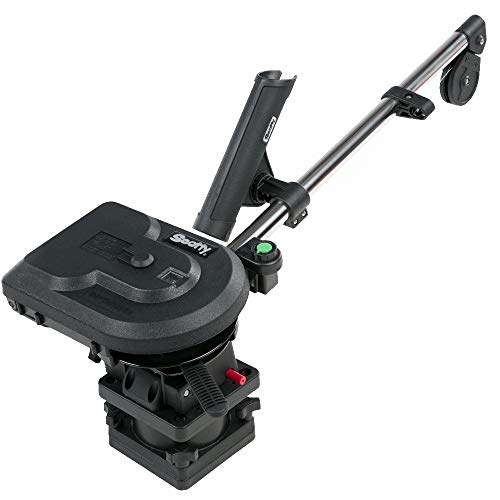
As an Amazon Associate we earn from qualifying purchases at no extra cost to you. Ratings are shown as listed on Amazon.
Best Downriggers at a Glance
| Best for | Recommended model | Drive | Typical weight capacity | Boom length | Typical cable length |
|---|---|---|---|---|---|
| Small lakes and compact boats | Scotty Laketroller 1050 | Manual | Up to about 8 lb | About 23 in | Usually 100 ft |
| General-purpose manual trolling | Cannon Uni-Troll 10 STX | Manual | Up to about 10 lb | About 24 in | Usually 200 ft |
| Electric trolling on small or medium boats | Cannon Magnum 10 STX | Electric | Up to about 20 lb | About 24 in | Usually 250 ft |
| Heavy cable and wide gunwale clearance | Scotty 1106 Depthpower | Electric | Up to about 20 lb | About 36 in | Usually 250 ft |
Published capacities and cable configurations can vary by version, boom extension, and included spool. Check the exact specification before ordering replacement cable, a boom upgrade, or a weight heavier than the standard recommendation.
Manual vs. Electric Downriggers
Manual models: fewer failure points and lower cost
A manual downrigger is the better choice when you fish one or two lines, move between boats, or troll mainly in water shallower than about 100 feet. The crank is mechanically simple, does not depend on a battery, and usually costs less to install. The Cannon Uni-Troll 10 STX is a strong all-round option because its 10-pound class is adequate for inland lakes and moderate coastal trolling.
The limitation is retrieval effort. A 10-pound ball lifted from 150 feet requires substantially more cranking than a ball raised from 40 feet, especially when current creates additional drag. Manual units also slow down a crew that regularly changes depths, clears lines, or fishes multiple downriggers.
Electric models: speed, repeatability, and less fatigue
Electric downriggers make sense for deep water, frequent depth changes, heavy weights, or a crew that wants to bring the ball up quickly when a fish strikes. The Cannon Magnum 10 STX is a practical 12-volt choice for many trailerable boats. The Scotty 1106 Depthpower is aimed at anglers who value a longer boom and a heavy-duty setup.
Electric does not automatically mean better. It adds wiring, a fuse or circuit breaker, battery demand, and another motor or control component that must be protected from spray. If your boat has no convenient 12-volt supply near the mounting point, installation can be more important than the difference between two similarly rated models.
Choosing Weight Capacity
Downrigger weight is determined by depth, trolling speed, line diameter, and current. A light ball may work at 30 feet in calm freshwater but blow back considerably at 100 feet. Blowback means the cable angles behind the boat, so the ball is not directly beneath the downrigger. That reduces depth accuracy and can place two lines closer together than expected.
- 4–8 pounds: suitable for small lakes, light tackle, and compact boats at modest trolling speeds.
- 8–12 pounds: the useful middle range for many freshwater boats and moderate currents.
- 12–20 pounds: better for deep trolling, stronger current, larger boats, and reduced cable angle.
Do not select a weight solely because the downrigger can lift it. Confirm the rod holder, boom, mounting plate, cable termination, and boat structure can handle the load. A heavy ball swinging beside a small aluminum boat creates a large side load when the boat turns or rocks.
Boom Length and Boat Size
Boom length controls how far the cable and weight sit outside the boat. A short boom keeps the unit compact and places less leverage on the mount, which suits narrow gunwales and small fishing boats. The Scotty Laketroller 1050 is a sensible class of product for this application.
A boom around 24 inches is a useful compromise for many 16- to 20-foot boats. It provides clearance from the hull without making the downrigger excessively heavy or awkward. A 36-inch boom, such as the configuration associated with the Scotty 1106 Depthpower, is more helpful on a broad large boat, when trolling multiple lines, or when the hull shape makes a short boom place the weight too close to the side.
Longer is not always safer. Every extra inch increases leverage on the mounting surface. If the boom extends 36 inches and carries a 20-pound weight, the mount experiences much more torque than a short boom carrying the same weight. Reinforce the mounting area rather than relying on a thin rail or a single small clamp.
Mounting Options: Match the Hardware to the Boat
Flush or fixed gunwale mount
A fixed mount is the most rigid choice for a permanent installation. It is appropriate for larger fiberglass or aluminum boats with a strong horizontal deck or gunwale. Use a backing plate below the deck whenever possible. The backing plate spreads the load and reduces the chance of cracked laminate, distorted aluminum, or pulled fasteners.
Clamp-on mount
A clamp mount is convenient for rental boats, removable equipment, and owners who do not want to drill. It works best when the gunwale is thick, flat, and structurally sound. Measure the rail before buying: curved caps, windshield tracks, flotation compartments, and rub rails can prevent a clamp from sitting squarely.
Swivel or quick-release mount
A swivel plate can let you rotate the downrigger inward for storage or outward for fishing. A quick-release system is valuable when the boat is trailered frequently. The trade-off is added height and another interface that must remain tight. Inspect the locking pin and mounting bolts before every trip; movement at the base can amplify boom flex.
A Practical Decision Matrix
| Your situation | Useful specification | Best product class | Why |
|---|---|---|---|
| 12–16 ft boat, shallow lake, one or two lines | Manual, 4–8 lb capacity, 20–24 in boom | Scotty Laketroller 1050 class | Low weight, simple mounting, modest cable demand |
| 16–19 ft boat, mixed lake fishing | Manual, about 10 lb capacity, 24 in boom | Cannon Uni-Troll 10 STX class | Good balance of depth range, cost, and portability |
| Frequent depth changes or deep trolling | Electric, 15–20 lb capacity, 200–250 ft cable | Cannon Magnum 10 STX class | Faster retrieval and less crank effort |
| Large boat, multiple lines, strong current | Electric, 20 lb capacity, 30–36 in boom | Scotty 1106 Depthpower class | More hull clearance and heavy-duty cable range |
Electric Power Planning: A Simple Calculation
Before choosing an electric model, check the battery and wiring rather than assuming the starter battery has unlimited reserve. As an example, suppose a downrigger motor draws 20 amps while lifting and runs for 90 seconds per retrieval. Ten retrievals consume:
20 amps × 1.5 minutes × 10 ÷ 60 = 5 amp-hours.
That is only the motor’s estimated consumption. Add fish-finding electronics, pumps, lights, engine starting reserve, cold temperatures, and the fact that a lead-acid battery should not normally be deeply discharged. A 50-amp-hour auxiliary battery might theoretically cover the downrigger workload, but a dedicated fused circuit from an auxiliary battery is safer than relying on small accessory wiring.
Use marine-grade wire sized for the distance from the battery to the downrigger, install the manufacturer’s recommended fuse or breaker close to the battery, and protect connectors from spray. Voltage drop can make an electric downrigger slow even when the battery appears charged.
What to Check Before Buying
- Measure the gunwale width, mounting surface, and clearance from rod holders, cleats, and outboard controls.
- Confirm whether the package includes stainless cable, a swivel base, a weight, or only the downrigger body.
- Match cable length to maximum fishing depth; 200–250 feet gives useful reserve for deep-water trolling.
- Check the rod-holder angle and placement so a loaded rod does not interfere with the crank, motor, or neighboring line.
- Confirm replacement parts are available, especially cable, termination hardware, boom supports, switches, and mounting plates.
Final Recommendation
Choose the Scotty Laketroller 1050 class for a compact boat and light freshwater use. Choose the Cannon Uni-Troll 10 STX when you want a dependable manual downrigger with more general-purpose range. For repeated deep retrievals, the Cannon Magnum 10 STX is a strong electric starting point. Move to a long-boom electric model such as the Scotty 1106 Depthpower when your larger boat, heavier weights, and multiple lines justify the extra mounting strength and battery planning.