Key takeaways
- Pro: Highest RPM rating in this group at 990,000
- Pro: Two batteries and a charger included in the box at under $60
- Con: RPM figures on generic cordless blowers are not standardized across brands, so real-world airflow may not match the spec-sheet gap versus competitors
Few search queries for outdoor power equipment are as specific as “wood ranger leaf blower,” yet buyers arriving at that phrase share the same underlying need: a lightweight, cordless handheld unit that can clear a patio, drive the dust out of mulch beds, and push a few stray leaves off the walk without the bulk of a full-size backpack model. The options have multiplied dramatically, and the spec sheets range from modest 20V motors to claims exceeding 980,000 RPM, making it genuinely hard to separate a dependable workhorse from a rebranded generic.
What separates a good pick from a mediocre one in this compact segment comes down to three things: whether the motor and battery combo can sustain meaningful airflow for the full charge cycle, how the unit balances in your hand after ten minutes of sweeping, and whether the included accessories (extra batteries, multiple nozzles) actually cover the varied jobs a homeowner faces. Price matters, but a $40 blower that stalls after three minutes of continuous use costs you more in frustration than a $70 unit that finishes the yard in one pass. This guide compares eight current models on published specs and aggregated owner feedback to help you narrow the field.
Our top picks




As an Amazon Associate we earn from qualifying purchases at no extra cost to you. Ratings are shown as listed on Amazon.
Quick Picks
| Product | Best For | Price |
|---|---|---|
| FAOGO 990K RPM | Maximum claimed power in a budget cordless | $59.98 |
| 560 CFM Handheld (Red/Black) | Patios and dust-heavy cleanup | $59.99 |
| YOOVL 6-Speed | Versatility across snow, leaves, and dust | $58.98 |
| YUQUESEN 980K RPM | Buyers prioritizing raw speed claims | $79.99 |
| Brushless 980K RPM (3 Nozzles) | Variable speed precision on mixed tasks | $69.99 |
| MZK 20V | Tight budgets and light, quick jobs | $39.98 |
| BLACK+DECKER LB700 | Small yards near an outlet | $42.69 |
| Makita DUB185Z | Existing 18V LXT battery owners | $79 |
How We Picked
We filtered this group on four criteria: published motor output or airflow figures, battery configuration (voltage, capacity, and count), weight and ergonomics as described in owner reviews, and whether the included accessories reduce the need for separate purchases. Where RPM or CFM claims differ wildly between manufacturers using different measurement standards, we flagged the inconsistency rather than treating the numbers as directly comparable.
The 8 Best Wood Ranger Leaf Blower in 2026
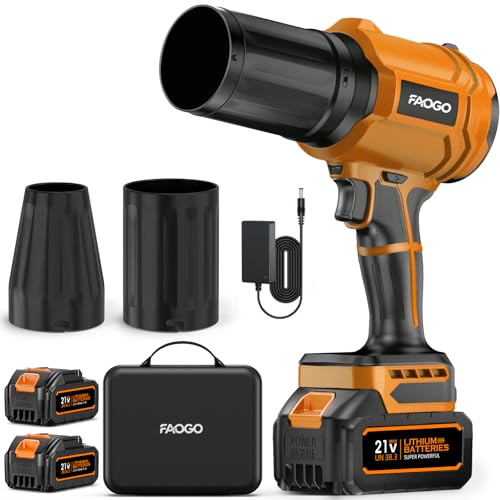
FAOGO Cordless Leaf Blower with 2 Batteries & Charger
For homeowners who want the highest RPM figure on this list without paying a premium price, the FAOGO makes the claim at 990,000 RPM. The orange housing is distinctive, and the dual-battery setup means you can swap packs mid-job rather than waiting on a recharge. Owners frequently note how light it feels during extended patio sweeps.
- Pro: Highest RPM rating in this group at 990,000
- Pro: Two batteries and a charger included in the box at under $60
- Con: RPM figures on generic cordless blowers are not standardized across brands, so real-world airflow may not match the spec-sheet gap versus competitors
Skip it if you already own 18V or 20V batteries and want to avoid carrying a proprietary pack.
Cordless Leaf Blower 560 CFM with 21V 4.0Ah Batteries
Unlike most entries that lead with RPM, this unit publishes a CFM number—560—giving buyers a more tangible airflow reference point. The red-and-black styling is conventional, and the 21V 4.0Ah battery pair keeps runtimes reasonable for medium-sized cleanup tasks. Owners call it out for handling dust on concrete and gravel patios effectively.
- Pro: States a CFM rating directly, making it easier to compare against other brands that use CFM
- Pro: Generous 4.0Ah capacity on both included batteries extends work time between charges
- Con: No variable speed dial mentioned in the listing, so you work at a fixed output level
Skip it if you need speed control for delicate tasks like clearing flower beds without scattering mulch.
YOOVL Leaf Blower with 6 Speed Modes
The YOOVL earns its place here by offering six distinct speed settings, which is unusually granular for a cordless handheld under $60. It is marketed for leaves, dust, and light snow, making it a genuine year-round option in milder climates. The two 4.0Ah batteries match the capacity of pricier competitors, and the overall weight stays low enough for overhead comfort.
- Pro: Six speed modes give you fine control from a gentle dust nudge to a full-power leaf blast
- Pro: Lowest price on this list at $58.98 while still including two high-capacity batteries
- Con: Published RPM and CFM figures are not listed, so you are relying on speed-mode labels rather than hard airflow data
Skip it if you want a single unit with transparent, comparable performance specs.
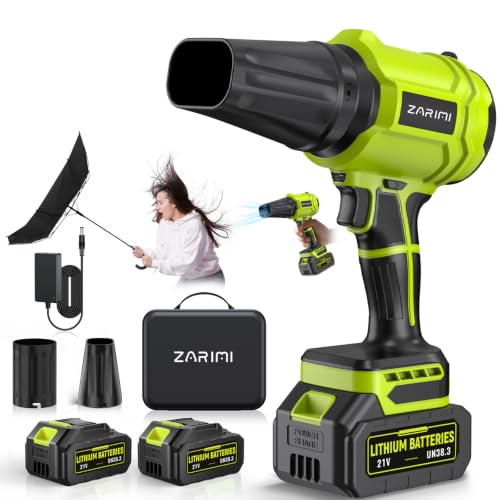
YUQUESEN Cordless Leaf Blower 980,000 RPM
Coming in at $79.99, the YUQUESEN is the priciest battery-included option here and claims 980,000 RPM. The bright green colorway sets it apart on a crowded shelf. Buyers looking at this one are primarily chasing that high-RPM figure and the lightweight handheld form factor. Two batteries and a charger round out the package.
- Pro: Claims the second-highest RPM in this group, close to the FAOGO leader
- Pro: Lightweight design noted across owner feedback for reduced arm fatigue
- Con: The $20 premium over the FAOGO for a 10,000-RPM difference (within typical measurement variance) is hard to justify on spec alone
Skip it unless the bright green color or specific grip shape appeals to you over the cheaper alternatives.
Brushless 980,000 RPM Handheld Leaf Blower with 3 Nozzles
This unit is the only one on the list explicitly calling out a brushless motor and infinite speed control. For anyone who has dealt with stepped speed switches snapping to the wrong setting, a variable trigger or dial makes a real difference. Three included nozzles let you narrow the airstream for crevices or widen it for open lawns. Two 4.0Ah batteries keep it competitive on runtime.
- Pro: Brushless motor typically means longer service life and less maintenance than brushed alternatives
- Pro: Three nozzles plus infinite speed control offer the widest task coverage in this lineup
- Con: No brand name is listed, which may make warranty or replacement-part sourcing harder down the road
Skip it if brand-name support and a recognized warranty network matter to you.
MZK 20V Cordless Leaf Blower
At $39.98, the MZK is the cheapest cordless option in this roundup. It strips away extras—no second battery, no speed dial, no color story—and focuses on the basics: a 20V motor in a lightweight handheld shell. For quick jobs on a small patio or deck, it does the work. MZK is an established budget brand in cordless outdoor tools, which lends some reliability confidence.
- Pro: Lowest price on the entire list, undercuts even the corded BLACK+DECKER
- Pro: Recognizable budget-tool brand with a track record in cordless outdoor equipment
- Con: Single-battery design limits you to shorter continuous sessions before a recharge break
Skip it if you routinely clear more than a quarter-acre yard or need both hands free during long runs.
BLACK+DECKER Electric Leaf Blower LB700
The LB700 is a corded, 7-amp unit producing 180 MPH and 180 CFM. It is the only entry here that plugs into a wall, which removes any runtime anxiety but tethers you to an outlet or extension cord. For small yards where you can reach a porch outlet without a 100-foot cord, the BLACK+DECKER name brings dealer support and a familiar warranty process.
- Pro: Corded power means unlimited runtime with no battery swaps or recharge downtime
- Pro: Major brand with broad parts availability and a recognizable service network
- Con: The cord is a genuine restriction on larger properties or areas without easy outlet access
Skip it if your cleanup zone is more than a comfortable extension-cord distance from power.
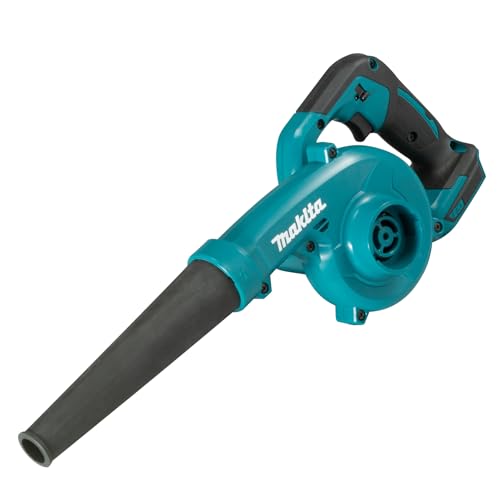
Makita DUB185Z Cordless Handheld Leaf Blower
The Makita DUB185Z arrives bare—no battery, no charger—because it is designed for people already invested in the 18V LXT platform. If you own a Makita drill, impact driver, or string trimmer, dropping in an existing battery makes this the cheapest long-term ownership option in the group. At $79 for the tool only, it costs more upfront than most here, but the platform savings add up. Build quality and motor refinement from Makita are consistently praised in owner feedback.
- Pro: Integrates into a vast existing 18V LXT ecosystem, so no new charger or proprietary battery is needed
- Pro: Known build quality and motor longevity from a professional-grade tool manufacturer
- Con: Sold without battery or charger, adding $50 or more if you do not already own compatible packs
Skip it if you do not already own Makita 18V batteries and want a complete out-of-the-box package.
Buying Guide
Understand What the Numbers Actually Measure
RPM, CFM, and MPH are different units answering different questions. RPM describes motor shaft speed, CFM describes total air volume moved, and MPH describes exit velocity through the nozzle. A high-RPM motor does not automatically produce higher CFM because impeller design, housing geometry, and nozzle diameter all play roles. When comparing a 990,000-RPM FAOGO against a 560-CFM competitor, you are comparing apples and oranges. Prioritize CFM and MPH if both are published, since those translate more directly into clearing performance.
Battery Configuration Determines Real-World Usability
A 4.0Ah pack roughly doubles the capacity of a 2.0Ah pack, but weight scales with it. Two 4.0Ah batteries at 21V (the YOOVL, the 560 CFM unit, and the brushless model) give you extended sessions and a backup swap. Single-battery units like the MZK force a stop-and-charge cycle that breaks workflow. If your property has multiple distinct zones, the second battery saves meaningful time.
Speed Control and Nozzle Variety Match Your Tasks
Fixed-speed blowers are fine for uniform leaf cover but struggle when you need to gently nudge dust off outdoor furniture without toppling a lightweight chair. Infinite or multi-step speed control (the YOOVL, the brushless model) covers that range. Multiple nozzles extend the same tool from wide-area sweeping to targeted crevice work. If your cleanup involves a mix of surfaces and debris types, prioritize units with variable speed and interchangeable nozzles over those that simply chase a higher RPM number.
Our Verdict
Top pick: The brushless 980,000 RPM handheld with three nozzles and infinite speed control at $69.99 offers the best balance of motor longevity, task versatility, and included accessories in this group. Budget pick: The MZK 20V at $39.98 is the most affordable entry that still delivers a functional cordless experience for light, quick jobs. Condition where another wins: If you already own Makita 18V LXT batteries, the DUB185Z becomes the best long-term value in this list because you bypass battery and charger costs entirely.
FAQ
Is a higher RPM always better on a handheld leaf blower?
No. RPM measures motor shaft speed, not the airflow that actually moves debris. A well-designed 560-CFM blower can outperform a poorly housed 990,000-RPM unit. Look at CFM and MPH together when those figures are published.
Can I use a cordless blower to move wet leaves or packed snow?
Most handheld cordless units handle light, dry snow effectively—the YOOVL explicitly markets for it—but wet, compacted snow and matted leaves require significantly more airflow and weight that backpack or wheeled models provide. Treat these handhelds as finishing tools, not primary snow removal equipment.
Why does the Makita cost $79 without a battery while others include two batteries for less?
Makita sells tools bare because their 18V LXT ecosystem assumes you already own compatible packs. The $79 reflects tool-only pricing from a professional brand. The cheaper battery-included units are typically consumer-grade generics where the batteries are the bulk of the retail value.
Do I need a corded or cordless blower for a typical suburban yard?
For lots under roughly half an acre with a patio, a walkway, and a small lawn area, a cordless handheld is the practical choice. The freedom of no cord outweighs the runtime limitation for most homeowners, especially when a second battery is included. Reserve corded models like the LB700 for properties near outlets where you want zero downtime.