
Key takeaways
- Sensor quality over DPI numbers: Ignore 26,000 DPI marketing. Almost no one plays above 3,200 DPI. What matters is tracking consistency and zero smoothing or acceleration — modern Hero and Focus-series sensors deliver this reliably at this price.
- Shape and grip style: Palm-grip players want a taller, filled-out hump; claw and fingertip players want something shorter and lighter. Measure your hand from wrist crease to middle fingertip and match it against the mouse’s listed length before buying.
- Weight and cable: Under 100g is the comfortable modern standard for wired mice. If you go wired, insist on a flexible paracord-style or well-relieved rubber cable — a stiff cable adds more perceived drag than 20g of extra weight.
- Wireless is now viable under $50: Budget wireless no longer means input lag. Look for a dedicated 2.4GHz USB receiver rather than Bluetooth-only, and check battery life claims are quoted at realistic polling rates.
- Buttons and switch durability: Six programmable buttons is the sweet spot for most genres; MMO and MOBA players benefit from more. Check the rated click lifespan (50–70 million is standard now) and whether onboard memory lets you keep macros without running software.
What's inside
Shopping for a gaming mouse under $50 is trickier than it looks. The budget tier is crowded with lookalike shells, inflated DPI claims, and sensors that drift the moment a match gets tense — and the marketing rarely tells you which corners were cut. Meanwhile, genuinely good mice from Logitech and Razer routinely dip into this range during sales, which means the difference between a forgettable purchase and a mouse you keep for four years often comes down to timing and knowing what actually matters.
This guide cuts through that. We’ve focused on models that deliver flagship-grade sensors, honest build quality, and software that won’t fight you — all realistically obtainable at or under $50 in 2026. Below you’ll find our shortlist, a quick framework for choosing the right shape and switch type for your grip, short expert reviews of each pick, and answers to the questions budget buyers ask most.
As an Amazon Associate we earn from qualifying purchases.




⚡ Save on Your Next PC — Amazon Prime
Prime members get fast free shipping on the systems above, plus early access to Prime Day & Black Friday PC deals. New members get a 30-day free trial.
Watch: Best Gaming Mouse Under $50 — Video Review
How to Choose Gaming Mouse Under $50
- Sensor quality over DPI numbers: Ignore 26,000 DPI marketing. Almost no one plays above 3,200 DPI. What matters is tracking consistency and zero smoothing or acceleration — modern Hero and Focus-series sensors deliver this reliably at this price.
- Shape and grip style: Palm-grip players want a taller, filled-out hump; claw and fingertip players want something shorter and lighter. Measure your hand from wrist crease to middle fingertip and match it against the mouse’s listed length before buying.
- Weight and cable: Under 100g is the comfortable modern standard for wired mice. If you go wired, insist on a flexible paracord-style or well-relieved rubber cable — a stiff cable adds more perceived drag than 20g of extra weight.
- Wireless is now viable under $50: Budget wireless no longer means input lag. Look for a dedicated 2.4GHz USB receiver rather than Bluetooth-only, and check battery life claims are quoted at realistic polling rates.
- Buttons and switch durability: Six programmable buttons is the sweet spot for most genres; MMO and MOBA players benefit from more. Check the rated click lifespan (50–70 million is standard now) and whether onboard memory lets you keep macros without running software.
The Best Picks Reviewed
Logitech G305 Lightspeed
Still the benchmark for affordable wireless, the G305 pairs Logitech’s Hero sensor with genuinely lag-free Lightspeed connectivity and runs for months on a single AA. It’s a compact, ambidextrous-leaning shape that suits small-to-medium hands and claw grips especially well.
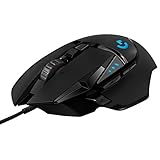
Logitech G502 Hero
The G502 remains the most feature-dense mouse in this bracket, with eleven programmable buttons, an infinite-scroll wheel, and adjustable weights for players who like a heavier glide. It’s a big, right-handed shape best suited to palm-grip users who want one mouse for gaming, work, and creative apps.
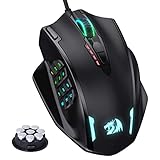
Redragon M612
The M612 is the value outlier here — 8000 DPI optical tracking, fully remappable keys, and RGB for a fraction of what the name brands charge. Build quality is plainly a step below the Logitech and Razer options, but for a first gaming mouse or a spare rig, the performance-per-dollar is hard to argue with.
Razer Basilisk V3
Razer’s ergonomic workhorse delivers optical switches, a superb tilt-and-free-spin scroll wheel, and eleven configurable inputs in a shape that’s noticeably more comfortable than the G502 for long sessions. It regularly falls under $50 during sale periods, and at that price it’s arguably the best all-round wired mouse listed here.
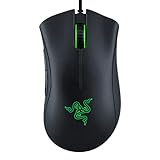
Razer DeathAdder Essential
The DeathAdder shape has sold tens of millions of units for a reason, and the Essential strips it back to a reliable optical sensor, five buttons, and a rock-solid 6,400 DPI. If you have medium-to-large hands, palm grip, and simply want a mouse that works without fuss, this is the safest sub-$50 purchase on the list.
Frequently Asked Questions
Is a wireless gaming mouse under $50 actually good enough for competitive play?
Yes. Dedicated 2.4GHz wireless like Logitech’s Lightspeed has been indistinguishable from wired in blind testing for several years now. The compromise at this price isn’t latency — it’s usually fewer buttons, no charging dock, and a plastic rather than magnesium shell.
How much DPI do I really need?
Far less than the box claims. Most competitive FPS players sit between 400 and 1,600 DPI and adjust sensitivity in-game. Every mouse on this list exceeds what you’ll ever use, so treat DPI as a non-factor and judge sensor consistency instead.
Does mouse weight matter at this budget?
It matters for fast-flick shooters, where sub-80g helps. For MOBAs, MMOs, strategy, and general use, a 90–120g mouse with a good glide feels perfectly fine — and heavier mice often come with sturdier shells and more buttons, which is a fair trade.
Are premium models like the G PRO X2 Superstrike worth saving for?
Only if you play competitively at a high level. The Superstrike’s inductive switches and ultralight build are genuine upgrades, but they sit well above this budget. For most players, a G305 or DeathAdder plus a good mousepad delivers more real-world improvement per dollar.
Final Thoughts
If you want one recommendation, take the Logitech G305 Lightspeed — it’s the rare budget mouse with no meaningful compromises, and cutting the cable genuinely changes how a mouse feels. Palm-grip players who want maximum buttons should look to the Logitech G502 Hero, while the Razer Basilisk V3 is the pick to watch during sales, where it delivers near-flagship ergonomics and optical switches for well under $50. Any of the three will outlast several GPU upgrades.


