Key takeaways
- Print speed: 55 ppm and up (A4/letter). Color and mono speeds should be identical on true office flagships.
- Monthly duty cycle: 150,000 to 300,000 pages, with a recommended monthly volume of 5,000-30,000 pages.
- Paper capacity: 1,200 sheets standard, expandable to 2,300-6,300 sheets via cassettes and high-capacity feeders.
- Duplex scanning: Single-pass duplex ADF scanning 100-270 images per minute (ipm).
- Security and fleet management: TPM chips, self-healing firmware, user authentication, and remote fleet tools.
The best high end office multifunction laser printers for demanding workflows in 2026 are the HP Color LaserJet Enterprise Flow MFP 5800zf/6800zf series, Canon imageRUNNER ADVANCE DX C5800 series, Xerox VersaLink C7100 series, and Lexmark CX944/CX963 series, because they combine 55-70 ppm print speeds, 200,000+ page monthly duty cycles, 2,000+ sheet paper capacity, single-pass duplex scanning at 100+ ipm, and enterprise security with manageable toner costs.
Our top picks

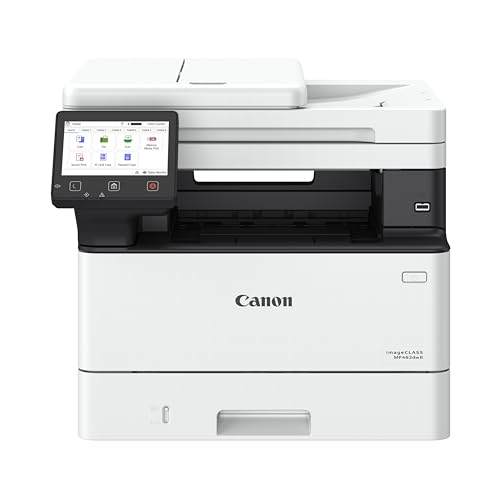
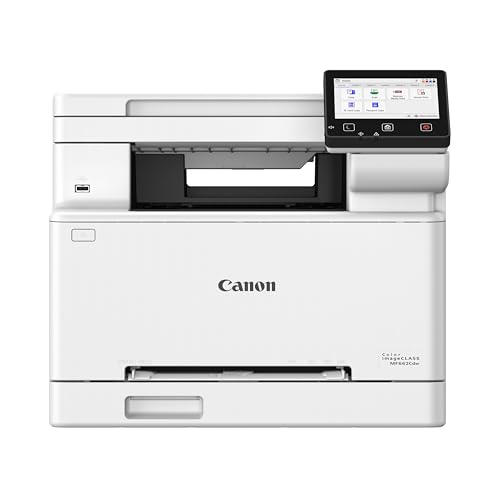

As an Amazon Associate we earn from qualifying purchases at no extra cost to you. Ratings are shown as listed on Amazon.
What Defines a High-End Office Multifunction Laser Printer
For a small office or workgroup, a 20-30 ppm printer is enough. High-end office MFPs are built for 15-50+ users sharing one device for print, copy, scan, and fax with minimal downtime. The threshold specs to look for are:
- Print speed: 55 ppm and up (A4/letter). Color and mono speeds should be identical on true office flagships.
- Monthly duty cycle: 150,000 to 300,000 pages, with a recommended monthly volume of 5,000-30,000 pages.
- Paper capacity: 1,200 sheets standard, expandable to 2,300-6,300 sheets via cassettes and high-capacity feeders.
- Duplex scanning: Single-pass duplex ADF scanning 100-270 images per minute (ipm).
- Security and fleet management: TPM chips, self-healing firmware, user authentication, and remote fleet tools.
If a device misses on two or more of those, it is a mid-range workgroup printer, not a high-end office MFP.
Head-to-Head Comparison: 5 Proven High-End Models
These classes represent the most deployed high-end laser MFPs in enterprise offices as of 2026. Specs are for the top configuration in each family.
| Model Class | Print Speed (A4) | Monthly Duty Cycle | Recommended Monthly Volume | Standard / Max Paper Capacity | Duplex Scan Speed | Security Core |
|---|---|---|---|---|---|---|
| HP Color LaserJet Enterprise Flow MFP 5800zf | 55 ppm color/mono | Up to 150,000 pages | Up to 15,000 pages | 650 / 2,300 sheets | Up to 120 ipm (single-pass) | HP Wolf Pro Security, TPM 2.0, Sure Start self-healing BIOS |
| HP Color LaserJet Enterprise Flow MFP 6800zf | 60 ppm color/mono | Up to 200,000 pages | Up to 20,000 pages | 650 / 3,200 sheets | Up to 144 ipm | HP Wolf Pro Security, TPM 2.0, run-time intrusion detection |
| Canon imageRUNNER ADVANCE DX C5870i / C5860i | 70 / 60 ppm color/mono | Up to 270,000 pages | Up to 40,000 pages | 1,200 / 6,350 sheets | Up to 270 ipm | TPM 2.0, McAfee Embedded Control, SIEM integration |
| Xerox VersaLink C7155 / C7130 | 55 / 30 ppm color/mono | Up to 200,000 pages | Up to 25,000 pages | 620 / 5,140 sheets | Up to 104 ipm | TPM 2.0, ConnectKey with Cisco TrustSec, user auth |
| Lexmark CX944adxse / CX963se | 55 ppm color/mono | Up to 250,000 pages | Up to 20,000 pages | 650 / 6,650 sheets | Up to 144 ipm | TPM 2.0, Lexmark Confidential Print, integrity checks |
What the Table Means for Real Workflows
Print speed: The difference between 55 ppm and 70 ppm is not just 15 ppm. In a shared queue, a 100-page color report takes about 1:49 at 55 ppm versus 1:25 at 70 ppm, but the HP and Lexmark models reach first-page-out in 5.7-7.2 seconds, which matters more for short jobs. If your office prints mostly 1-5 page jobs, first-page-out time saves more than top speed.
Paper capacity: A 650-sheet standard tray means refilling twice a day at 1,000 pages/day. Moving to 2,300+ sheets with extra cassettes cuts refill labor and avoids tray-empty errors during large mailings. Canon and Lexmark lead here with the highest max capacity for departments that run pre-printed letterhead, envelopes, and A3 via related imageRUNNER ADVANCE DX 6800 models.
Duplex scanning: Dual-pass ADFs scan one side, flip, then scan the other. They are slower and jam more. All five models above use single-pass duplex ADFs with ultrasonic double-feed detection. Canon’s 270 ipm is in a different class and justifies its price if you scan batches of 100+ double-sided contracts daily. For occasional scanning, 120-144 ipm is sufficient.
Running Costs: A Worked Total Cost Calculation
Purchase price is only 20-30% of the 5-year cost. Toner yield and drum life dominate.
Example calculation for a 15,000 page/month office, 60% mono / 40% color, over 3 years (540,000 pages total):
- Assumed hardware cost: usually $3,000-$5,500 for this class (HP 5800zf / Xerox C7155 range), usually $6,000-$10,000+ for Canon DX C5870i with finishers.
- Consumable yields (OEM standard): Black toner ~25,000-33,000 pages, Color toners ~22,000-28,000 pages, Imaging drum ~150,000-200,000 pages.
- Cost per page (CPP) estimate with OEM toner: Mono $0.010-$0.014, Color $0.065-$0.085. With high-yield cartridges and managed print contracts, often lower.
- 3-year consumables math: Mono pages = 324,000 x $0.012 = $3,888. Color pages = 216,000 x $0.075 = $16,200. Drums/maintenance kit (~3 kits) = ~$900-$1,400.
- 3-year TCO = ~$24,000-$27,000 plus hardware. At 15,000 pages/month, every $0.01 saved on color CPP saves $2,160 over 3 years.
How to lower CPP without cutting quality:
- Use high-yield (H/Y or Extra High Yield) toners only – standard yields cost 30-40% more per page.
- Enable toner save / draft only for internal documents via print driver presets, not as a device default.
- Set default to mono and duplex. Color and single-sided should require explicit selection. This alone cuts color volume by 15-25% in most offices.
- Negotiate a cost-per-page contract if monthly volume is stable above 10,000 pages; it fixes drum, toner, and service into one rate.
Security and Manageability for an Office Fleet
High-end MFPs are network endpoints with storage, so 2026 enterprise procurement requires:
- Hardware root of trust: All models above include TPM 2.0. HP Sure Start and Canon Verify System at Startup validate BIOS/firmware at every boot and can self-repair if tampered.
- Access control: Require badge/PIN release printing (HP JetAdvantage, Canon uniFLOW, Xerox Workplace Suite, Lexmark Print Management) so confidential jobs do not sit in the output tray.
- Encryption: Enable encrypted SSD/HDD, automatic job erasure, and TLS 1.3 / IPsec for scan-to-email and SMB. Disable outdated protocols like SMBv1 and SNMPv1/v2.
- Fleet hardening: Apply security templates via HP Web Jetadmin, Canon imageWARE Management Console, or Xerox CentreWare Web. Turn on whitelisting (Canon McAfee Embedded Control, HP run-time intrusion detection) to block unapproved firmware.
Concrete settings to apply on day one: enforce LDAP/Kerberos authentication, disable USB printing/scanning if not needed, enable automatic firmware updates in a maintenance window, and turn on audit logging to a SIEM.
Decision Matrix: Which Class Fits Your Office
| If Your Situation Is… | Best Fit Class | Why |
|---|---|---|
| 15-25 users, heavy color reports, limited floor space, need stapling/finishing | HP Color LaserJet Enterprise Flow MFP 5800zf / 6800zf | Compact floor-standing design, best balance of speed and cost, strong Wolf Security and driver ecosystem for Microsoft Universal Print |
| 30+ users, 15,000+ pages/month, large duplex scanning batches, A3 and booklet needs | Canon imageRUNNER ADVANCE DX C5870i (or DX 6800 series for A3) | Highest duty cycle and paper capacity, 270 ipm scan, advanced finishing, deepest workflow integration |
| Hybrid cloud office using Microsoft 365 / Google Workspace, app-based workflows | Xerox VersaLink C7155 | ConnectKey apps for direct cloud scanning, translation, and workflow automation without a server |
| Cost-sensitive department printing mostly mono with bursts of color | Lexmark CX944adxse / CX963se | Very high max paper capacity, long-life consumables, low mono CPP, robust steel frame for high volumes |
| Need a managed fleet of 5+ devices across sites | HP Enterprise or Canon ADVANCE DX platform | Mature fleet tools, common drivers, and consistent security policies across all devices |
Buying Checklist Before You Commit
- Match recommended monthly volume, not duty cycle, to your actual volume. Running consistently above recommended volume accelerates drum/fuser wear.
- Confirm finishing: Do you need internal stapler, booklet maker, or hole punch? Third-party finishers often cost more retrofitted.
- Test your paper: If you use 160-220 gsm, envelopes, or labels daily, check the supported media weights for the bypass and cassettes – not just the headline tray.
- Check scan destinations: Verify native scan-to SharePoint, Teams, OneDrive, and encrypted email without extra middleware.
- Power and networking: These devices need a dedicated 15A circuit and Gigabit Ethernet. Wi-Fi is included but not reliable for 20+ users. Energy use is typically 700-1,100W printing, 40-60W ready, 0.5-1.5W sleep.
FAQ
Is a laser MFP still better than inkjet for high-end office use?
For volumes above 5,000 pages/month, laser remains more economical and durable. Inkjet page-wide devices like HP PageWide Enterprise have lower color CPP but require more frequent printhead maintenance in dusty offices. Laser is the safer choice for mixed media and finishing.
Do I need the “Flow” or “i” version?
Flow (HP) and the “i” models (Canon DX) add the faster single-pass ADF, OCR, larger touchscreen, and advanced workflow features like scan batching and editable formats. If scanning is core to your workflow, the premium is worth it. If you only copy and print, the base “z” or non-Flow saves money.
What about mono-only high-end MFPs?
If color is under 5% of volume, consider mono flagships like the HP LaserJet Enterprise Flow MFP 6801zf (65 ppm mono) or Canon imageRUNNER ADVANCE DX 6800 series mono models. They offer higher mono speeds and lower CPP than color equivalents.