Key takeaways
- A dash camera sounds like a simple purchase until the listings start throwing channel counts, sensor names and Wi-Fi bands at you.
A dash camera sounds like a simple purchase until the listings start throwing channel counts, sensor names and Wi-Fi bands at you. The real decision in 2026 is how much of the car you want recorded: a tiny front-only unit that tucks behind the mirror, a front-and-rear pair, or a multi-channel setup that also covers the cabin and both sides. Each step up adds wiring, memory-card demands and cost, so the best choice is the one that matches the risks you actually face.
This guide is for drivers who want evidence after a fender bender, rideshare drivers who need the cabin on record, and anyone who parks on a busy street. The ten models below cover single-lens minis through four-channel 360-degree systems, and every note is based on the specifications printed in the product titles.
Quick Picks
Our top picks




As an Amazon Associate we earn from qualifying purchases at no extra cost to you.
| Product | Best for | Key spec from the title |
|---|---|---|
| ROVE R2-4K | Front and rear coverage | STARVIS 2 sensor, 4K upscaled front, FHD rear |
| 360 View 4-Channel | Full-perimeter recording | Front, rear, left, right and inside cameras |
| galphi 4K Mini | Discreet front-only install | Screen-free, 4K, 160-degree angle |
| IIWEY N6 | Night-focused 360 coverage | 8 IR lights, 4 channels, 128GB card |
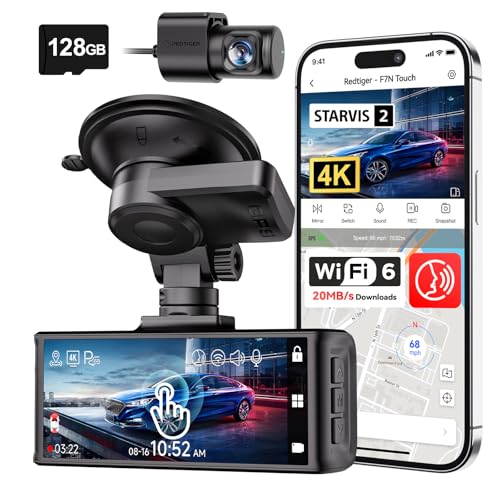
| REDTIGER 4K STARVIS 2 | Hands-free operation | Voice control, touch screen, GPS |
| Terunsoul 4K+4K | Sharp rear footage | 4K front and 4K rear, WiFi 6 |
| Affver 4K+2.5K | Large on-device screen | 3.59-inch IPS screen, 5G WiFi 6 |
| 4K+4K+1080P 3-Channel | Rideshare cabin view | Front, rear and cabin cameras |
| Veement V300 | Hidden, low-profile mount | 1296P, mini hidden design |
| VIOFO A229 Plus | Dual-sensor image quality | 2K dual STARVIS 2 sensors with HDR |
How to Choose
Channels: how many angles do you need?
A front-only camera covers the most common claim scenario, the car ahead of you. Add a rear lens if you are often hit while stopped. Choose three or four channels only if you drive for a living or park where side impacts happen. More lenses mean more cable runs and a hungrier memory card, so a budget four-channel unit can cost you recording time per gigabyte.
Resolution, sensor and night performance
Look for a recording resolution of at least 1440P on the front lens; the listed 4K models give more room to read a plate when you zoom in. A STARVIS 2 sensor, HDR or WDR, and infrared lights all point to better night and tunnel handling. Ignore “upscaled” marketing on its own: a title that says 4K upscaled front tells you the native sensor is not 4K. Wide angles help too, but past roughly 170 degrees the edges stretch and distant plates shrink, so wider is not automatically better.
Storage, loop recording and Wi-Fi
A 64GB card is workable for a single lens, while 128GB suits two or more. Loop recording overwrites the oldest clips, and a G-sensor locks collision footage so it is not erased. Dual-band 5GHz Wi-Fi speeds up copying clips to a phone; the 20MB/s figure in several titles is a download ceiling, not a recording spec.
Parking mode and power
Titles that mention 24-hour or 24/7 parking mode generally need a hardwire kit to stay on while the engine is off. Without one, the camera shuts down with the ignition, which is why a camera that looks capable on paper can still miss a hit-and-run in a parking lot. Check for a low-voltage cutoff so the car battery is protected.
The 10 Best Options
ROVE R2-4K
This dual camera pairs a 4K upscaled front lens with a full HD rear lens and a STARVIS 2 sensor. A free 128GB card is bundled, so it is ready for loop recording out of the box. It fits commuters who want both ends of the car covered without going to a multi-camera rig, and anyone who would rather skip shopping for a separate memory card.
- Strength: front and rear recording with a card already included.
- Strength: 5.8GHz Wi-Fi with a 20MB/s download figure for quicker clip transfer.
- Trade-off: the 4K front is upscaled, so native detail is lower than the label suggests.
Skip it if you need cabin or side coverage.
360 View 4-Channel Dash Cam
This unnamed-brand system lists front, rear, left, right and inside cameras, plus GPS, 5G Wi-Fi, WDR and a 160-degree wide angle. It is aimed at drivers who want the whole perimeter documented, from lane-change scrapes to parking-lot dings, and who accept a more involved installation to get it.
- Strength: five viewpoints give the widest coverage in this group.
- Strength: GPS and WDR help with route logging and mixed lighting.
- Trade-off: no brand or model name appears in the title, so check support and warranty terms before buying.
Skip it if you want a simple one-wire install.
galphi 4K Mini
A screen-free, app-controlled front camera with a 160-degree wide angle, G-sensor and loop recording. The bundled 32GB card gets you started. It suits drivers who dislike a bulky device on the windshield and who are happy to manage settings and playback entirely from a phone app.
- Strength: mini footprint and no screen keep it out of your sightline.
- Strength: 5GHz Wi-Fi and app control handle playback on a phone.
- Trade-off: front-only, and 32GB fills quickly at 4K.
Skip it if you want rear coverage or an on-device display for setup.
IIWEY N6
A four-channel 360-degree system with eight IR lights for night vision, STARVIS 2K imaging and 5.8GHz Wi-Fi 6. A free 128GB card and 24/7 parking mode are in the title. It is for people who park outdoors, especially at night, and want the interior watched as well as the road.
- Strength: eight IR lights target low-light cabin and side views.
- Strength: 128GB card included for multi-channel recording.
- Trade-off: the 2K class resolution is lower than the 4K models listed here.
Skip it if maximum front-lens resolution matters most.
REDTIGER 4K STARVIS 2
A front-and-rear unit with voice control, a touch screen, GPS and loop recording. A free 128GB card and 5GHz Wi-Fi at up to 20MB/s round it out. It fits drivers who want to save a clip by voice without taking a hand off the wheel, then review it later on the touch screen.
- Strength: voice control and touch screen simplify in-car operation.
- Strength: STARVIS 2 sensor with GPS for location-stamped footage.
- Trade-off: the title does not list a cabin lens.
Skip it if you need inside-the-car recording.
Terunsoul 4K+4K
Both the front and rear lenses are listed at 4K, backed by AProX HD night vision, GPS, G-sensor and Wi-Fi 6 at 5.8GHz. A free 128GB card is included. It is the pick for buyers who often need to read plates behind them, such as drivers who deal with tailgaters on a daily commute.
- Strength: matched 4K resolution at both ends.
- Strength: 24-hour parking mode and GPS appear in the listing.
- Trade-off: two 4K streams consume card space fast, so plan on replacing the card as it wears.
Skip it if you only need a basic front camera.
Affver 4K+2.5K
A dual camera with a 3.59-inch IPS screen, built-in 5G Wi-Fi 6, GPS and app control, with a 64GB card included. The 4K front and 2.5K rear split gives sharper forward footage. It suits drivers who prefer to review clips on the device itself.
- Strength: large screen makes aiming the lens easy.
- Strength: GPS and G-sensor with loop recording.
- Trade-off: a 64GB card is the smallest bundle among the dual-lens models.
Skip it if you want a screen-free, low-profile look.
4K+4K+1080P 3-Channel
This three-channel kit records front and rear in 4K plus a 1080P cabin camera, with AProX HD night vision, 5.8GHz Wi-Fi 6 and GPS. A free 128GB card is bundled. It is built for rideshare drivers who need passengers and the road documented.
- Strength: dedicated cabin lens alongside two 4K cameras.
- Strength: 128GB card and app control included.
- Trade-off: three cables and a cabin lens complicate installation and raise privacy considerations.
Skip it if you carry passengers who would object to cabin recording.
Veement V300
A 1296P front camera with a mini hidden design, 170-degree lens, night vision, Wi-Fi and app support. The title references 256GB of storage. It is for drivers who want something almost invisible behind the mirror, including owners who worry about visible gear inviting a break-in.
- Strength: discreet shape that reads as part of the mirror area.
- Strength: wide 170-degree lens for lane coverage.
- Trade-off: 1296P is the lowest resolution here, so plate detail at distance is limited.
Skip it if you want 4K or a rear lens.
VIOFO A229 Plus
A front-and-rear pair with 2K dual STARVIS 2 sensors, HDR and 1440P recording on both lenses, plus 5GHz Wi-Fi and smart voice control. It suits buyers who prefer sensor quality and balanced front and rear detail over headline 4K numbers, and who already own a suitable memory card.
- Strength: 1440P on both lenses plus HDR for tricky lighting.
- Strength: voice control and 5GHz Wi-Fi.
- Trade-off: no memory card is mentioned in the title, so budget for one.
Skip it if you want bundled storage or cabin coverage.
Which One Fits Your Situation
You drive for a rideshare or delivery service
The 4K+4K+1080P 3-Channel kit gives you the cabin camera that single and dual models lack. If you want more than three angles, the IIWEY N6 adds side views.
You commute and want a clean windshield
The galphi 4K Mini or Veement V300 stay out of view. Pick galphi for sharper front footage, Veement if concealment matters more.
You park on a busy street
The 360 View 4-Channel covers all four sides, and the Terunsoul 4K+4K lists 24-hour parking mode with matched front and rear lenses.
You want quality without a cabin lens
The VIOFO A229 Plus balances both lenses at 1440P, while the ROVE R2-4K comes with a card already included.
Common Mistakes
- Buying on 4K alone and ignoring whether the figure is native or upscaled.
- Skipping a high-endurance microSD card; constant loop recording wears out ordinary cards.
- Assuming parking mode works without a hardwire kit or low-voltage cutoff.
- Mounting the camera where wipers do not clear the glass in front of the lens.
- Ignoring local rules on cabin audio and interior recording before turning those features on.
Related guides
- Logitech G Pro X Superlight 2 Vs Razer Viper V3 Pro
- Motherboard Io Panel And Back Connectors Explained
- Budget Motherboards For Intel Desktop
Frequently Asked Questions
Do I need a rear camera?
If you are often stopped in traffic or park on the street, a rear lens documents the impacts a front camera misses. Commuters on open highways may be fine with a front-only unit.
How much storage should I get?
A 64GB card suits a single lens, and 128GB is a safer baseline for two or more channels. Choose a card rated for high endurance.
Is Wi-Fi necessary?
It is not required, but it lets you pull clips to a phone without removing the card. The 5GHz band is quicker for large 4K files.
Will a dash cam drain my car battery?
Only if wired for parking mode without a voltage cutoff. A properly set cutoff stops recording before the battery drops too low to start the car.