Key takeaways
- You own a broad mechanic or fabrication collection.
- You want many shallow drawers for visibility and fast tool retrieval.
- Your garage has a permanent tool wall or central work zone.
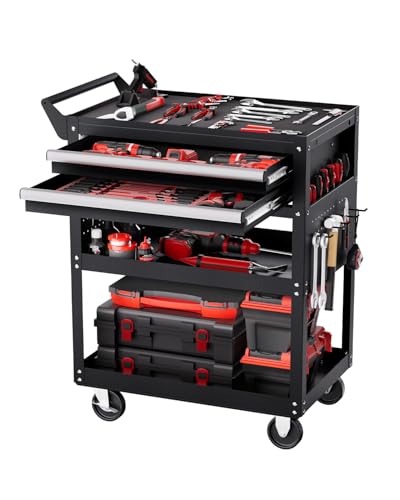
The best tool storage carts for organized workspaces are the U.S. General Series 3 56-inch cart for maximum capacity, the Husky 52-inch Heavy-Duty cart for a balanced garage setup, and the Milwaukee 46-inch mobile work station for a compact, jobsite-oriented layout.
Our top picks


As an Amazon Associate we earn from qualifying purchases at no extra cost to you. Ratings are shown as listed on Amazon.
Quick comparison: the best tool storage carts
| Cart | Drawer capacity | Typical advertised capacity | Wheel setup | Locking system | Best fit |
|---|---|---|---|---|---|
| U.S. General Series 3 56-inch, 22-drawer | 22 drawers, including wide drawers | Up to about 2,000 lb total, depending on configuration | Large industrial-style casters; verify current specification | Keyed central locking system | Large garages and full mechanic tool collections |
| Husky 52-inch Heavy-Duty, 15-drawer | 15 drawers with deep full-width storage | About 1,200–1,500 lb total on commonly listed versions | Large swivel casters, usually with two locking casters | Keyed drawer lock | Home garages needing high capacity without the widest footprint |
| Milwaukee 46-inch mobile work station | Approximately 11 drawers, depending on model generation | Roughly 1,000–1,200 lb class | Heavy-duty casters designed for frequent repositioning | Lockable drawers; some versions include integrated security features | Mixed workshop and jobsite use |
| Craftsman 2000 Series 41-inch | About 6 drawers in common configurations | Generally under 1,000 lb total | Medium-duty casters | Keyed locking drawers | Smaller garages and starter tool collections |
Specifications can change by retailer, revision, and regional model number, so confirm the product label before purchase. Total capacity also assumes an evenly distributed load; a single overloaded drawer can fail before the cabinet reaches its advertised maximum.
1. U.S. General Series 3 56-inch: best for maximum drawer organization
The 56-inch U.S. General Series 3 cart is the strongest choice when the main problem is not simply storage volume but tool separation. With 22 drawers, it can give sockets, ratchets, pliers, electrical tools, measuring equipment, and specialty tools their own locations instead of forcing everything into a few deep compartments.
Its wide cabinet needs substantial floor space, but that width also improves stability when several drawers are open. Large casters are important here: a heavily loaded cabinet can weigh several hundred pounds before tools are added, so small wheels make turning and crossing garage thresholds unnecessarily difficult.
Choose it if:
- You own a broad mechanic or fabrication collection.
- You want many shallow drawers for visibility and fast tool retrieval.
- Your garage has a permanent tool wall or central work zone.
Skip it if your available wall-to-wall aisle is narrow. Measure the cart with its handles, side rails, and drawers fully open—not just the closed cabinet width.
2. Husky 52-inch Heavy-Duty: best balance for a home garage
A 52-inch Husky Heavy-Duty cart is a practical middle ground between a compact rolling chest and a professional-size cabinet. The drawer count is lower than the U.S. General 56-inch model, but several deep drawers provide useful room for power tools, impact sockets, cordless tool batteries, and bulky accessories.
Its main advantage is workspace fit. A cabinet around 52 inches wide can hold a serious collection while leaving more room for a vehicle, workbench, or storage shelves than a 56-inch-plus professional cart. Look for a version with full-extension ball-bearing slides, a thick top, and casters rated for the loaded cabinet rather than merely the empty unit.
Best organization pattern
- Top shallow drawers: daily-use hand tools and precision measuring tools.
- Middle drawers: sockets, ratchets, screwdrivers, and pliers.
- Deep lower drawers: impact tools, chargers, pullers, and boxed accessories.
This arrangement prevents a common failure mode: using every drawer as a mixed “junk drawer.” Dividers and foam trays are more valuable than a small difference in advertised capacity because they reduce searching time.
3. Milwaukee 46-inch mobile work station: best for mobility and mixed use
The Milwaukee 46-inch mobile work station suits users who move tools between a garage bay, driveway, workshop, or service area. It is narrower than the large mechanic carts and generally easier to steer around vehicles, while still offering dedicated drawers and a substantial top surface.
It is particularly attractive for cordless-tool users because deep drawers can hold batteries and chargers together. Before loading it, check the drawer height: battery packs, impact wrenches, and boxed kits consume vertical space quickly, and a high drawer count does not help if the drawers are too shallow for your equipment.
Choose this type of cart when wheel quality and maneuverability matter as much as maximum storage. For a stationary workshop, its mobility-focused design may offer less storage per dollar than a wider cabinet.
4. Craftsman 2000 Series 41-inch: best for smaller spaces and starter collections
A Craftsman 2000 Series 41-inch cart is a sensible option for a first organized tool cabinet or a garage where every inch matters. Its smaller width makes it easier to position beside a workbench, and its lower overall load is less demanding on the floor.
The compromise is drawer capacity. It is better suited to hand tools, automotive basics, and a modest collection of cordless equipment than to a professional mechanic’s complete inventory. If you expect to add tools quickly, check whether a matching top chest or side cabinet is available before buying; expansion compatibility can matter more than the initial price.
How to choose by garage layout
| Your situation | Recommended size | Why |
|---|---|---|
| One-car garage with a vehicle parked inside | 41–46 inches wide | Leaves more clearance for doors, walking paths, and steering |
| Dedicated workshop wall | 52–56 inches wide | Uses the wall efficiently and supports more tool categories |
| Frequent movement over seams or thresholds | Large casters, preferably 5 inches or larger | Reduces pushing force and the chance of snagging |
| Shared household garage | Lockable 41–52-inch cart | Balances security, footprint, and everyday access |
| Heavy power-tool collection | Deep lower drawers and at least 1,000-lb-class capacity | Provides vertical room without stacking tools dangerously |
Calculate the real space you need before buying
Cabinet width alone does not tell you whether a cart will work. Use a clearance calculation before ordering. For example, if a cart is 52 inches wide and you want 30 inches of working clearance on each side, the required wall span is:
52 inches + 30 inches + 30 inches = 112 inches, or 9 feet 4 inches.
For a garage aisle, include the cart depth and opening clearance. A 24-inch-deep cabinet with a 36-inch passage leaves only 12 inches of spare depth beyond the walking lane. If a vehicle door must open beside it, measure the door swing rather than assuming the aisle is usable.
Also estimate the loaded mass. A cart weighing 250 lb, loaded with 500 lb of tools, and carrying 100 lb on its top has a 850-lb working load. That is below a 1,000-lb rating, but only with 150 lb of margin. A 1,500-lb-rated model gives substantially more tolerance for future purchases and uneven drawer loading.
Features that matter more than a high drawer count
- Full-extension slides: They let you see the back of a drawer, reducing lost tools and awkward reaching.
- Large casters: Five-inch or larger wheels generally handle cracks, thresholds, and extension cords better than small casters.
- Two-wheel locks: A lock on only one caster may allow the cabinet to pivot while you work.
- Central locking: Useful in shared garages, but confirm that the lock secures every drawer rather than only the top section.
- Drawer liners: They reduce sliding and rattling, especially for sockets and heavy metal tools.
- Reinforced top: A thick work surface is useful for assembly, but do not treat it as an unlimited bench; check its separate top-load rating.
Final recommendation
Choose the U.S. General Series 3 56-inch cart when maximum organization and drawer count are the priorities. Choose the Husky 52-inch Heavy-Duty cart for the best balance of capacity and garage fit. Pick the Milwaukee 46-inch mobile work station when frequent movement and cordless-tool storage matter most, and choose the Craftsman 2000 Series 41-inch for a compact or growing collection.
The best tool storage carts are not necessarily the largest ones. The right choice is the cabinet that fits your actual aisle, carries your heaviest planned load with reserve capacity, rolls easily over your floor, and gives frequently used tools a consistent home.