Key takeaways
- Under 1 mm: acceptable for occasional use, but most likely to warp.
- 1.2–1.5 mm: a reasonable minimum for regular smoking.
- 1.5–2.0 mm: the preferred range for a durable stainless box.
- 3 mm or more: generally indicates cast iron or another heavy design; excellent retention but significantly heavier.
The best smoker boxes for gas grills are heavy-gauge stainless-steel or cast-iron boxes with a lid, enough capacity for 1–2 cups of wood chips, and dimensions that sit securely over one burner without blocking the rest of the cooking surface.
Our top picks

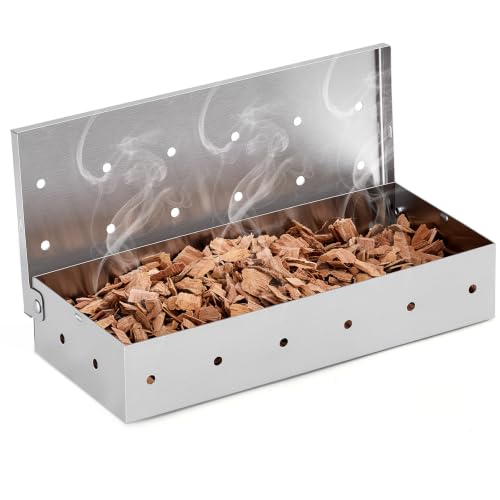
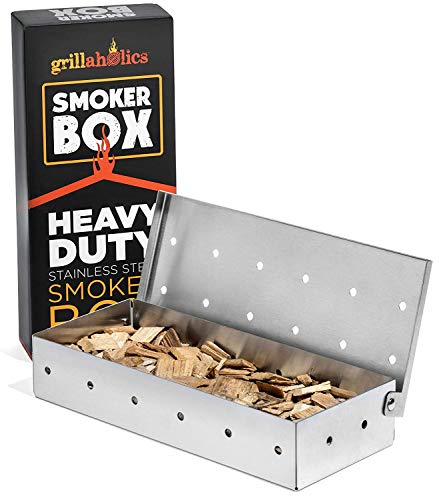

As an Amazon Associate we earn from qualifying purchases at no extra cost to you. Ratings are shown as listed on Amazon.
Quick comparison: which smoker box fits your grill?
| Smoker-box type | Typical metal thickness | Wood-chip capacity | Best grill size | Main advantage | Main drawback |
|---|---|---|---|---|---|
| Thin stainless-steel tray | 0.8–1.2 mm | 0.5–1 cup | Small 1–2 burner grills | Low cost and quick heating | Can warp or burn through over time |
| Heavy stainless-steel box | 1.5–2.0 mm | 1–2 cups | Medium and large grills | Balanced durability and heat control | May need a longer preheat |
| Cast-iron box | 3–5 mm | 1–2 cups | Three-burner and larger grills | Excellent heat retention | Heavy and vulnerable to rust if neglected |
| Smoker tube | Usually 0.8–1.5 mm | 2–4 hours of pellets | Any grill with adequate clearance | Long smoke duration and compact footprint | Less direct control over smoke intensity |
For most gas-grill owners, a heavy stainless-steel box is the safest all-purpose choice. Choose cast iron when your grill has a strong burner and you value stable heat more than low weight. A thin tray is suitable for occasional use, while a smoker tube is better when long, low-volume smoke matters more than producing a strong burst of smoke.
Best smoker boxes for gas grills by use case
Best all-round choice: heavy stainless-steel smoker box
A box made from roughly 1.5–2.0 mm stainless steel offers the most useful compromise. It resists corrosion, distributes heat more evenly than thin sheet metal, and is lighter and easier to maintain than cast iron. The Weber Universal Stainless Steel Smoker Box is a familiar example of this design category; comparable heavy stainless-steel boxes are also sold under several grill-accessory brands.
Look for a removable or hinged lid with several small vent holes rather than one large opening. Small vents let the chips smolder instead of igniting immediately. A box around 9–13 inches long and 3–5 inches wide generally fits the flavorizer bars or heat tents of medium and large gas grills, but measure the space above your burner before buying.
Best for heat retention: cast-iron smoker box
A cast-iron box, such as the Char-Broil Cast Iron Smoker Box, takes longer to heat but stays hot when the burner cycles or the lid is opened. This makes it useful for ribs, pork shoulder, and other foods that need steady smoke over a longer cook.
Cast iron is not automatically better. Its weight can damage porcelain-coated flavorizer bars if dropped, and its porous surface needs drying and a thin coating of cooking oil. Never store a damp cast-iron box inside the grill. Surface rust can often be removed with a stiff brush, but deep scaling is a reason to replace it.
Best for compact grills: low-profile stainless tray
A shallow tray is easier to fit above the burner in a portable or two-burner grill. It also reaches smoking temperature quickly, which is useful when cooking chicken wings, burgers, or vegetables for less than an hour.
The trade-off is weaker heat buffering. A thin tray can overheat directly above a burner, causing chips to ignite rather than smolder. Use less fuel, keep the burner below the box at medium or medium-low, and place a water pan or a heat diffuser between the box and the food if your grill runs aggressively.
Best for long smoke: pellet tube
Products such as the A-MAZE-N 12-inch pellet smoker tube are not traditional chip boxes, but they solve a different problem. A filled tube can produce smoke for several hours without repeatedly opening the grill to add chips. They work particularly well for cheese, nuts, salmon, or cold-smoking setups where a box would produce too much direct heat.
A tube does not deliver the same concentrated smoke burst as a box over a burner. It also needs to be placed on a stable, nonflammable surface with enough clearance from the grill lid and food. Follow the product’s lighting procedure and allow the flame to establish before blowing it out, rather than leaving an open flame inside the grill.
Metal thickness and durability: what the numbers mean
Thickness is useful only when considered with the metal type and construction. A thin stainless box may resist rust better than thick untreated steel, but it will transfer burner heat quickly and may distort after repeated high-temperature cycles. A 1.5 mm stainless box is usually a better long-term choice than a 0.7 mm tray.
- Under 1 mm: acceptable for occasional use, but most likely to warp.
- 1.2–1.5 mm: a reasonable minimum for regular smoking.
- 1.5–2.0 mm: the preferred range for a durable stainless box.
- 3 mm or more: generally indicates cast iron or another heavy design; excellent retention but significantly heavier.
Inspect the lid fit, corners, handle attachment, and ventilation holes. A box with a loose lid leaks smoke and lets chips burn faster. A permanently welded lid is durable, but a removable lid is easier to load and clean. Avoid boxes with sharp unfinished edges, which can cut gloves and scratch coated grates.
Wood-chip capacity and smoke duration
Most gas-grill smoking sessions need less wood than beginners expect. One US cup is approximately 237 milliliters. If a box holds two cups, filling it completely does not necessarily produce twice the useful smoke: excess chips can restrict airflow, smolder unevenly, or ignite when the lid is opened.
A practical starting calculation is:
Usable load = box capacity × 0.5 to 0.75
For a 2-cup box, that means starting with 1–1.5 cups of chips. If the first load produces smoke for about 45 minutes, a three-hour cook needs roughly four loads, or 4–6 cups total. That is a planning estimate, not a universal burn rate; burner output, chip size, ventilation, weather, and lid opening can change it substantially.
Use a smaller 0.5–1 cup load for quick cooks. For pork shoulder or brisket, a larger box is convenient, but smoke quality matters more than continuous visible smoke. Once the food has absorbed enough smoke during the early part of cooking, adding more wood may make the exterior bitter.
Heat distribution and placement
Place the smoker box directly above one active burner, normally on the flavorizer bars or heat tents rather than directly on the cooking grate. The metal needs concentrated heat to make the chips smolder. Keep the food over the unlit burner section to create indirect heat.
For example, on a three-burner grill, place the box above the left burner, turn that burner to medium-low, and leave the center and right burners off initially. Put the food on the right side. If the grill temperature stays below the target, increase the smoking burner slightly before lighting another burner; using multiple burners under the box can cause flare-ups and excessive smoke.
| Grill configuration | Recommended box placement | Starting burner setting | Useful smoking area |
|---|---|---|---|
| 1 burner, portable grill | Above the burner, with a diffuser if available | Low to medium-low | Small foods; rotate often |
| 2 burners | Above one burner; food above the other | Low on smoker side | Chicken, fish, vegetables, small roasts |
| 3–4 burners | At one end over a single burner | Medium-low, adjusted to temperature | Ribs, pork shoulder, whole chicken |
| Side-burner setup | Only if the manufacturer permits it | Low; monitor continuously | Useful when the main grate is crowded |
Most low-and-slow gas-grill cooks target approximately 225–275°F at grate level, depending on the recipe. Use a separate grate thermometer because the hood thermometer may read 20–75°F higher than the cooking surface. The box should create smoke without raising the grill far above the desired cooking temperature.
Compatibility checklist before buying
- Measure the flat support area above the burner, not just the cooking grate.
- Leave clearance for the lid to close without touching the box.
- Check that the box does not cover more than one burner unless the manufacturer specifically allows it.
- Confirm that its feet or edges cannot slide into the burner ports.
- For porcelain-coated heat tents, prefer a box with stable feet rather than a sharp flat base.
- For infrared burners, use only accessories approved for that grill; extreme localized heat can warp ordinary boxes.
If your grill has a dedicated smoker-box slot, use that location first. It is designed to balance heat and airflow. On older grills, a box that technically fits may still sit too close to the burner, so watch for flaming chips during the first session.
How to use a smoker box without bitter smoke
- Start with dry, appropriately sized chips. Pieces around 1/4–1/2 inch smoke more predictably than powder or very large chunks.
- Preheat the grill with the box in place. Wait about 10–20 minutes for the box to begin producing smoke.
- Reduce the burner. The goal is a thin, steady stream of smoke, not thick white clouds or visible flames.
- Place food on the indirect side. This prevents drippings from falling into the box and avoids direct scorching.
- Vent through the upper damper or partially open lid only as needed. Too little airflow produces stale smoke; too much airflow can ignite the chips.
Soak chips only if the box instructions specifically recommend it. Wet chips usually delay smoking rather than create more smoke, and excess water can cool the box enough to produce a long period of steam.
Final buying recommendation
Choose a 1.5–2.0 mm stainless-steel box holding about 1–2 cups if you want the best balance of durability, fit, and controllable smoke. Pick cast iron for maximum heat retention on a sturdy three- or four-burner grill. Choose a shallow tray for a compact grill and a pellet tube when your priority is several hours of light smoke rather than intense smoke directly over a burner.