Key takeaways
- 120Hz feels substantially smoother than 60Hz for desktop scrolling and games.
- 5120 × 2160 provides 11.1 million pixels while retaining a practical ultrawide shape.
- Thunderbolt connectivity can carry display, data, networking, and laptop charging through one cable.
- The large canvas is excellent for video editing, spreadsheets, coding, and simulation games.
Best 5K Monitors for Sharp Gaming and Work
The best 5K monitors depend on whether you want a true 5K 16:9 screen for maximum text clarity or a 5K2K ultrawide for a wider gaming and productivity workspace: the Samsung ViewFinity S9 and Apple Studio Display lead the 27-inch category, while the Dell UltraSharp U4025QW is the more versatile choice for work, multitasking, and high-refresh gaming.
Quick comparison
| Monitor | Resolution and format | Refresh rate | Best for | Typical market range |
|---|---|---|---|---|
| Apple Studio Display | 5120 × 2880, 27-inch 16:9 | 60Hz | Mac productivity, design, sharp text | Usually $1,400–$1,700 |
| Samsung ViewFinity S9 | 5120 × 2880, 27-inch 16:9 | 60Hz | Color-focused work and mixed-device desks | Usually $900–$1,300 |
| LG UltraFine 5K 27MD5KL-B | 5120 × 2880, 27-inch 16:9 | 60Hz | Mac-centered creative work | Usually $1,000–$1,400 |
| Dell UltraSharp U4025QW | 5120 × 2160, 39.7-inch 21:9 | Up to 120Hz | Wide workspaces and smoother gaming | Usually $1,500–$2,000 |
| 5K2K high-refresh class | 5120 × 2160, usually 39–45-inch ultrawide | 100–165Hz | Immersive gaming with workstation space | Often $1,000–$2,000 |
1. Dell UltraSharp U4025QW: best overall for work and gaming
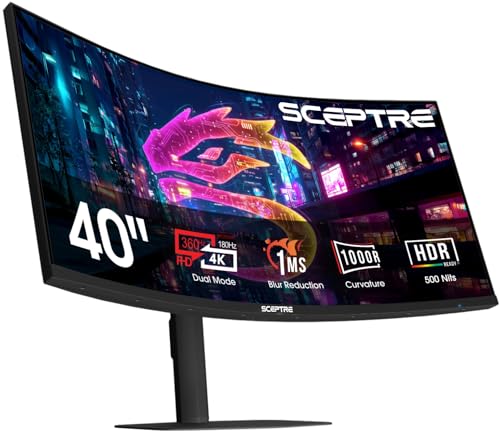
The Dell U4025QW is the strongest all-rounder because it combines a 5120 × 2160 5K2K panel with a 120Hz refresh rate. Its 21:9 aspect ratio provides enough horizontal room for a large timeline, two documents, or a game alongside chat and monitoring tools without using two separate displays.
Our top picks



As an Amazon Associate we earn from qualifying purchases at no extra cost to you. Ratings are shown as listed on Amazon.
Its Thunderbolt 4 connection, USB hub, Ethernet connectivity, and high-power USB-C charging make it particularly useful as a laptop dock. The display also offers a curved panel, which helps the edges remain within a comfortable viewing angle at nearly 40 inches wide.
Why choose it
- 120Hz feels substantially smoother than 60Hz for desktop scrolling and games.
- 5120 × 2160 provides 11.1 million pixels while retaining a practical ultrawide shape.
- Thunderbolt connectivity can carry display, data, networking, and laptop charging through one cable.
- The large canvas is excellent for video editing, spreadsheets, coding, and simulation games.
The trade-off is desk size. The monitor is wide and deep, and its 5K2K resolution is less vertically spacious than a true 5120 × 2880 display. It is also not a high-refresh competitive gaming monitor in the same sense as a 240Hz 1440p model.
2. Samsung ViewFinity S9: best 27-inch 5K alternative
The Samsung ViewFinity S9 is a strong choice for people who want a true 5120 × 2880 image without committing to Apple hardware. At 27 inches, its pixel density is about 218 pixels per inch, so text, interface edges, and high-resolution photographs look exceptionally clean.
It includes USB-C and Thunderbolt 4 connectivity, making it suitable for modern laptops, and its design includes features aimed at creative work. The 60Hz limit is the main weakness for gaming, but it is perfectly adequate for turn-based games, strategy titles, RPGs, and general desktop use.
Best fit
- Windows or Mac users who prioritize sharp text over refresh rate.
- Photographers, designers, and editors who need a dense 27-inch canvas.
- Small desks where a 40-inch ultrawide would be excessive.
For gaming, use the monitor when image detail matters more than motion clarity. If you regularly play fast shooters, a 1440p or 4K display at 144Hz or higher will usually provide a more suitable experience.
3. Apple Studio Display: best for a Mac-first desk
The Apple Studio Display remains one of the simplest choices for a Mac user who wants a polished 5K image, integrated speakers, a webcam, and dependable USB-C connectivity. Its 5120 × 2880 resolution at 27 inches gives the crisp interface rendering many Mac users expect from a high-density workspace.
It is especially appealing for writing, design, coding, and photo work where consistent scaling matters. macOS commonly renders the interface at a logical setting equivalent to 2560 × 1440, allowing sharp text without making controls uncomfortably small.
The important limitation is its 60Hz refresh rate and Apple-oriented feature set. It has no conventional HDMI input, so a desktop PC or game console may require an appropriate USB-C or Thunderbolt video path. Check graphics-card output compatibility before buying.
4. LG UltraFine 5K: best for a compact Mac workstation
The LG UltraFine 5K 27MD5KL-B is an older but still relevant option for a Mac-focused setup. It delivers the same 5120 × 2880 class resolution in a 27-inch format and uses USB-C and Thunderbolt connectivity rather than traditional HDMI or DisplayPort inputs.
Its appeal is straightforward: connect a compatible Mac, receive a sharp 5K image, and use the display as a simple workstation screen. It is less flexible than the Dell or Samsung for multi-device desks, and its 60Hz refresh rate makes it a productivity monitor rather than a gaming-first display.
5. 5K2K high-refresh monitors: best for immersive gaming
If gaming is the priority, look for a 5K2K ultrawide with at least 120Hz rather than automatically choosing a 5K 27-inch office monitor. The 5120 × 2160 format preserves much of the sharpness of 4K while adding horizontal space for racing games, simulators, open-world titles, and multitasking.
This category is less standardized than 4K gaming monitors. Check the exact panel type, adaptive-sync support, HDR performance, response-time behavior, and graphics inputs rather than relying on the “5K” label alone. Some models support 120Hz or more only through DisplayPort, while HDMI may be limited to a lower refresh rate.
Resolution, bandwidth, and graphics-card requirements
5K requires considerably more bandwidth than 4K. A 5120 × 2880 image contains 14.7 million pixels per frame. At 60Hz and 10-bit RGB color, the uncompressed active image alone needs approximately:
5120 × 2880 × 60 × 30 bits = 26.5Gbps
Timing overhead increases the real signal requirement, which is why DisplayPort 1.4 commonly relies on Display Stream Compression for 5K at 60Hz. A 5120 × 2160 signal at 120Hz requires approximately:
5120 × 2160 × 120 × 30 bits = 39.8Gbps
That is before blanking and protocol overhead. Confirm that your graphics card and cable support the required combination of DisplayPort version, HDMI 2.1, USB-C, Thunderbolt, and DSC. A cable that works at 4K 60Hz is not automatically suitable for 5K 120Hz.
Rendering performance also matters. A 5K frame has about 1.8 times as many pixels as 4K. If a game runs at roughly 70–100 frames per second at 4K with a particular graphics card and settings, a rough 5K expectation might fall around 40–60 frames per second before upscaling. Actual results vary substantially with the GPU, CPU, ray tracing, game patch, and quality preset.
Scaling and desk-size guide
| Desk situation | Recommended format | Useful scaling approach |
|---|---|---|
| Desk under 120cm wide | 27-inch true 5K | Use 2560 × 1440 logical scaling for comfortable text |
| 120–160cm desk, one-screen setup | 32-inch 4K or 39–40-inch 5K2K | Use 125–150% scaling depending on viewing distance |
| 160cm or wider desk | 39–45-inch 5K2K ultrawide | 100–125% scaling, with windows arranged into thirds |
| Competitive gaming priority | 4K 144Hz+ or 1440p 240Hz | Favor refresh rate and frame rate over 5K sharpness |
At 27 inches, running 5K at 100% scaling makes interface elements very small for many users. A 200% scale is sharp but gives the workspace of a 2560 × 1440 display. In practice, 1440p-equivalent scaling is often the best compromise: applications remain readable while images and text retain the benefits of the dense panel.
Which 5K monitor should you buy?
- Choose the Dell U4025QW if you want one monitor for serious productivity, laptop docking, and smoother 120Hz gaming.
- Choose the Samsung ViewFinity S9 if you want true 27-inch 5K sharpness with more flexibility than an Apple-only setup.
- Choose the Apple Studio Display if you use a Mac every day and value integrated features and seamless macOS scaling.
- Choose the LG UltraFine 5K if you want a compact Mac workstation and can accept limited input flexibility.
- Choose a 5K2K high-refresh model if immersive gaming and a wide multitasking layout matter more than maximum vertical resolution.
The key decision is not simply whether a monitor says “5K.” Decide first between true 5120 × 2880 sharpness and the wider 5120 × 2160 format, then verify refresh rate, video bandwidth, scaling comfort, and physical desk space. Those four checks determine whether the display will feel like an upgrade in everyday use.