Key takeaways
- Pull hair away from the forehead and remove a hood if possible. Place the mask against your face without using the strap.
- Inhale gently through your nose and hold for 5-10 seconds. The mask should stay in place with light suction.
- Look up, down, and smile. If the seal breaks when you change expression or the skirt lifts off the temples or under the nose, try another model.
- Check the nose pocket: you should be able to pinch your nose fully for equalization without the frame pressing your upper lip or the glass touching your nose bridge.
- Finally, put the strap on loosely, high on the back of your head. A strap should only hold position, not create the seal. Overtightening causes leaks and headaches.
The best diving masks for most divers in 2026 are low-volume frameless or twin-lens designs with 100% liquid silicone skirts and tempered ultra-clear glass, with the Cressi F1 Frameless, SCUBAPRO Spectra, Atomic Aquatics Venom Frameless, TUSA Paragon S, and Hollis M1 representing the top balance of fit, field of view, and anti-fog durability across different face shapes.
Our top picks
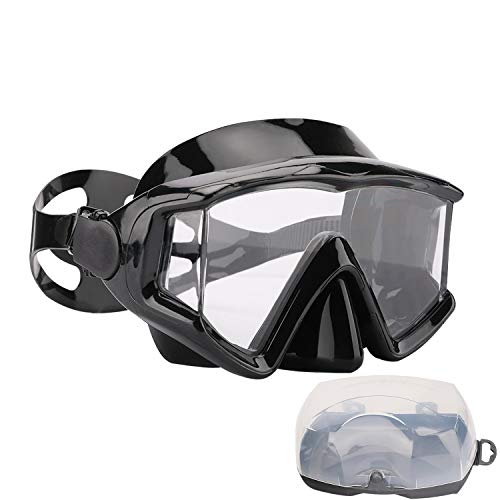


As an Amazon Associate we earn from qualifying purchases at no extra cost to you. Ratings are shown as listed on Amazon.
How to Choose a Diving Mask That Actually Fits
Fit determines whether a mask is usable long before lens clarity or brand matters. A mask seals not by strap tension but by the skirt conforming to your facial contours and by slight negative pressure when you inhale through your nose.
The 10-Second Fit Test (No Strap Needed)
Use this sequence in a shop or immediately upon unboxing:
- Pull hair away from the forehead and remove a hood if possible. Place the mask against your face without using the strap.
- Inhale gently through your nose and hold for 5-10 seconds. The mask should stay in place with light suction.
- Look up, down, and smile. If the seal breaks when you change expression or the skirt lifts off the temples or under the nose, try another model.
- Check the nose pocket: you should be able to pinch your nose fully for equalization without the frame pressing your upper lip or the glass touching your nose bridge.
- Finally, put the strap on loosely, high on the back of your head. A strap should only hold position, not create the seal. Overtightening causes leaks and headaches.
Face Shape Match
Mask sizing is not S/M/L in most lines, but skirt geometry varies significantly:
- Narrow / Small faces: Look for low-volume frameless masks with a narrower skirt footprint and smaller nose pocket, such as the Cressi F1 Frameless or TUSA Ceos. Wider twin-lens frames will gap at the temples.
- Medium / Oval faces: Most twin-lens and frameless designs fit here, including the SCUBAPRO Spectra and Atomic Venom Frameless.
- Wide / High cheekbones: A mask with a softer, high-grade liquid silicone skirt and a slightly wider frame, like the Hollis M1 or SCUBAPRO Spectra, conforms better without pressure points.
- Mustache / Facial hair: A black silicone skirt with a slightly tackier seal and a skirt that sits higher above the lip line seals better than clear silicone. Apply a small amount of food-grade silicone grease to the mustache for daily diving.
- High nose bridge / Deep-set eyes: Avoid ultra-low-volume masks where glass sits close to the eyes; a two-window design with angled lenses reduces nose bridge contact.
Skirt Material: Why Silicone Type Matters More Than Color
All modern dive masks use silicone, but not all silicone is equal.
- Standard silicone vs. Liquid silicone (LSR): LSR is injection-molded at higher purity and remains softer and more elastic over time, resisting hardening and yellowing from UV and salt. Usually $70-$150 masks use LSR, while usually $30-$60 entry masks often use conventional silicone that is stiffer and less durable.
- Clear vs. Black silicone: Clear transmits more peripheral light, which can feel more open but increases glare and reflections on the inner lens surface. Black silicone blocks side light, improving contrast and reducing eye fatigue, preferred for spearfishing, photography, and bright tropical conditions. For students or claustrophobic divers, clear often feels less enclosed.
- Matte interior finish: Premium skirts have a matte inner surface near the glass to reduce light scatter. If you see a glossy ring around the lens edge, expect more glare.
- Skirt thickness and feather edge: A thin, double-feathered edge seals with less pressure than a thick, blunt edge. Double-feathered skirts are the current standard on mid-range and premium masks.
Lens Types Compared: Single, Twin, and Ultra-Clear
Lens configuration changes field of view, volume, weight, and corrective lens options.
Single Lens (Mono) vs. Twin Lens (Two-Window)
- Frameless single lens: Glass bonded directly to the silicone skirt with no rigid frame. Lowest weight and often the lowest internal volume (around 150-160ml), which makes clearing easier and requires less air to equalize. Slightly wider uninterrupted forward view. Example class: Atomic Venom Frameless, Cressi F1 Frameless.
- Twin lens with frame: Two separate lensed supported by a frame, with a lower volume under the nose for easier nose access. Easier to fit corrective lenses (stock diopters or custom ground lenses). Slightly higher durability if one side is impacted, but adds frame weight. Example class: SCUBAPRO Spectra, TUSA Paragon S.
- Side Window / Multi-Window: Adds small side panes for peripheral light. Increases volume and potential leak points without improving forward clarity. Rarely recommended unless peripheral awareness is the sole priority.
Glass Quality
- Standard tempered glass: Required by EN 16805 / ANSI Z87.1 for dive masks. Has a slight greenish tint due to iron content.
- Ultra-Clear (Ultra VX, Crystalview, Ultraclear): Low-iron tempered glass that transmits about 6-8% more light and shows truer colors, especially noticeable below 15m and for underwater photography. Usually $80-$180. The difference is subtle at the surface but meaningful for photographers who compose through the mask.
- Coatings: Mirrored or UV coatings look premium but can delaminate with improper cleaning and reduce low-light transmission. For most recreational diving, uncoated ultra-clear glass lasts longer.
Anti-Fog Durability: Why New Masks Fog and How to Fix It Permanently
New masks fog not because of poor quality, but because of a thin film of silicone off-gassing and mold-release residue on the interior glass. Toothpaste or flame treatments are folklore that risk damaging silicone or coatings. Use this method based on chemistry, not abrasion:
- Initial prep (once): Apply a small amount of non-gel, non-whitening toothpaste alternative or a dedicated mask scrub (mild calcium carbonate abrasive suspended in detergent) to DRY interior glass. Rub with fingertips for 60 seconds, rinse thoroughly, repeat 3-4 times. The goal is to strip the hydrophobic silicone film, not scratch the glass. For masks with manufacturer-applied anti-fog films, check the manual first; some pre-treated lenses instruct to rinse only.
- Before every dive: Apply a surfactant anti-fog (commercial defog or diluted baby shampoo 1:10 with water). Spread a thin layer on dry interior glass, give a quick rinse without touching, then do not wipe. Saliva works as a temporary surfactant by lowering surface tension, but it introduces bacteria and breaks down faster than a proper surfactant.
- Between dive days: Rinse in fresh warm water, air dry out of direct sun, store in a hard case. Do not leave defog to dry inside for days; it can cloud certain coatings.
- Durability expectation: A properly stripped and surfactant-treated tempered glass lens will hold fog-free for 60-90 minutes per application. Aftermarket spray-on anti-fog coatings typically last 10-20 dives before needing reapplication, while factory permanent hydrophilic coatings, if present, usually degrade after 80-120 dives and then behave like standard glass.
Internal Volume and Clearing Effort: A Worked Calculation
Low volume is marketed heavily, but the practical benefit is air saved during clearing and equalization. You can estimate it:
Clearing a flooded mask requires exhaling through your nose to displace water with air. At the surface, that is roughly equal to the internal volume. At depth, the same mass of air occupies less volume due to ambient pressure.
Example: A large-frame mask with 210 ml internal volume vs. a low-volume frameless mask with 155 ml internal volume.
- Surface clear: 210 ml vs. 155 ml (difference 55 ml, or about 26% less air needed for the small mask).
- At 20m (3 ATA): That 155 ml still requires 155 ml at ambient pressure, which equals 155 x 3 = 465 ml of surface-equivalent air. The 210 ml mask requires 630 ml surface-equivalent. Over 5 clears in a dive, you save (630-465) x 5 = 825 ml of gas, roughly 0.8 liters. It will not change your dive time dramatically, but it reduces thermal loss from exhaling and makes one-handed clearing much easier for beginners and divers with smaller lung volume.
Rule of thumb: If you struggle with mask clearing, have a small face, or dive in conditions requiring frequent clearing (surf, training), prioritize masks under 165 ml. If you need corrective lenses or have a prominent nose bridge, accept 170-200 ml for comfort.
Best Diving Masks: Head-to-Head Comparison
| Mask (Class) | Lens / Frame | Internal Volume (approx.) | Weight (approx.) | Skirt | Best For | Market Range |
|---|---|---|---|---|---|---|
| Cressi F1 Frameless | Single, frameless, tempered | 155 ml | 165 g | Black or clear liquid silicone | Small to medium faces, minimal volume, travel | usually $50–$80 |
| SCUBAPRO Spectra | Twin, framed, Ultra-Clear | 185 ml | 205 g | Liquid silicone, TruFit double-feather | Wide faces, corrective lens users, comfort priority | usually $70–$110 |
| Atomic Aquatics Venom Frameless | Single, frameless, UltraClear Schott | 160 ml | 175 g | High-grade LSR, matte interior | Photographers, low glare, color accuracy | usually $130–$170 |
| TUSA Paragon S | Twin, framed, CrystalView + AR | 180 ml | 195 g | Liquid silicone, Freedom Fit | Medium faces, tech layering with hoods | usually $110–$160 |
| Hollis M1 | Single, framed, tempered | 170 ml | 200 g | Black silicone, wide seal | Large faces, mustache seal, freediving | usually $60–$90 |
Weights and volumes are manufacturer nominal and diver-measured averages; actual water displacement varies by facial immersion depth.
Decision Matrix: Map Your Situation to the Right Type
| Your Situation | Choose This Configuration | Why |
|---|---|---|
| Beginner, pool and open water training | Twin-lens, 170-190 ml, clear or black LSR | Easier nose access for equalization, forgiving fit, accepts rental defog routine |
| Frequent traveler, wants one mask for everything | Frameless single lens, 150-165 ml | Lightest, packs flat, easiest to clear |
| Photographer / Videographer | Single frameless Ultra-Clear, black silicone | Highest light transmission, least internal reflection, better contrast for composition |
| Need reading or distance correction | Twin-lens framed with stock diopters or custom grind | Only twin-lens supports field-replaceable corrective lenses; frameless single cannot |
| Diving cold water with thick hood | Framed twin with soft LSR and wide strap | Hood interferes less with rigid frame seal than with soft frameless skirt compression |
| Freediving / Spearfishing | Low-volume black silicone, 150-170 ml | Minimal air wasted equalizing mask, black skirt reduces glare for eyeing fish |
Comfort and Durability Details Most Spec Sheets Skip
- Buckle placement: Buckles mounted on the skirt rather than the frame pull the skirt more evenly and allow folding flat for travel. Frame-mounted buckles give more precise micro-adjustment but can create pressure points with hoods.
- Strap vs. Strap alternatives: A wide silicone strap distributes pressure but slips on hoods. A neoprene sling strap or silicone strap with neoprene cover stays put over a hood and reduces hair pull. Both are usually $15-$35 as an accessory.
- Purge valves: A one-way valve under the nose seems helpful but adds a failure point for sand and salt crystals. Most instructors recommend no purge valve for reliability; clearing technique matters more than hardware.
- Temper and safety: Only buy masks marked tempered glass (often a small etched T). Non-tempered glass is not dive-rated and can fracture into sharp shards.
- Storage: UV hardens silicone. A hard case that prevents skirt deformation extends seal life by years compared to tossing the mask in a gear bag. Replace the strap when it shows fine cracks; a broken strap mid-dive is a common abort cause.
When to Replace Your Mask
A silicone skirt that has yellowed, become rigid, or holds a permanent crease no longer seals reliably. Glass with fine crazing from heat exposure will not hold an anti-fog layer. Strap buckles that slip under light pull will loosen with a hood squeeze at depth. If any of these appear, replacement is cheaper than repeated dive interruptions. Most actively used masks last 3-6 years before skirt aging degrades fit.