Key takeaways
- Resin volume: How much mixed-bed resin is in the tanks. More resin = more total gallons per refill.
- Flow rate: How fast water can pass through and still reach 0 ppm. Exceed the resin’s contact time and TDS will slip.
The best CR Spotless deionized water rinse system for cars for most home detailers is the CR Spotless DIC-20, while owners with very hard water or who wash multiple vehicles per week should step up to a high-output dual-tank system like the DIW-20 wall-mount class — the choice comes down entirely to your incoming TDS, resin capacity, and how many gallons of 0 ppm water you need per wash.
Our top picks


As an Amazon Associate we earn from qualifying purchases at no extra cost to you. Ratings are shown as listed on Amazon.
How CR Spotless Systems Work and Why Resin Capacity Matters
All CR Spotless systems use mixed-bed deionization resin (cation and anion resin in one cartridge) to strip total dissolved solids (TDS) to 0 ppm. When you rinse with 0 ppm water, there are no minerals left to leave spots as it evaporates, so you can let the car air-dry or sheet off with a blower. The filter does not remove TDS like a carbon filter; it exchanges it. Once the resin is exhausted, TDS climbs rapidly from 0 to 10-20 ppm, and spotting returns.
Capacity is measured in grains or gallons at a given incoming TDS. CR Spotless publishes this as total gallons of 0 ppm water produced before resin exhaustion. The two numbers that define any system are:
- Resin volume: How much mixed-bed resin is in the tanks. More resin = more total gallons per refill.
- Flow rate: How fast water can pass through and still reach 0 ppm. Exceed the resin’s contact time and TDS will slip.
Compact single or small dual-cartridge units sacrifice capacity for portability and lower upfront cost, while high-output dual 20-inch tank systems prioritize total gallons and stable flow rate for long rinses.
The Core Models: Compact vs. High-Output
CR Spotless has consolidated around two form factors that are widely available in 2026. Other bundle names exist, but they use the same tanks and resin:
1. CR Spotless DIC-20 (Rolling Dual 20-Inch System)
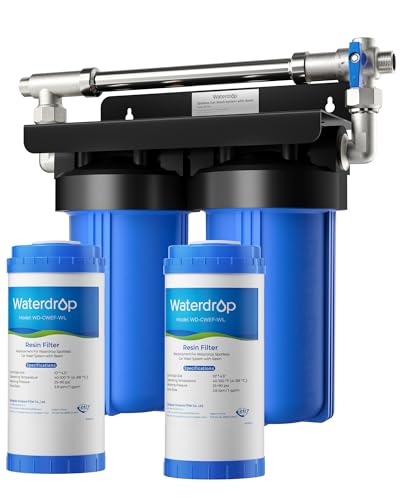
The reference system for cars. Two 20-inch housings each holding a refillable cartridge of mixed-bed resin, mounted on a rolling cart with inlet/outlet hose fittings, a TDS meter, and a bypass valve. Usually $350–$500 for the complete unit without extra resin. It is the default recommendation because it balances capacity and flow rate for a standard car rinse (2–4 gallons of deionized water for the final rinse only).
2. CR Spotless DIW-20 (Wall-Mount High-Output System)
Same dual 20-inch cartridge volume as the DIC-20, but in a wall-mount bracket intended for a garage with a dedicated hose bib. Usually $400–$600 for the system. Functionally identical in capacity, but preferred if you have space and wash weekly because it stays plumbed, reduces hose kinking, and keeps the tanks vertical for even flow. CR Spotless also sells extension and resin refill configurations in this class that are marketed as high-output or pro systems — the differentiator is not the tank size but whether you keep spare resin on hand.
Compact/Single-Cartridge Class (e.g., 10-Inch Systems)
Single-cartridge or dual 10-inch units with roughly half the resin volume. Usually $200–$350. They are lighter and easier to store in an apartment or small garage, but they produce roughly half the 0 ppm gallons before needing a resin change and are more sensitive to high flow rates. Only choose this class if you have low TDS tap water (under ~100 ppm) and wash one car.
| System Class | Resin Volume (Total) | Max Effective Flow Rate | Gallons of 0 ppm Water @ 100 ppm Inlet | Gallons of 0 ppm Water @ 200 ppm Inlet | Gallons of 0 ppm Water @ 400 ppm Inlet |
|---|---|---|---|---|---|
| Compact 10-Inch Dual | ~0.5 cu ft | 1.5 – 2.0 GPM | 110 – 140 | 55 – 70 | 28 – 35 |
| DIC-20 / DIW-20 (Dual 20-Inch) | ~1.0 cu ft | 2.5 – 3.0 GPM | 250 – 300 | 125 – 150 | 62 – 75 |
| High-Output Dual 20-Inch + Spare Resin Set | ~1.0 cu ft + 1.0 cu ft spare | 2.5 – 3.0 GPM | 500 – 600 (with one refill) | 250 – 300 (with one refill) | 124 – 150 (with one refill) |
Flow rates above these ranges will cause TDS breakthrough even if the resin is not exhausted. If your home spigot pushes 4+ GPM wide open, throttle the valve to ~50% or use the built-in bypass to regulate the DI rinse to ~2 GPM.
Worked Calculation: Cost-Per-Wash for Your Water
Spec sheets list total gallons, but cost-per-wash tells you which system is actually cheaper. Use this calculation with your own TDS reading (a $15–$25 TDS meter is essential).
Example scenario: Incoming tap water is 220 ppm TDS, you use 3 gallons of DI water per final rinse (typical for a sedan if you wash first on tap water, then switch to DI for the final sheeting rinse only), and a DIC-20 produces ~135 gallons of 0 ppm water at that TDS level.
- 135 total gallons / 3 gallons per wash = 45 spot-free washes per resin fill
- Resin refill cost for a DIC-20 / DIW-20 (two cartridges): usually $80–$130 for bulk mixed-bed resin
- $110 refill / 45 washes = $2.44 per wash in resin cost
Now compare the same water on a compact 10-inch system making ~62 gallons:
- 62 / 3 = 20 washes per fill
- Refill cost ~$50–$80
- $65 / 20 = $3.25 per wash and you refill more than twice as often
If your TDS is very high, e.g., 450 ppm in Arizona, Texas, or Southern California:
- DIC-20 yield drops to ~65 gallons. 65 / 3 = 21 washes. $110 / 21 = $5.23 per wash
- This is where buying resin in bulk (5–10 lb bags) and refilling yourself instead of buying pre-filled cartridges cuts cost by 30–40%.
The key lever is not the system price, but your filtered gallons per wash. If you run the entire wash on DI water (8–12 gallons), cost-per-wash triples. Always wash and foam on tap water, then switch to DI with the bypass valve for the final rinse only.
Decision Matrix: Which System to Choose
Match your situation to the right class instead of just buying the biggest unit:
| Your Situation | Inlet TDS | Washes Per Month | Best Fit | Why |
|---|---|---|---|---|
| Apartment, one car, storage-limited | <120 ppm | 2 – 4 | Compact 10-Inch Dual | Low TDS stretches small resin life; portability outweighs capacity |
| House, 1-2 cars, moderate hard water | 120 – 250 ppm | 4 – 8 | DIC-20 | Best balance of gallons, flow rate, and refill interval |
| Hard water region, 2+ cars or truck/SUV | 250 – 450+ ppm | 6+ | DIW-20 + bulk resin | You need maximum gallons and cheap refills; wall-mount reduces hassle |
| Detailing side business, multiple clients | Any | 10+ | DIC-20 or DIW-20 with spare resin set | Downtime matters — swap pre-filled cartridges and regenerate later |
How to Get Rated Flow Rate and Maximize Resin Life
Two mistakes kill resin quickly: high flow and feeding hot or softened water.
- Keep DI flow at 2.0–2.5 GPM. Check by timing how long it takes to fill a 5-gallon bucket through the DI outlet. If it fills in under 2 minutes, you are flowing too fast. Close the spigot or add a ball valve to restrict flow. High flow reduces contact time and you will see 5–10 ppm on the outlet meter even with fresh resin.
- Use cold water only. Mixed-bed resin degrades above ~100°F. Do not feed from a water heater or hot hose left in the sun.
- Plumb before your water softener if possible. Softeners exchange calcium for sodium but do not lower TDS significantly — you still exhaust DI resin. Feeding the DI system directly from the main line before the softener gives a more accurate TDS and prevents sodium overload.
- Always use the bypass. Wash, foam, and initial rinse on untreated tap water. Only flip to DI for the final 30–60 second sheeting rinse at low pressure. A sheeting rinse at low pressure (remove the nozzle and let water flow) uses 2–3 gallons vs. 6+ gallons spraying at high pressure.
- Store cartridges wet and sealed. If you will not wash for a month, close the inlet/outlet caps with water inside. Dried resin channels and leaves pockets of untreated water.
- Watch the TDS meter, not a calendar. Change resin when the outlet reads 10 ppm or higher during flow. At 20+ ppm you will spot on black paint in direct sun. The inlet TDS after a heavy rain may drop 20–30%, giving you a few extra washes.
What to Budget Beyond the Unit
In 2026, a DIC-20 or DIW-20 system is a one-time hardware purchase, but resin is the ongoing cost. Budget as a range rather than a fixed number because TDS dominates:
- Initial system: usually $350–$600 depending on cart vs. wall mount and whether resin is included
- Refill resin (bulk mixed-bed, 5 lbs): usually $40–$70, enough for one full refill of a dual 20-inch system with careful packing
- Pre-filled replacement cartridges: usually $70–$120 per pair, convenient but cost more per wash
- TDS meter and spare O-rings: usually $15–$30
If you calculate more than $5–$6 per wash at your TDS level and you wash weekly, buying resin in 10–25 lb bulk bags lowers cost-per-wash more than upgrading the tank size.
FAQ
Do I need a DIC-20 or DIW-20 if I already have a water softener?
Yes, if you want spot-free air drying. A softener does not produce 0 ppm water; it typically leaves TDS at 80–100% of the incoming level. You will still get spots. The DI system should be fed with unsoftened cold water for best efficiency.
Can I use a pressure washer with a CR Spotless system?
You can feed a pressure washer from the DI outlet, but most gas pressure washers demand 2.5–4.0 GPM which exceeds the effective DI flow rate. The resin will not have time to fully exchange and TDS will rise. For best results, use the pressure washer on tap water for the wash, then do a final low-pressure rinse directly from the DI system with a garden hose and no nozzle.
How do I know the resin is exhausted vs. a flow problem?
Test at low flow. Turn flow down to ~1.5 GPM and check outlet TDS. If it still reads over 10 ppm at low flow with inlet TDS normal, the resin is spent. If TDS drops back to 0–5 ppm at low flow, you were simply flowing too fast.